US Treasury Buyback Today: The Bond Move Bitcoin Traders Are Watching


US Treasury Buyback Today: Why Crypto Traders Watch This Bond Move
As of November 4, 2026, the US Treasury buyback this week centers on older 10-year to 20-year bonds, with an operation window of 1:40 pm to 2:00 pm ET.
For crypto news today, the angle here is simple: the bond market often steers risk appetite across other assets.
The US Department of the Treasury also holds its quarterly refunding on the same day.
Its August 19 press release said more detail on future buyback sizes would come then.
What Is US Treasury Buyback and Why Does It Matter?
A buyback means the department purchases older bonds that trade less often, known as off-the-run Treasuries, instead of selling new ones. The goal is better Treasury market liquidity for those bonds.
That notice lifted the cap for 10 year to 20 year and 20 year to 30 year operations from $2 billion to at least $4 billion. The higher size runs September 9 through November 4.
Treasury Buyback November 2026: Which Operations Are Listed?
The US Treasury buyback schedule November 2026 lists two operations, according to the tentative schedule.
Detail | Wed, Nov 4 | Thu, Nov 5 |
Maturity bucket | 10Y to 20Y | 1 month to 2Y |
Time (ET) | 1:40 to 2:00 pm | 1:40 to 2:00 pm |
Maximum | $4B or more | $4B |
Settlement | Nov 5 | Nov 6 |
CryptosR_Us also covered this news in its tweet on X, saying the department would buy back up to $6 billion of longer-term debt to improve liquidity.
The tweet called it a Thursday event, but the schedule places the 10-year to 20-year operation on Wednesday.
The $6 billion size matches the September 10 listing, while the November 4 line reads $4 billion or more.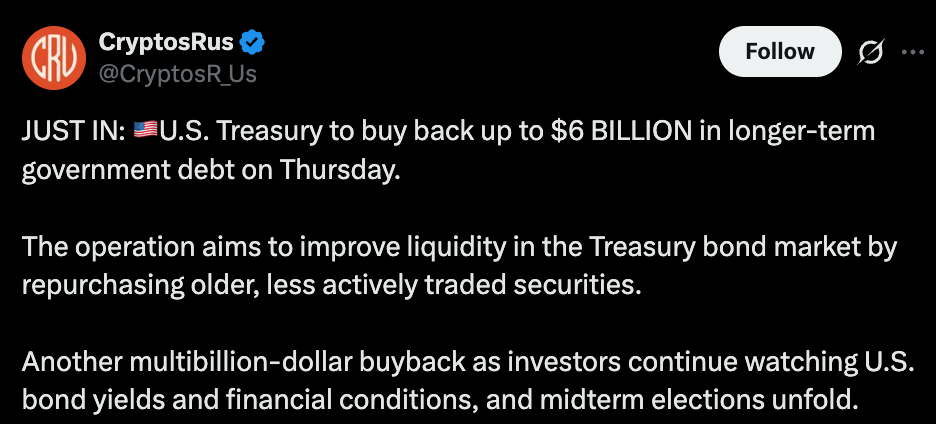
Why Is US Treasury Buying Back Bonds?
The department framed the change as Treasury liquidity support, citing steady demand and many strong offers in longer-dated operations.
This liquidity support buyback has a $0 minimum, so purchases can land below the cap.
Targets: older nominal coupons and TIPS
Excluded: bills, floating rate notes, STRIPS
Size: a maximum, not a fixed purchase
Data: records in Fiscal Data
Treasury Buyback vs Quantitative Easing: What Is the Difference?
Quantitative easing is a Federal Reserve tool. This buyback operation is a debt management step, where the department uses its own cash to redeem selected older bonds.
US Treasury Buyback Crypto Impact: Does It Move Bitcoin?
Does Treasury buyback affect Bitcoin? No official source draws that link. Treasury yields are the usual bridge.
The latest Federal Reserve H.15 data show the 20-year at 5.31% and the 30-year at 5.28% as of November 2. The 10-year Treasury yield is the other benchmark.
Higher yields give investors a rival return, which is why traders compare bond moves with risk assets.
Bitcoin Price Snapshot: CoinGecko Data
CoinGecko data, as of November 4, 2026:
Metric | Value |
24h low | $76,498 |
24h high | $78,374 |
No official source ties this range to the buyback.
Expert View: What Could the Buyback Mean for Markets?
US Treasury buyback explained in one line: the department swaps cash for older bonds to keep trading smooth. Analysts following crypto news may treat it as plumbing rather than policy.
Treasury buyback and bond yields are the pair to watch. A Treasury bond buyback is capped, so the bigger signal may come from the refunding.
If long yields ease, risk assets could find relief, though the Treasury buyback Bitcoin impact stays unproven.
Disclaimer: This article is for information only and is not financial, legal, or investment advice. Crypto assets are volatile, and you can lose money. Verify details with official sources before making any decision.






