USDC Significant EMT: Why the EU Just Changed Circle Oversight

USDC Significant EMT: What EBA Oversight Means for Circle and EU Users
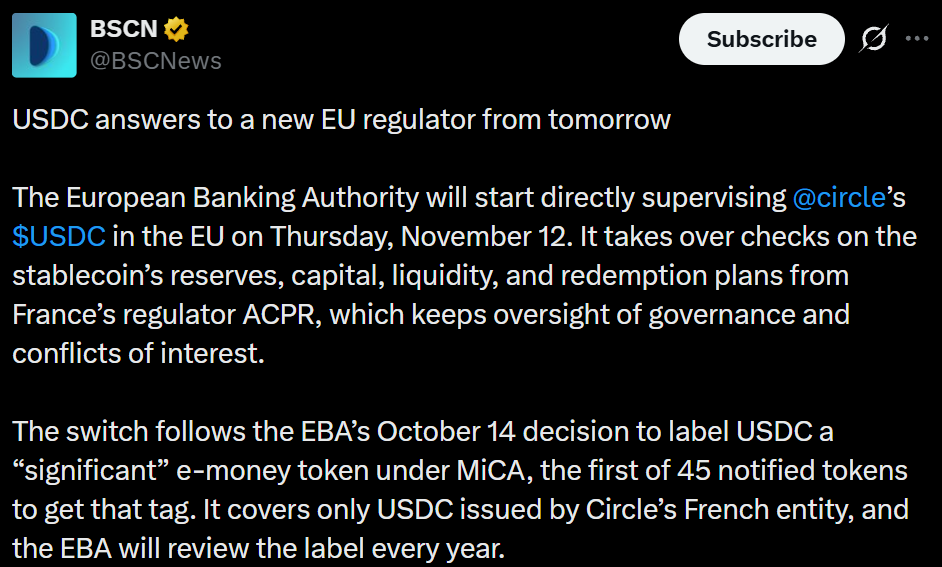
Here is the latest USDC significant EMT update: starting today, 12 November 2026, the European Banking Authority directly supervises the stablecoin in the EU.
It takes over key safety checks from France’s regulator. This follows its 14 October decision to label the coin “significant” under the EU’s MiCA rulebook.
Source: BscNews Post
What Changes Today for the Stablecoin?
From 12 November 2026, two regulators share oversight in the EU. The EBA now directly supervises the stablecoin’s own funds, reserve of assets, liquidity requirements, and recovery and redemption plans, according to its official press release.
France’s regulator, the ACPR, handled these checks before and keeps other areas.
In plain words:
Own funds: the issuer’s own money, held as a safety cushion.
Reserve of assets: the assets that back every coin.
Liquidity: the ability to pay out quickly when holders want their money back.
Recovery and redemption plans: how the issuer would handle a crisis and how holders would get their money back.
Handled by the EBA from 12 November | Stays with the ACPR |
Own funds | Governance |
Reserve of assets | Qualifying holdings |
Liquidity requirements | Fit and proper assessment |
Recovery and redemption plans | Outsourcing |
Qualifying holdings means large ownership stakes. A fit and proper assessment checks that managers are suitable.
Why Was the Stablecoin Labelled “Significant”?
The classified USDC, issued by Circle Internet Financial Europe SAS, as a significant e-money token (EMT) under MiCA, the Markets in Crypto-Assets Regulation.
An e-money token is a stablecoin tied to one official currency. The EBA says it assessed the criteria set out in the regulation.
The indicators are specified in Commission Delegated Regulation (EU) 2024/1506, as its procedure decision notes. The release does not publish the figures behind the decision.
| Fact | Detail |
| Decision date | 14 October 2026 |
| Issuer | Circle Internet Financial Europe SAS |
| EMTs notified under MiCA | 45 |
| First to be classified significant | USDC |
| New supervision starts | 12 November 2026 |
What Does Dual Supervision Mean?
MiCA places issuers of significant EMTs under the dual supervision of the EBA and the relevant national authority (Article 117).
Think of it as two inspectors with split duties. The EBA works with other authorities and supervisory colleges under Articles 117(5), 128, and 119 and says it will work closely with the ACPR for a smooth transition.
The EBA’s page on its MiCA role explains more. In practice:
-
Money-safety checks move to an EU-level authority.
-
Checks on management and ownership stay with the national regulator.
-
Both authorities coordinate during the handover.
For anyone following USDC significant EMT news, that handover is the part to watch.
Which Version of USDC Is Covered?
The decision names the EU issuer, Circle Internet Financial Europe SAS. In the United States, USDC is issued by a separate company, Circle Internet Financial, LLC.
To support supervision of cross-border stablecoin activity, the EBA signed a Memorandum of Understanding, which is a cooperation agreement, with the New York State Department of Financial Services.
This makes it easier for the two authorities to cooperate and exchange information.
What Happens Next?
The label is not permanent. The EBA annually assesses whether tokens should be considered significant or continue to meet the criteria.
USDC was the only one of the 45 notified EMTs with the label.
The release describes supervision duties only. It does not describe any change for people who hold or use the coin.
In the author’s view, this is a change in oversight, not in daily use, so the annual review and the handover are the signals to watch.
Conclusion
In short, the USDC significant EMT label moves key safety checks to a new EU supervisor from today, while France’s regulator keeps governance and ownership checks. Watch the handover between the two authorities and the yearly review.
Disclaimer
This article is for educational and informational purposes only and is not financial or investment advice. Crypto assets are high risk, their prices can be very volatile, and you can lose some or all of your money. Always do your own research and consider speaking with a licensed financial advisor before making investment decisions.






