USDe Explained: How Ethena's Synthetic Dollar Really Works

Introduction: What Makes Ethena’s USDe Different?
What gives a dollar token its value when no bank holds the dollars behind it? That question sits at the center of USDe Explained, a guide to Ethena’s synthetic dollar and the way it tries to stay close to $1 without relying on bank deposits or government debt.
USDe is a crypto-backed stablecoin that uses collateral and offsetting derivatives positions, and that unusual design is the reason it keeps drawing attention across the Ethena DeFi ecosystem, so the backing, the yield, and the risks all need a careful read before any number on a dashboard means much.
What Is Ethena USDe?
Ethena USDe Explained is a synthetic dollar designed to hold a value close to $1. It’s supported by crypto collateral, offsetting derivatives positions and other approved backing assets, and not by traditional bank deposits.
USDe itself doesn’t distribute staking yield, because eligible holders have to stake it to receive USDe, the version that accrues rewards.
What Is USDe? Understanding Ethena’s Synthetic Dollar
USDe is issued through the protocol, and the word "synthetic" means its value comes from a financial structure instead of cash sitting in a bank account. A fiat-backed stablecoin relies on an issuer, a custodian, and a pile of reserves, while the USDe stablecoin relies on collateral that is hedged in derivatives markets.
The aim is to keep a value close to $1, and the token is used in DeFi for lending, trading, and liquidity pools, where that design shapes everything from how tokens get created to the kinds of risk holders accept.
Ethena’s official documentation is the best place to confirm how the protocol describes itself at any given time.
How Does Ethena’s USDe Actually Work?
The USDe mechanism rests on hedging, a defined backing structure, controlled minting and redemption, and market forces that pull the price toward $1, and each part is covered below.
How Does the Delta-Neutral Hedging Strategy Work?
Delta-neutral means a position is built so that price moves largely cancel each other out. Ethena holds collateral such as ETH, BTC, or liquid staking assets and opens a short futures position of roughly equal size, which is a contract that profits when the price falls.
If the collateral drops in value, the short position gains about the same amount, and if the collateral rises, the short loses about as much as the collateral earns. This offset is approximate and not a guarantee, and it reduces exposure to price direction without promising a fixed $1 outcome on its own.
Is USDe Fully Backed by Collateral?
According to Ethena’s published overview, the backing includes crypto assets, liquid stablecoins, and the derivatives hedges that sit against them, so the old description of USDe as purely ETH and BTC is incomplete. Custody matters as much as composition here.
Ethena documents the use of off-exchange settlement providers, which hold the collateral while the matching short positions run on derivatives venues, and that setup reduces some exchange risk while adding reliance on the custody providers themselves.
Who Can Mint and Redeem USDe?
Direct minting and redemption are limited to approved counterparties that pass KYC or KYB checks, which are identity and business verification steps. These participants deposit supported collateral to mint new USDe, while it opens the matching hedge, and redemption runs the other way under set terms.
Most holders never touch this process and simply buy USDe on exchanges or DeFi platforms, which means market-price stability and redemption rights are two separate things.
Can USDe Lose Its $1 Peg?
Yes, it can. The link between collateral and the short position supports the backing, and arbitrage adds pressure toward $1, because approved participants can buy USDe below $1 and redeem it for collateral.
But that loop depends on working markets, functioning venues, and available liquidity, so heavy stress can pull the price above or below the target, and the $1 figure is a goal and not a promise.
USDe Explained: What Does the Ethena Diagram Show?
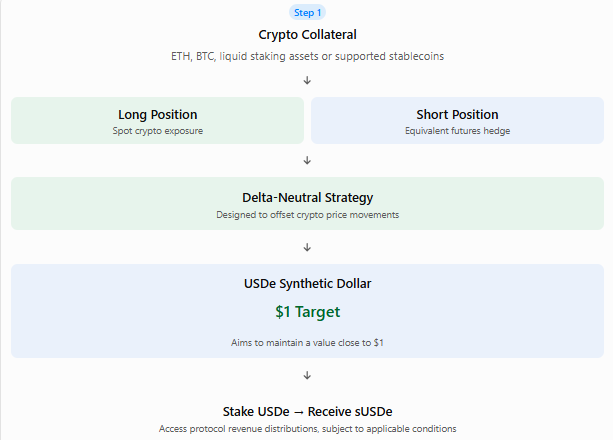
The Ethena diagram runs from top to bottom in a few steps. Step one is crypto collateral, which can include ETH, BTC, liquid staking assets, or supported stablecoins, and that collateral splits into a long position, meaning plain spot exposure, and a short position, meaning an equal futures hedge.
Together they form the delta-neutral strategy, built to offset crypto price movements, and the result is the USDe synthetic dollar with its $1 target. The final step lets holders stake USDe to receive USDe, which gives access to protocol revenue distributions, subject to applicable conditions.
Where Does USDe Yield Come From?
The main USDe yield sources are funding rates and staking rewards. Funding rates are regular payments between traders in perpetual futures, which are contracts with no expiry date, and when long traders pay short traders, the hedge earns income.
Staking rewards from eligible collateral, such as liquid staking assets, add a second stream, but neither stream is fixed, and both flow to USDe holders and not to plain USDe.
What Happens When Funding Rates Turn Negative?
When funding turns negative, the short hedge pays instead of earning, and protocol revenue falls. Ethena describes a reserve fund meant to cover such periods, though its size changes over time and a prolonged stretch of negative funding could still strain returns, so the current figure should be checked on official dashboards.
What Is the Difference Between USDe and sUSDe?
USDe is the synthetic dollar, while sUSDe is the staking token that users receive after staking USDe. Rewards accrue within the USDe staking mechanism through a rising exchange rate, so one USDe becomes redeemable for more USDe as time passes, and that’s how the yield shows up.
Ethena’s staking guide describes a seven-day unstaking cooldown, which can change, and staking adds smart contract and yield risk on top of the base token.
USDe vs. USDT and USDC Explained: What Is the Difference?
Anyone comparing stablecoins will find that USDe vs. USDT vs. USDC explained comes down to what sits behind each token and who controls it.
Factor | USDe | USDT | USDC |
Backing | Crypto assets, liquid stablecoins, and short hedges | Issuer-held reserve assets | Issuer-held reserve assets |
Peg method | Hedging, arbitrage, and restricted redemption | Reserves and redemption | Reserves and redemption |
Custody | Off-exchange settlement providers plus derivative venues | Centralized issuer | Centralized issuer |
Transparency | Published collateral and protocol data | Periodic reserve reports | Periodic reserve reports |
Yield | Through sUSDe, variable | None built in | None built in |
DeFi use | Growing | Wide | Wide |
Fiat-backed coins depend on an issuer and its banking partners, while USDe replaces that dependence with market-based hedging and custody arrangements. It trades one set of risks for another, and holders should know which set they’re accepting.
What Are the Main Risks of Holding USDe?
Funding rate risk: negative funding can reduce protocol revenue.
Exchange and counterparty risk: derivatives venues add third-party exposure.
Custody and settlement risk: off-exchange providers can face operational problems.
Liquidation risk: poor hedge management can create losses.
Depegging risk: the token may trade below or above $1.
Liquidity risk: market stress can affect redemptions and trading.
Smart contract risk: technical flaws can disrupt protocol operations.
These risks can build up at the same time during a sharp market move, and a disruption at a venue or custody provider would hit hedging and redemptions together.
Is Ethena’s USDe Safe for Crypto Investors?
Safety here isn’t a yes or no answer. Published collateral data and proof of reserves help holders check what backs the token, but derivatives-based backing brings exposures that bank deposits don’t carry, so USDe isn’t risk-free and isn’t insured like a bank account.
Funding rates, reserve fund size, and liquidity deserve regular checks through official dashboards and Ethena news.
What Is the Future of Ethena’s USDe in DeFi?
USDe could keep growing across lending, trading, and liquidity protocols, where a dollar asset with built-in yield attracts demand.
Competition is heavy, because fiat-backed and other synthetic stablecoins chase the same users. Sustainable yield and disciplined risk management will likely decide how far it goes.
Conclusion: Is USDe a Different Approach to Digital Dollars?
USDe Explained in Short: Ethena combines collateral, short derivatives, and delta-neutral hedging to create a synthetic dollar that aims for $1 but doesn’t guarantee it.
The benefits include DeFi flexibility and variable yield through sUSDe, and the costs include funding, liquidity, custody, counterparty, and depegging risks.
Readers should check live collateral data, current funding rates, and Ethena’s official terms before forming a view.
Disclaimer
This article is for informational purposes only and isn’t financial, investment, or legal advice. Crypto assets, including stablecoins, are high-risk and can lose value. Readers should research independently and consult a licensed advisor before making any decision.