

The latest crypto news on Venice AI privacy allegations comes from researcher KTibow. He says many Venice image-input models on OpenRouter run on outside providers. Venice, tied to the VVV token, sells its Private tier as zero data retention.
Founder Erik Voorhees says Private models stay private. He also agrees some documentation needs an update.
KTibow built a GitHub project called venetian-recursion. It sends each Venice image-input model on OpenRouter a unique image link. Then it logs which servers download that image. The downloader shows who ran the model. The repository notes that Venice docs call Private models "self-hosted open-source models."
The results carry GitHub attestations and a Sigstore Rekor entry. That lets readers check that no one changed the files later. Privacy is central to Venice. So the Venice AI privacy allegations matter to holders of AI crypto tokens.
The Probe 2026-11-21 release lists these hosts for Venice's OpenRouter models, based on download fingerprints:
Host named in probe | Example Venice models |
BaseTen | DeepSeek V4.1 Flash, GLM 5.3 Flash |
DeepInfra or Mancer 2 | Kimi K2.6, Gemma 4 26B, Mistral Small 3.2 |
Fireworks | MiniMax M3 |
Parasail | Qwen3.5 35B, Qwen3 VL 235B |
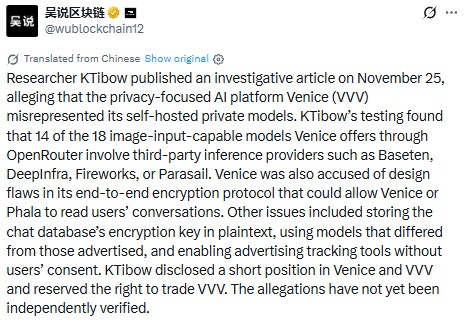
WuBlockchain summed up the work as 14 of 18 image-input models using third parties. Qwen3.5-397B was different. All 40 test requests went back into OpenRouter, where other hosts downloaded the images.
Voorhees replied on X on November 26. He said any model marked Private has zero logging of prompts and replies. Some run on GPUs Venice controls, he said. Others run at U.S. partners that signed zero-data-retention deals, including Baseten and DeepInfra.
He also said the "self-hosted" wording deserves an update. Venice's privacy documentation now describes Private as contract-enforced zero data retention. It does not describe hardware isolation for that tier.
The probe shows routing, not logging. It does not show that any partner kept a prompt. The host labels come from download patterns. One result reads "DeepInfra or Mancer 2," so the match is not exact.
Venice docs say TEE and E2EE modes are text-only for now. These image tests do not touch them, so the probe says nothing about those modes. Readers of crypto security news should keep that gap in mind.
WuBlockchain said the researcher also alleges encryption flaws, a plaintext database key, model substitution, and ad tracking without consent. No regulator or independent audit has confirmed them. Voorhees said no vulnerability has been demonstrated in the encryption paths.
KTibow disclosed a short position in VVV, WuBlockchain said. Some media reports said VVV fell over 15% but gave no price or time. Treat that figure as unconfirmed.
Venice docs say each model's privacy setting reads "anonymized" or "private," and separate flags show whether it supports TEE or E2EE. In Anonymous mode, the provider can still see the prompt.
Users can check a model's label first. They can also watch for the promised wording change.
Disclaimer: This article is for information only and is not financial advice. Crypto assets such as VVV are volatile. Do your own research before making any decision.
Frequently Asked Questions (FAQ)




Owned by:-
DCG Tech FZCO, UAE
Delivery Partner:-
Gabbar MediaTech Pvt Ltd.
Copyright © 2026 Coin Gabbar. All Rights Reserved


