How Does War Affect Bitcoin? Oil Spikes, Fear and Crypto Sell-Offs


Missiles land far from your city, yet the first thing that flashes red is the crypto app in your pocket. That gap confuses a lot of new investors.
War and crypto feel like they belong to different worlds. Markets disagree, and they react within minutes.
So how does war affect bitcoin, and why does a conflict thousands of miles away drag your portfolio down the same night? The answer runs through oil, the dollar and plain fear.
How Does War Affect Bitcoin in the First Hours?
In the first hours of a conflict, traders sell anything they can sell fast. Bitcoin trades every minute of every day, so it often moves before stock markets even open.
That makes crypto an early pressure valve for global fear. The war impact on crypto usually shows up as a quick drop, not a calm bid.
Leverage makes it sharper. When prices fall, over-leveraged long positions get liquidated, and those forced sales push the coin down further in a cascade.
Why Do Oil Prices and Inflation Matter for Crypto?
So how does war affect bitcoin through the oil market? It starts with where the fighting sits.
Many big conflicts sit near oil, so when supply looks at risk, prices jump, and that single move ripples into everything else.
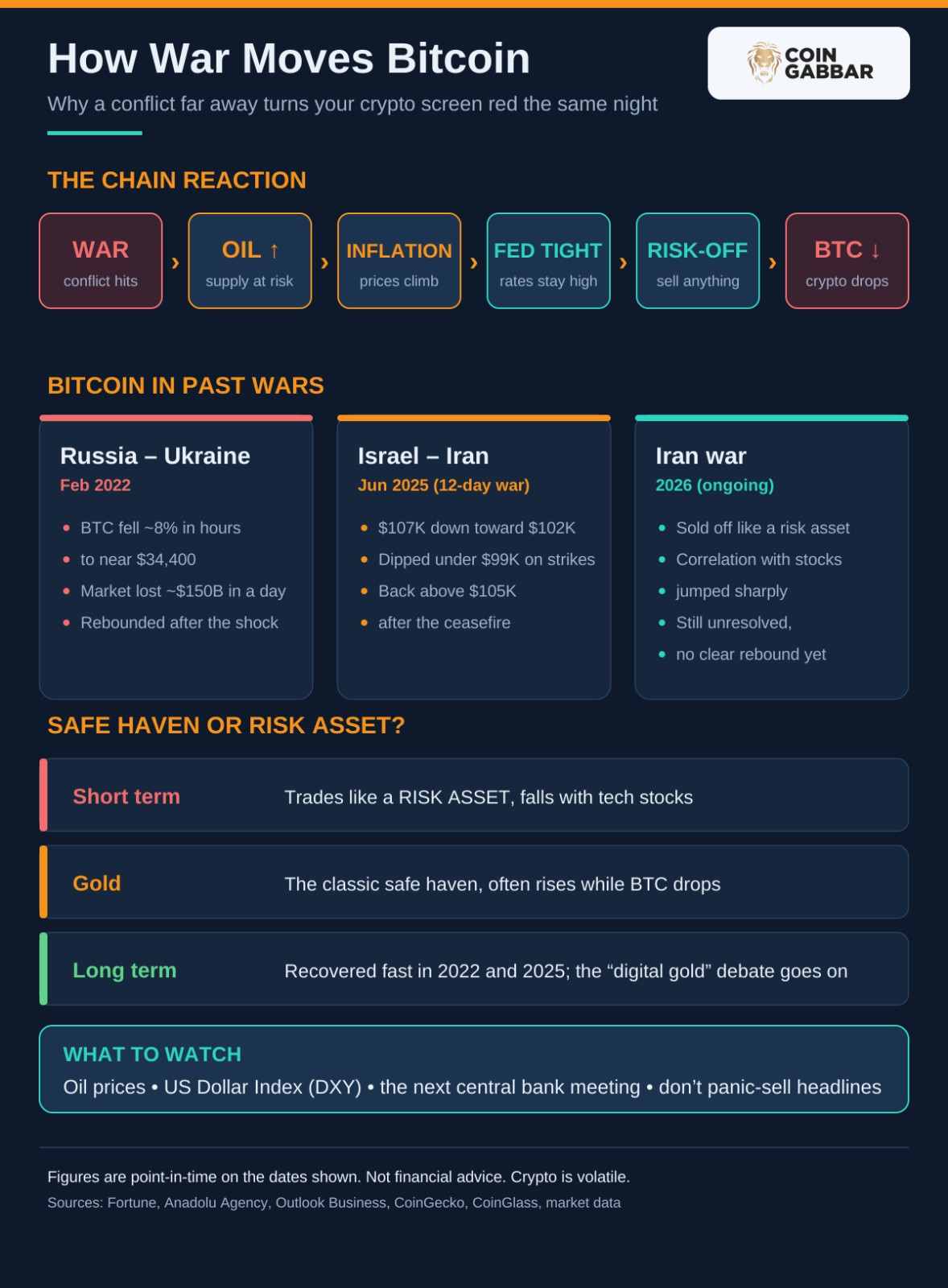
Higher oil feeds inflation. When inflation fear rises, central banks stay strict and keep interest rates high, so liquidity tightens and risk assets lose their easy fuel.
A nervous world also rushes into US dollars, and a stronger dollar tends to push the coin lower. This war-to-oil-to-inflation chain is spelled out in CoinGabbar's look at what a US-Iran war means for crypto
Is Bitcoin a Safe Haven During War?
So how does war affect bitcoin once the shock lands, and is it really a safe haven? In the first days, not the way gold is.
Time and again, the coin has sold off alongside tech stocks when a war breaks out, which is risk-asset behaviour. Gold still plays the classic haven role and often climbs while crypto drops, which is why the Bitcoin versus gold debate flares up in every crisis.
The longer view is kinder. BTC has tended to recover once the first shock is priced in, and supporters still call it digital gold for its fixed supply. For now it is better described as a risk asset slowly gaining crisis utility.
What Do Past Wars Tell Us About War Impact on Crypto?
So how does war affect bitcoin once the first panic fades? Three recent conflicts give the pattern.
Russia invaded Ukraine on 24 February 2022. Bitcoin fell about 8% within hours to near $34,400, and the wider crypto market shed roughly $150 billion in a day before staging a rebound.
During the 12-day Israel-Iran war in June 2025, the coin slid from about $107,000 toward $102,000, then dipped under $99,000 after US strikes. It climbed back above $105,000 once a ceasefire was announced.
The 2026 Iran war is the test case still running. Bitcoin dropped to about $63,000 when US and Israeli strikes began in late February, and with the conflict unresolved it still trades well below its 2025 record. The clean rebound seen in earlier wars has not arrived.
How Should Indian Investors React to War Headlines?
So how does war affect bitcoin for Indian investors? It comes down to oil, the rupee and the Fed.
India imports most of its oil, so a war-driven oil spike means a costlier import bill, a softer rupee and imported inflation at home. That macro weight sits on top of the global sell-off.
The worst move is panic selling into a red headline. Fixed, regular buying and careful position sizing usually beat guessing the bottom, an idea covered in CoinGabbar's guide on how corrections create opportunities.
This week is a live case: fresh attacks on Gulf shipping pushed Brent back above $95, the coin slipped under $69,000, and the Fear and Greed Index sat at 20 on 13 November, as the latest crypto market update shows. Such drivers move prices far more than the headlines themselves.
Expert Opinion
CoinGabbar analysts read war as a short-term risk-off trigger for crypto, passed through oil and the dollar rather than a clean flight to safety. The repeated move is sell first, then recover once the shock is understood.
The bullish case is that the 2022 and 2025 conflicts both ended with Bitcoin reclaiming lost ground faster than many expected. The bearish case is simple: as long as the coin falls with stocks during panic, the safe-haven label stays unearned, and the unresolved 2026 war is the current reminder.
The question of how does war affect bitcoin has a steadier answer than the headlines suggest: be positioned before the news lands, not after.
Disclaimer: This article is for general information only and is not financial or investment advice. Crypto is highly volatile and prices can fall sharply during a war or any geopolitical shock. Past moves in Bitcoin or gold do not guarantee future results. Do your own research and invest only what you can afford to lose.
















