What Is Canton Network? Wall Street's Quiet Blockchain

How Does Canton Network Work for Institutional Finance
Canton Network is an institutional blockchain network built for banks, asset managers, and the firms that run financial markets. It doesn’t make much noise online. But two recent events put it on more radars. DTCC announced that its Tokenization Service went live on October 28, 2026, and SEC staff published a no-action letter on Canton Coin on November 3, 2026.
So what is it, exactly? Canton Network explained in plain terms: a blockchain that keeps the open access of a public chain while protecting the privacy regulated finance can’t live without.
This guide covers features, workings, token use, tokenomics, builder pathways, and risks. Facts come from official documentation, the project’s whitepaper, and the SEC letter, all reviewed on November 12, 2026. Figures reported by the project are labeled as such.
What Is the Canton Network, and Who Built It?
Digital Asset, the company behind the Daml smart contract language, developed this public, privacy-enabled blockchain, which launched in June 2024. Governance of the Global Synchronizer, the shared layer that coordinates activity, sits with the Canton Foundation.
The Canton Network blockchain aims to connect financial systems that have worked in silos for decades. Tokenized Treasuries, equities, ETFs, and cash instruments can move between applications there.
Most public chains copy every transaction to every node. Canton doesn’t. Data reaches only the parties involved.
Key Features of Canton Network
Canton Network privacy features: each party sees only the part of a deal that concerns it.
Proof-of-Stakeholder consensus: only the parties in a transaction check it, and the project says running a validator needs no staking.
Canton Network interoperability: the Global Synchronizer connects separate applications and supports atomic settlement, where every step of a trade completes or none does.
Regulator-friendly design: visibility can include auditors and regulators.
Tokenized asset support: bonds, money market products, stablecoins, and collateral.
How Does Canton Network Work?
How does Canton Network work day to day? Applications run Daml contracts, and each validator node checks only the transactions that involve its own parties. The Global Synchronizer puts encrypted messages in order and collects confirmations. It doesn’t validate every application transaction, and it sees little beyond status and participant names.
In the project’s privacy documentation, a delivery-versus-payment trade shows the idea. The bank sees only the cash side. The registrar sees only the share side. The buyer and seller see both.
Canton Network validators come in two kinds. Super Validators run the synchronizer and vote on governance. Regular validators host users and applications.
Ethereum shows transactions publicly by default, while Canton limits visibility to stakeholders. R3 Corda and Hyperledger Fabric also serve permissioned finance, each with different privacy and interoperability designs.
Canton Coin Utility: What Is CC Used For?
Canton Coin (CC) is the native utility token of the Global Synchronizer. Per the documentation, Canton Coin utility covers three jobs: paying traffic fees, rewarding operators and application providers, and supporting Super Validator governance.
Canton CC privacy works differently from application privacy. CC balances and history are public through a scan service. Application contracts, meanwhile, stay private with the parties entitled to see them. Fees are priced in USD while the token price itself floats.
Canton Network Tokenomics and Token Allocation
The project says Canton Coin launched with no pre-mine, no pre-sale, and no special share for founders, venture investors, or the foundation. Coins in circulation were earned through activity, starting with the Canton launch phase in July 2024.
Minting runs in rounds. Qualifying activity creates records with weights, and participants mint CC in proportion. Fees paid in CC are burned. Net supply change equals minted CC minus burned CC, so rising usage alone doesn’t prove burning beats issuance.
Participant | Launch phase (2024) | Middle phase | Current phase (to mid-2029) |
Super Validators | About 80% | 48% | 20% |
Application providers | 15% | 40% | 62% |
Validators | 5% | 12% | 18% |
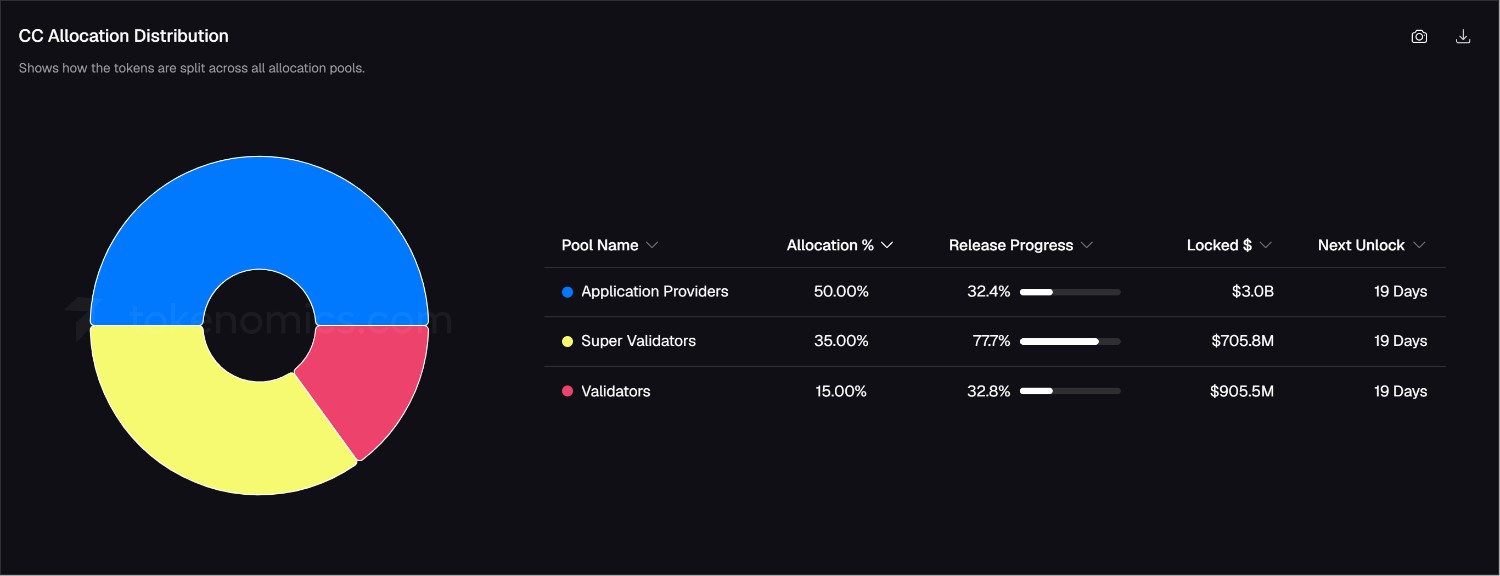
Since February 2026, 5% of mintable CC has gone to a development fund, drawn proportionally from all three categories, according to the SEC filing. Only featured applications earn app rewards. Separate validator liveness rewards, which paid for uptime alone, fell to $0 on April 30, 2026. Validators still earn activity rewards tied to burned fees.
Developer Pathways on Canton
The project lists five builder pathways. Learning Daml through certification and quests comes first. Builders then bring assets using digital asset utilities, build composable applications, or start from scratch with Quickstart. The last path covers exchange and wallet integration.
Canton Network Ecosystem, ETF Products, and Price
The Canton Network ecosystem includes tokenized Treasury products, repo and collateral workflows, stablecoin payments, and derivatives margin. The project says Broadridge’s repo platform in Canton handles over $4 trillion in monthly Treasury repo, though that figure is self-reported and unaudited. Pilot material, including an investment bank’s tokenized report on collateral mobility, points to repo as an early use case.
The 21Shares Canton Network ETF (TCAN) launched on Nasdaq on May 7, 2026, and the Bitwise Canton ETP (BWCC) listed on Deutsche Börse Xetra on May 26, 2026. They are different products on different exchanges.
Canton Network price data showed CC near $0.10 on November 4, 2026, a historical snapshot, against an all-time high near $0.19 on February 3, 2026.
SEC staff said, based on the requester’s representations, that Canton Coin is a “digital commodity” and won’t recommend enforcement over its programmatic minting. It is a staff position, not a commission rule or blanket approval, and it expresses no legal conclusion. Different facts could change it.
What Are the Main Risks?
Adoption risk: token demand depends on real institutional traffic, and reported volumes need outside confirmation.
Governance concentration: Super Validators vote on fees, minting curves, and upgrades.
Supply growth: minting continues, and burning may fall behind when activity is low.
What Does the Data Say?
The stronger signal is real adoption of the infrastructure, since the DTCC service and the regulatory letter are events anyone can verify. The bigger unknown is harder to pin down.
Does institutional activity actually turn into CC burn? Tokenized workflows could use the network without creating much token demand at all.
Conclusion: Is Canton Changing Wall Street?
Canton aims to update financial infrastructure by connecting separate applications while keeping data private and controlled with institutions.
Confirmed milestones include the DTCC launch and the SEC staff letter. Token demand, governance concentration, and reported volumes remain open questions.
Disclaimer
This article is for informational purposes only and does not constitute financial, investment, or legal advice. Cryptocurrency is highly volatile and carries a risk of loss. Readers should conduct independent research and consult a licensed advisor before making any decision.