What Is KAIO? Behind This Week's 146% Surge in Crypto

What Is KAIO, and Why Are Readers Searching for It Now?
What Is KAIO? It’s a real-world asset (RWA) protocol that helps asset managers offer tokenized versions of their assets on public blockchains, and the KAIO token is its governance and utility asset. Search interest rose after a spike of more than 100% on September 28, 2026, followed by a steady pullback.
This guide covers the five assets on the official KAIO website, what the token does, how supply and unlocks work, and where the risks sit. Capital details come from the official site, while price and supply figures come from independent market data checked between November 15 and 17, 2026.
Claims of a fresh 146% weekly gain circulating online couldn’t be confirmed against that data.
What Is KAIO in Short?
Project: KAIO, an RWA tokenization protocol that was originally launched as Libre Capital before a 2025 rebrand.
What it tokenizes: shares in institutional asset products, from money market assets to private equity strategies.
Token: KAIO, an Ethereum token with a 10 billion maximum supply, launched on May 6, 2026.
Token roles: governance votes, staking, and access to protocol products, without a legal claim to fee revenue.
Price check: about $0.0205 on November 15, 2026, down 5.4% over seven days, so the big spike is a September event, not a current one.
Fact | Detail |
Category | RWA tokenization |
Token launch | May 6, 2026 |
Maximum supply | 10 billion KAIO |
Circulating supply | About 681.25 million (6.8%) |
Listed funds | CASH, SCOPE, VOLT, MACRO, MCAS |
Next unlock | December 6, 2026 |
Official token contract | 0x00bac91fd8f5b4a0dc03c8021139b76f6549ee7e |
The contract address comes from the project’s official community page. Fake tokens with the same name exist across crypto, so any address should be matched against official pages before buying.
How Does KAIO Work, and Is It a Real-World Asset Project?
Yes, KAIO is an RWA project. Real-world assets are traditional financial products, such as asset shares, that get represented as tokens on a blockchain.
KAIO works as the connecting layer between capital managers and blockchains. The process, as described on its official pages, runs in four steps:
A fund product is chosen and turned into a token that represents a share in that fund.
Rules on who can hold the token and in which countries are written into the token’s code.
The investor passes KYC and AML checks, which are identity and anti-fraud checks, and the wallet gets approved.
Smart contracts verify eligibility before each transfer, and fund events such as value updates are handled on-chain.
What Is the Difference Between KAIO and Its Tokenized Funds?
Two different things share one brand name, and mixing them up is a common mistake. The fund tokens (CASH, SCOPE, VOLT, MACRO, MCAS) represent shares in investment products, and their value follows the fund. The KAIO token doesn’t represent fund ownership at all.
Some products are feeder funds. A feeder fund collects investor money and passes it into a main fund, so the holder gets exposure through an extra layer instead of owning the underlying assets directly. The site calls VOLT a tokenized feeder fund, and its legal notice names Conduit Asset Management Pte. Ltd., a Singapore-licensed manager, as investment manager for the listed assets.
A famous manager’s name on a product page doesn’t make the KAIO token safer. The token and the funds are separate assets with separate risks.
Can Retail Investors Access KAIO Funds?
The site marks every listed fund as for institutional and accredited investors only. It also says products may face distribution limits depending on the investor’s country.
Eligibility therefore depends on both the fund’s terms and local rules. A retail buyer can’t assume access, even for the $100 minimum product. The KAIO token itself is different, since it trades on exchanges such as Coinbase and Bitget.
What Is KAIO Token Utility, and Does It Share Revenue?
KAIO token utility rests on three uses:
Protocol access: the token supports access to KAIO products.
Staking: holders can stake for rewards, though reward mechanics vary across summaries and should be checked in the official documentation.
Governance: holders vote on protocol and treasury decisions, with the KAIO Foundation acting as the offchain steward.
Published token terms say holders have no legal claim to protocol fee revenue. Voting power is not profit power, and a governance token isn’t a share in the business.
How Much KAIO Supply Is Circulating Today?
About 681.25 million KAIO trades today, which is 6.8% of the 10 billion maximum. At roughly $0.02048, that gives a market cap near $13.95 million.
Fully diluted valuation (FDV) assumes every token already trades. Multiplying 10 billion by $0.02048 gives about $205 million, so market cap sits near 7% of FDV. That gap shows how much supply is still to come, and a low token price doesn’t mean a low project valuation.
When Is the Next KAIO Token Unlock?
Vesting is the schedule that controls when locked tokens become available, and a cliff is the waiting period before the first release. As of November 17, 2026, the published terms look like this:
Pool | Share | Vesting terms | Next unlock |
Community and Liquidity | 37.5% | 12.5% at launch, 6-month cliff, 60 months linear | Dec 6, 2026 (19 days) |
Foundation | 17% | 12.5% at launch, 6-month cliff, 36 months linear | Dec 6, 2026 (19 days) |
Early Investors | 31% | 12-month cliff, 24 months linear | About May 2027 (170 days) |
Team | 11% | 12-month cliff, 24 months linear | About May 2027 (170 days) |
Pre-TGE Sale | 3.5% | 12-month cliff, 24 months linear | About May 2027 (170 days) |
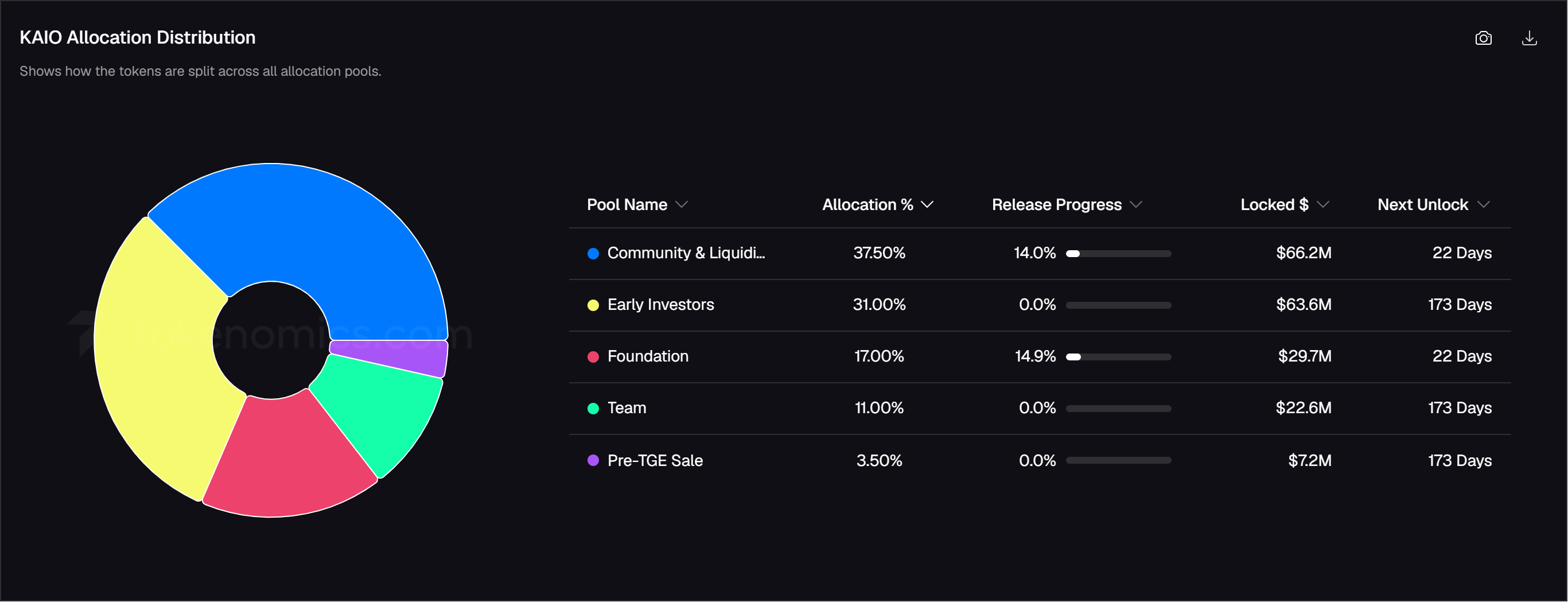
The December release is about 96 million KAIO, close to 1% of the maximum supply. Against today’s circulating supply, that’s roughly a 14% increase, worth about $2 million at current prices.
An unlock isn’t automatically a sale, since recipients can hold, stake, or use tokens for liquidity incentives.
The bigger test arrives in May 2027, when early investors and the team, who together hold 42%, finally unlock. Early investors entered near $0.00355 per token, so today’s price sits roughly 5.8 times above their entry. The pre-TGE sale entered near $0.0229, about 11% above today’s price.
What Happened to the KAIO Price in September 2026?
On September 28, 2026, KAIO rose to about $0.03323 after breaking out of a two-month range. Trackers reported a one-day move between roughly 113% and 127%, depending on the window used. The relative strength index, a momentum gauge, hit about 88, which traders treat as overbought.
By November 15, the price had slid to about $0.0205, which is roughly 92% below the May 6 peak near $0.25.
No source ties the spike to one cause. Confirmed events include the Mubadala Capital asset launch on July 23, 2026, and a September 17 update on locked value across more than eight chains and five fund issuers. Whether those drove the rally is a guess, not a fact.
How Does KAIO Compare With Other RWA Projects?
Project | General focus | How KAIO differs |
Ondo Finance | Tokenized treasuries and fixed income | KAIO covers a wider fund mix, including credit and hedge strategies. |
Centrifuge | Onchain credit and asset pools | KAIO centers on institutional fund feeders. |
OpenEden | Tokenized short-term government bills | KAIO adds private markets and hedge fund access. |
Securitize | Regulated tokenization platform | KAIO is a protocol layer with its own governance token |
These are general summaries, so current terms should be checked on each project’s own pages.
KAIO Roadmap: What Has Happened and What Is Still Pending?
February 2025: access to a Laser Digital fund opened on Sui.
March 2025: Hamilton Lane and BlackRock fund access expanded with on-chain use on Injective.
October 8, 2025: BlackRock and Brevan Howard tokenized assets went live on Sei.
May 6, 2026: the token launched, and Coinbase confirmed support.
July 23, 2026: The Mubadala Capital fund launched on Base, Solana, and Sui.
September 17, 2026: A locked value was reported across more than eight chains.
Pending: KASH, a retail yield app. The site still shows a waitlist and a coming soon label, and the original Q2 2026 target has passed.
What Are the Main KAIO Risks?
Supply risk: about 93% of supply is still locked, with unlocks due in December 2026 and May 2027.
Rights risk: token holders have no legal claim to fee revenue.
Access risk: the funds are limited to eligible investors and jurisdictions.
Collateral risk: if fund tokens back loans, a price drop could force a liquidation.
Execution risk: KASH missed its first target, and public code activity has been light.
Market risk: a market cap near $14 million can swing sharply on small trades.
Final Thoughts: Verify First, Judge Later
KAIO turns institutional fund products into onchain tokens, with a capped governance token released in stages. The asset list is real, the partners are well known, and the product range is broader than most small RWA tokens.
The price story is weaker. The spike was a September event, the token sits far below its peak, and the largest supply test comes in May 2027.
Readers should check the official documents, the unlock calendar, and live charts before forming a view.
Disclaimer
This article is for informational purposes only and isn’t financial advice. Crypto assets are volatile and risky, so readers should research independently and consult a licensed adviser before making any decision.