Lattice-Based Cryptography for Blockchain: How It Works


What Is Lattice-Based Cryptography for Blockchain Security?
Your crypto wallet runs on a lock that a future machine may pick. Researchers already have a stronger one. Lattice-based cryptography for blockchain is that plan, and it’s moving from labs into official standards. Here’s how it works, what NIST approved, and why Bitcoin and Ethereum holders should care long before any quantum threat becomes real.
What Is Lattice-Based Cryptography for Blockchain Security?
A lattice is a grid of points that repeats in every direction. Picture graph paper, then stretch it into hundreds of dimensions.
In lattice-based cryptography for blockchain, a secret is hidden inside that grid. Finding it means solving a very hard geometry puzzle. No fast method is known, even on a quantum computer.
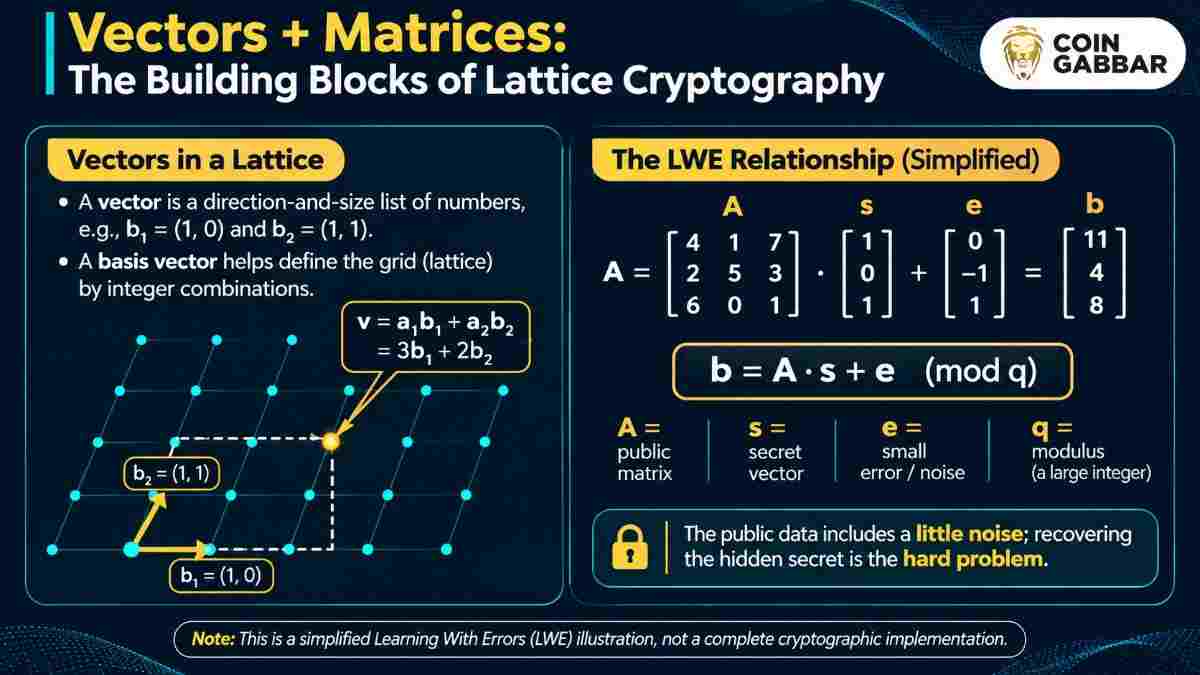
Think of it as a maze with far too many turns. A person who holds the right map walks through in seconds. Everyone else gets lost.
Today’s wallets don’t use this idea yet, and neither do Bitcoin or Ethereum at the protocol level. They rely on elliptic curve math instead. That’s the part under threat.
Why Can Quantum Computers Break Bitcoin and Ethereum Keys?
Bitcoin and Ethereum sign transactions with elliptic curve schemes. A signature proves you own the coins without revealing your private key. For classical computers, working backward from a public key is nearly impossible.
Quantum machines change that. In 1994, Peter Shor described an algorithm that could crack this math quickly on a large enough quantum computer. Nobody has built one that big. Still, standards bodies are acting early, because moving a global network takes years.
Exposure matters too. Once a public key appears on chain, it becomes a possible target. Our quantum crypto risk guide explains which addresses face the most risk. Hash functions face a much smaller threat, so signatures are the main worry. That’s the gap lattice-based cryptography for blockchain aims to close.
How Does a Lattice Problem Protect Your Private Keys?
Two puzzles sit at the core. The first asks for the shortest path between points in a huge lattice. The second, called learning with errors, asks you to solve equations that carry small random noise.
Without the noise, the equations are easy. A school student could solve them. With the noise added, recovering the secret becomes extremely hard.
Oded Regev introduced the idea in 2005. It built on Miklos Ajtai’s 1996 work, which linked average cases to worst cases. This survey of lattice methods covers the theory in depth.
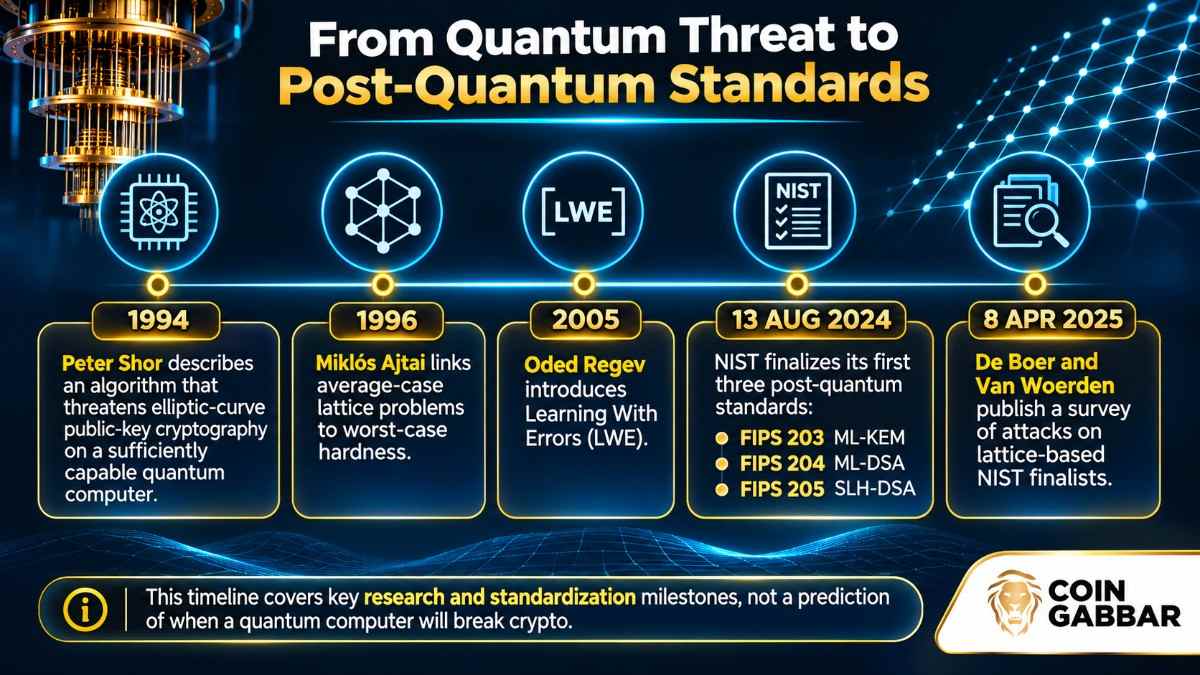
That link is a big selling point. Breaking a random key is roughly as hard as breaking the toughest lattice cases. It isn’t a proof of safety. It’s strong evidence, and cryptographers have tested it for decades.
Which Lattice Schemes Did NIST Approve as Standards?
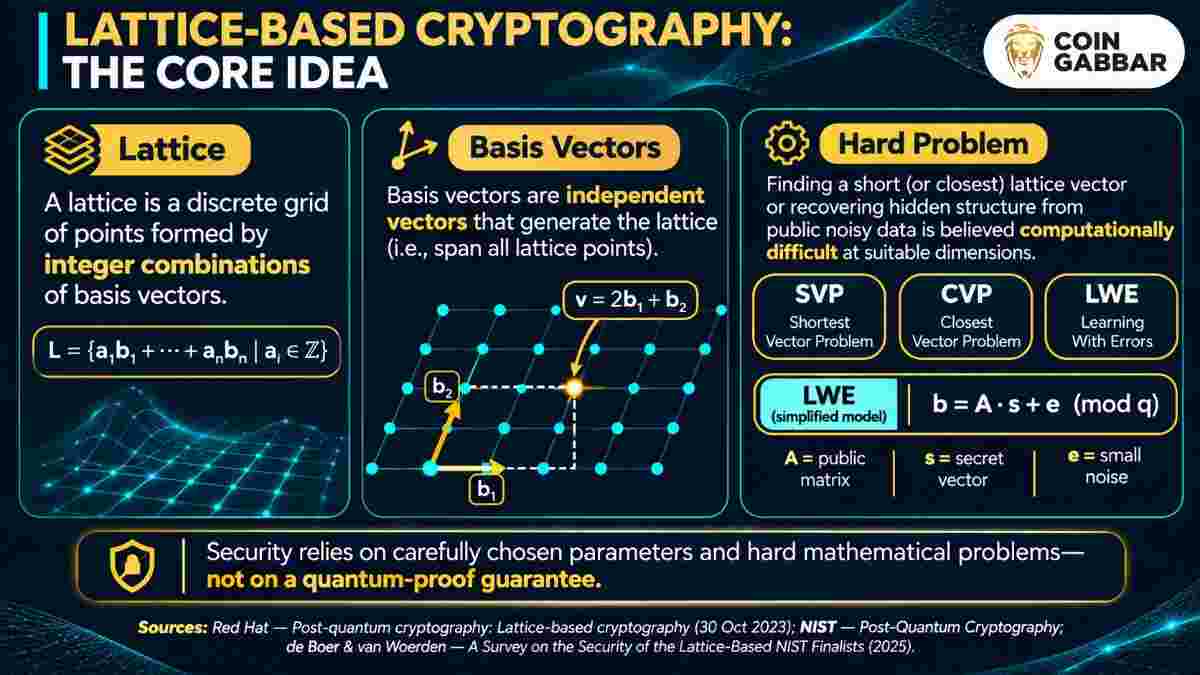
On 13 August 2024, NIST finalized three standards for post-quantum cryptography. Two of them are lattice-based.
ML-KEM, from FIPS 203, handles key exchange. It grew out of CRYSTALS-Kyber. ML-DSA, from FIPS 204, handles digital signatures. It grew out of CRYSTALS-Dilithium. Both rest on a problem called module-LWE.
The third, SLH-DSA, is hash-based, not lattice-based. NIST also chose Falcon, another lattice signature, for a separate standard that is still in progress. Falcon rests on a related problem called NTRU.
Why does this matter for crypto?
Because a standard gives wallet makers, exchanges, and developers one shared target instead of many competing guesses. Signatures authorize every transfer. So for lattice-based cryptography for blockchain, ML-DSA and Falcon are the names to watch.
How Does a Lattice Signature Prove You Own Your Coins?
A signature has one job. It shows you hold a secret without handing the secret over. Lattice schemes do this with a short secret hidden among huge, noisy numbers.
The signer builds a proof from that short secret. The verifier checks the proof against your public key. If the math lines up, the signature is valid. If not, it’s rejected.
The check is quick. The hard part is forging a proof, because a forger would need to solve the lattice puzzle first. That asymmetry is what makes lattice-based cryptography for blockchain so appealing. Honest users do easy work, and attackers face a wall.
What Do Bigger Keys and Signatures Mean for Blockchains?
Lattice keys and signatures are far larger than elliptic curve ones. The graphic below puts the sizes side by side. Keys come out about 40 times bigger, and signatures about 38 times bigger.
Blockchains store every signature for good, and every node checks them. Bigger signatures mean fuller blocks, higher fees, and slower syncing unless networks adapt.
Developers are weighing fixes. Options include signature aggregation, smaller schemes like Falcon, and hybrid designs that keep the old signature beside a new one. That’s why lattice-based cryptography for blockchain brings an engineering cost, not only a security gain.
How Can Wallets and Networks Prepare for Quantum Risk?
Nothing needs rushing today. But migration takes years, so early habits help.
Individual users can do three things. Avoid reusing addresses, since reuse exposes your public key. Follow wallet updates that add post-quantum options. Read network proposals before you upgrade.
Networks have harder jobs. They must pick a scheme, test it, and move funds safely. Coins held in old addresses need a clear path to new ones, and that takes coordination between developers, miners, validators, and wallet makers. Lattice-based cryptography for blockchain won’t arrive overnight. For background, see the basics of cryptography in crypto.
What Risks Remain With Lattice-Based Cryptography?
These schemes are young compared with elliptic curves. Cryptographers will keep probing them for years.
Real attacks often target code, not math. Side-channel leaks and sloppy implementations have broken strong schemes before.
Structure is a trade-off too. Research found that a quantum algorithm can find fairly short vectors in highly structured ideal lattices. No NIST pick relies on that design. A 2025 survey by Koen de Boer and Wessel van Woerden found no attack on module lattices that beats generic methods. That’s reassuring, though nobody can promise it forever. So lattice-based cryptography for blockchain needs upgrade paths that allow swapping algorithms.
Are Hash-Based Signatures a Better Option Than Lattices?
They’re a serious rival. SLH-DSA, the third NIST standard, builds signatures from hash functions alone. Its security rests on a simpler assumption, and many experts like that.
The cost is size. Its signatures run from roughly 8,000 to 50,000 bytes, which is far heavier than lattice signatures. For a chain that stores every signature, that adds up fast.
Lattice schemes land in the middle. They’re smaller than hash-based ones, yet larger than today’s curves. Neither choice is perfect, which is why researchers keep comparing them. Expect different networks to pick different tools.
Expert Opinion: What Should Crypto Readers Take Away?
CoinGabbar analysis suggests lattice-based cryptography for blockchain is the most practical route to quantum-resistant signatures right now. The main obstacle is size, not security, and that’s an engineering problem.
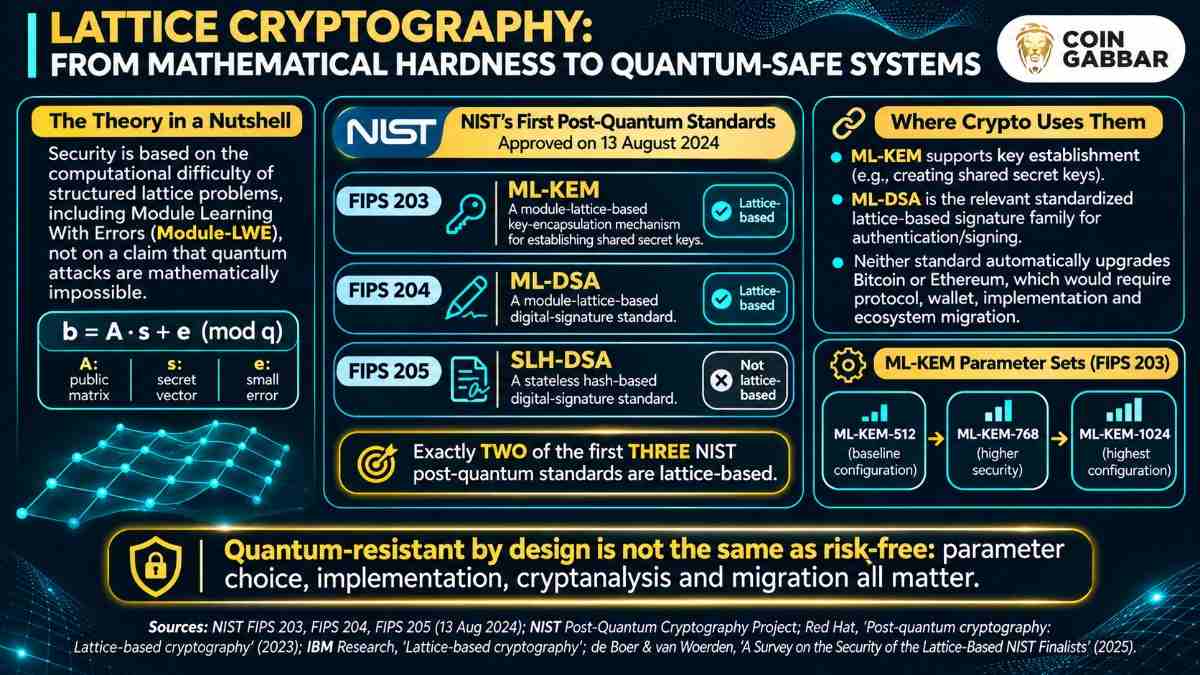
Networks that plan early will face fewer rushed choices. Readers can start by watching wallet and protocol updates and by treating quantum risk as a slow engineering project, not a panic. Lattice-based cryptography for blockchain won’t solve everything, yet it gives developers a tested starting point.
Disclaimer: This article is for information only. It isn’t financial or investment advice. Crypto carries risk, and technology and standards can change. Nothing here guarantees an outcome.