What is KOR Protocol? Exploring Its Creative Ecosystem in 2026

How Does KOR Protocol Support Digital Creators in 2026?
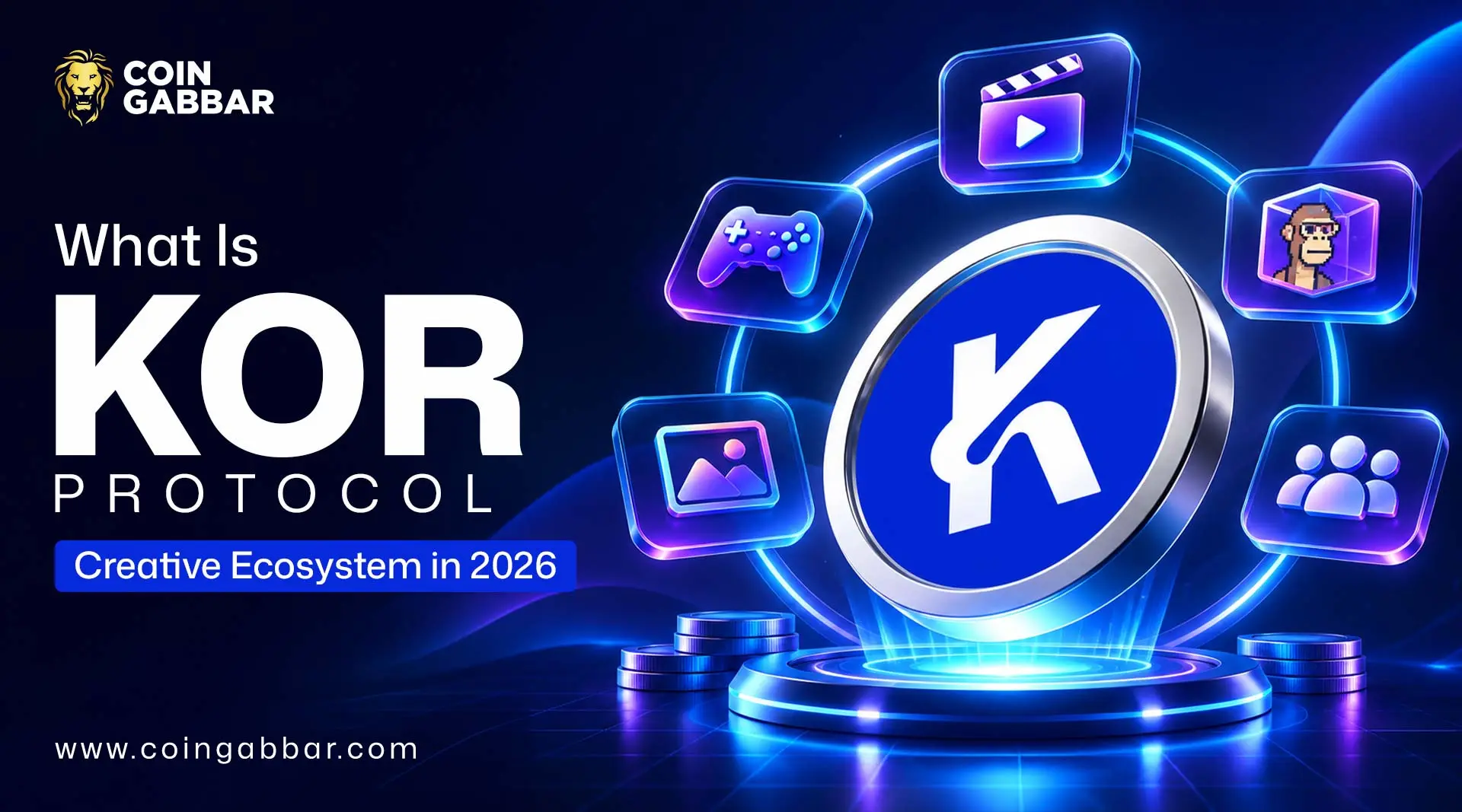
What is KOR Protocol, and why are creators and crypto readers asking about it? It is an on-chain system on Base that tries to verify creative work, match it with buyers, and settle the payment. The project calls itself a creative asset clearinghouse.
That is a big claim. The official white paper backs it with product numbers, a fixed token supply, and a detailed vesting plan.
What Is KOR Protocol, and How Does It Work?
The whitepaper describes one loop with three jobs: Verify, route, and settle. Registration creates a verified record. That record makes a work routine. A finished deal then writes its commercial history back to the asset.
So, what is KOR Protocol in plain terms? A shared record of who owns what, plus a payment layer on top.
Verify: Proving What Is Real
Each registered work gets an ERC-721 identifier, a content pointer, and signed metadata. The token itself does not hold deal data. A separate attestation graph stores signed claims about authorship, samples, AI provenance, and licenses.
Some claims cannot be checked automatically. For those, a participant locks KOR behind the claim. A false claim can cost that stake.
A work counts as "clear to move" only when the graph meets the conditions for a specific action.
Route: Matching Work With Demand
Route agents have an on-chain identity, a stated skill set, and a reputation score. The document lists agents for talent scouting, release planning, sync licensing, audience analysis, and partner matching.
A match engine ranks likely buyers using signal data and past outcomes. Curators can also stake KOR behind a call about talent. According to the project, curators carry more weight early on. The engine takes over as outcome data grows.
Settle: Paying Everyone at Once
Revenue splits are written at registration. A track with several producers, a vocalist, a manager, and a label can pay every party in a single step.
Settlement runs in stablecoins, mainly USDC. A creator gets paid in dollars, so the payout doesn’t swing with token prices. High-value deals get extra checks from bonded validators.
The whitepaper adds one clear limit. KOR is not a central counterparty. It does not absorb credit risk if a deal fails.
What Is KOR Protocol's Event Listener Doing in the Background?
The official technical documentation describes an Event Listener Service. It watches the protocol's smart contracts through two RPC providers.
An RPC provider is the gateway apps use to read blockchain data, as explained in this guide to RPC node access.
When a contract emits an event, the service sends it to a message queue. A consumer service decodes it. The result goes into an indexed database.
This design separates detection from processing. If traffic spikes, the queue holds events instead of dropping them. That suits an app suite tracking mints, licenses, and payments.
What Is KOR Protocol Already Running Today?
Five products run on the protocol. The project team operates all of them.
-
Korus: Music remixing and creation
-
VRSNS: Social content generation and repurposing
-
Pacer: An AI operating system for music careers
-
Streamline: A similar tool for video and visual creators
-
KOR Hubs: Stem packs, remix contests, courses, and paid feedback
The white paper reports over 1 million lifetime sign-ups and 285,000 assets minted on-chain. It also cites more than 1,000 IP partners and over $2 million in gross product revenue.
These are project-reported figures. Cross-checking them against on-chain records makes sense.
Onboarding is designed to hide the crypto. New users get smart accounts with social or passkey login, a model similar to smart wallet recovery setups.
What Is KOR Token Utility?
$KOR is an ERC-20 token issued on Base. Total supply is fixed at 10 billion. The whitepaper states that no further issuance is planned.
Settlement uses USDC, so the token is not the payment currency. Its main job is bonding. Attestors, agents, curators, and validators lock KOR behind claims that cannot be verified automatically. Slashing means that the locked stake is forfeited if the claim is proven false.
Three other uses appear in the document:
-
Staking for discounts on AI workflow costs
-
Governance votes on protocol parameters
-
Creator rewards across the network
The staking tiers run from 30 to 365 days. Discounts range from 10% to a 50% cap. The whitepaper labels these tiers as illustrative and pending finalization.
What Is KOR Protocol's Token Supply and Vesting Schedule?
At the token generation event (TGE), 22.87% of supply unlocks. That equals 2,286,666,667 KOR. Team and investor tokens start at zero.
| Category | Allocation | Unlocked at TGE | Vesting rule |
| Ecosystem Development | 35.32% | 4% | No cliff, monthly linear over 5 years |
| Investors | 22.38% | 0% | 1-year cliff, 10% release, then monthly over 2 years |
| Team and Core Contributors | 15.00% | 0% | 1-year cliff, 10% release, then monthly over 3 years |
| Foundation | 10.00% | 4% | No cliff, monthly linear over 5 years |
| Marketing | 8.30% | 5.87% | The remaining 2.43% unlocks one month after TGE. |
| Liquidity | 5.00% | 5% | Fully unlocked at TGE |
| Community Access | 4.00% | 4% | Fully unlocked at TGE |
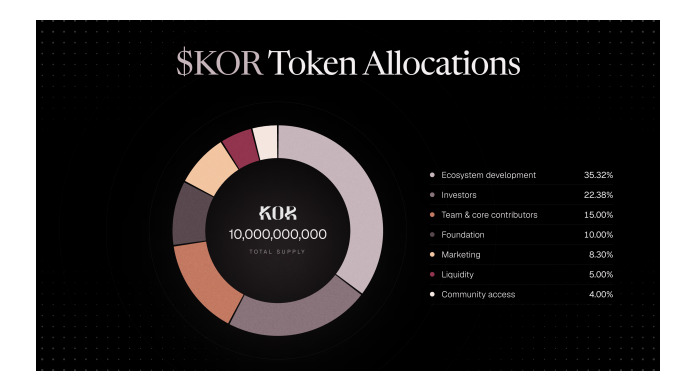
A cliff is a waiting period before any tokens unlock. Team tokens reach full unlock four years after TGE. Investor tokens follow in three. On paper, that delays insider selling pressure.
A 22.87% opening float is still sizeable. Market cap counts circulating tokens, while fully diluted valuation (FDV) counts all 10 billion. The two figures can differ widely early on.
Ecosystem and Foundation tokens also vest for five years. Supply keeps entering circulation long after launch. Readers trackingtoken unlock schedules will find this pattern familiar.
The white paper says vesting is enforced by smart contract. Allocation addresses are to be labelled on the Base block explorer at deployment. It also reserves liquidity tokens for market making and liquidity provision across trading venues.
What Are the Main Risks to Consider?
The document is open about its gaps. Several risks stand out:
-
Draft standards: KOR builds on two standards that aren’t final yet, ERC-8004 for agents and ERC-7683 for cross-chain payments. If their rules change, parts of the integration may need rework.
-
Unsolved problems: The project lists dispute resolution for unclear IP claims, match engine cold start, slashing calibration, cross-border royalty law, and selective disclosure.
-
Revenue model: Application revenue funds the early period. Clearing fees are where the model is meant to scale, and that flow is still to be shown.
-
Self-reported traction: User, asset, and revenue figures come from the project.
-
Launch details: The whitepaper places the TGE in early Q4. Contract addresses and claim pages should be confirmed only through the official KOR Protocol website, since lookalike pages are common around launches.
An audit or a partnership announcement does not guarantee safety or adoption. Neither does a clean tokenomics table.
Is KOR Protocol Worth Watching Right Now?
What is KOR Protocol, in the end? A clearing layer for creative work, built on Base, with working apps and a bonded token. The structure is clear. The vesting plan is detailed.
What remains uncertain is demand. The model needs outside partners and third-party apps to route real deals through its contracts. The listed open problems also matter.
This piece draws on the project’s whitepaper and technical docs, as read on November 20, 2026. Three things are worth checking next: the verified token contract, the live unlock schedule, and how much value actually settles on-chain
Disclaimer:
This article is for information only and is not financial advice. Crypto assets are volatile and can lose value. Readers should research independently before making any decision.