Is the Solarious Ecosystem Worth Watching? Full Breakdown

What Is the Solarious Ecosystem and How Does It Really Work
Can sunlight really power a blockchain? The Solarious Ecosystem says yes, and it’s selling SOLAR tokens before a planned market launch to pay for that bet.
Most people searching for this crypto project want three answers. What does it do, how does the token work, and where are the risks?
Here’s the thing: crypto news about energy tokens often stays fuzzy. This one comes with a device, a test network, and a published tokenomics report. Figures below come from the project’s website, docs, and report, checked on October 21, 2026.
What Is the Solarious Ecosystem and How Does It Really Work?
Solarious is a Layer-1 blockchain, meaning it runs its own base network. It’s built around proof-of-energy, where measured solar power becomes data the network can check.
Basically, electricity gets recorded on-chain, instead of computers wasting power on puzzles. The project’s docs list five steps:
Its panels make power.
A solar miner device measures it.
The hardware signs a proof record.
Validators, the computers that check network data, confirm it.
Confirmed output earns SOLAR rewards and feeds certificate trades.
Turns out, the device isn’t a normal miner. The site says it’s built only for solar power, not adapted from regular mining chips, and a patent is pending.
Core Features That Set the Solarious Ecosystem Apart
Security relies on real-world limits. The project says proofs are signed inside a secure chip, counters stop the same proof being reused, and caps on output reject inflated claims.
A wallet called Verdex handles claims and staking, a mining pool handles payouts, and a community platform brings in new users.
And there’s a planned certificate layer. SREC and REC are renewable energy certificates, records that prove clean power was made and can be traded.
Smart contracts, which are self-running programs, also work through EVM compatibility, per the tokenomics report.
Token Utility: What Can SOLAR Actually Do?
SOLAR pays network fees, rewards validators and producers, and works as the voting token, so holders can vote on upgrades and treasury spending.
That’s the plan. Demand is another matter. But what keeps demand alive once the reward boost fades?
Fees need real apps. Apps need users. No checked usage numbers turned up for either.
Solarious Ecosystem Tokenomics: Supply and Allocation Breakdown
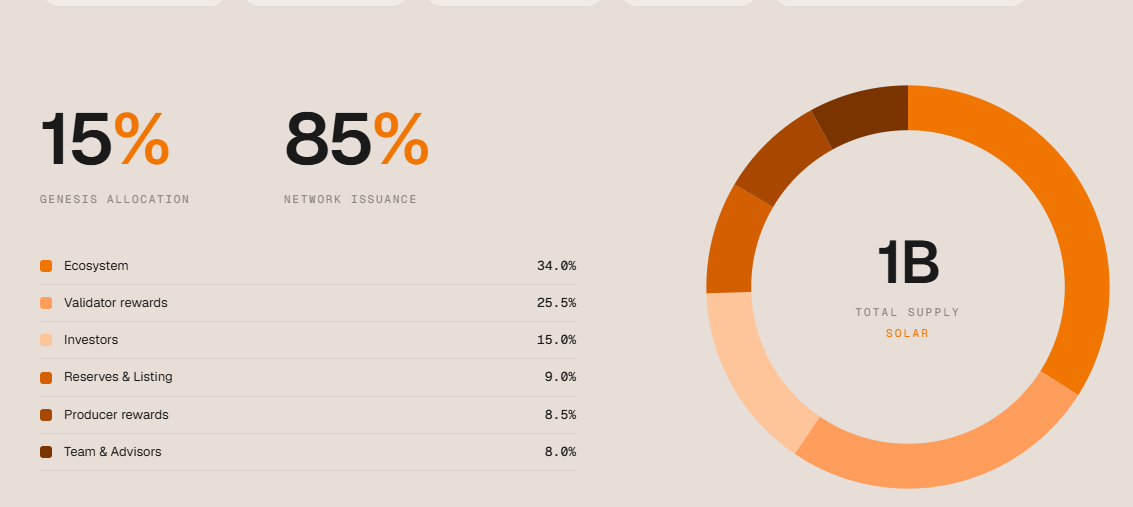
A fixed cap of 1 billion SOLAR. That’s the limit, and the report says no vote can raise it.
The site labels 15% as the starting share and 85% as network issuance. Validator and producer rewards come out slowly over about 120 months.
Allocation | Share | Main purpose |
Ecosystem | 34.0% | Grants, partners, growth |
Validator rewards | 25.5% | Keeping the network secure |
Investors | 15.0% | Seed and private rounds |
Reserves and listing | 9.0% | Backup funds and liquidity |
Producer rewards | 8.5% | Pay for verified its output. |
Team and advisors | 8.0% | Builders and guidance |
Seed and private rounds raised $10 million at $0.05 and $0.075. Both wait 12 months before any unlock starts, which is called a cliff, then release evenly over 36 months.
At launch, 69.02 million SOLAR (6.9%) should be in circulation. At a $0.10 reference price, that means a $6.9 million market cap against a $100 million FDV, which counts every token, locked ones included.
But the report’s detailed table lists 14 categories, and the shares add up to about 151%. The project says some overlap. A clearer answer is overdue.
Crypto Presale, Listing, and Airdrop: What’s Confirmed?
The presale is live. The page quotes 0.1 USDT per SOLAR, after an earlier private-sale price of 0.075. The growth plan shows 0.3 at listing. That’s a stated plan, not a confirmed price.
One page snapshot shows $213,570.25 raised out of $536,429.75, about 28%. The site text says the maximum is 750,000 USDT instead. Status labels clash.
Here’s the thing: any crypto price shown today is a presale price, meaning what early buyers pay, not what a market sets.
No crypto listing is confirmed, since roadmap phase four only mentions market-maker review. The crypto airdrop pool is 3.6% of supply, with half unlocked at launch.
Solarious Ecosystem Roadmap: Key Milestones to Watch
Six phases make up the plan. Two are called finished, and four are still ahead. Turns out, none of the four has a date.
Foundation Built: The proof-of-energy design, mining pool, community reach, and the solar miner layer.
Proof Demonstrated: A demo on April 29, with network activity and producers switched on.
Network Launch Readiness: Validator sign-ups, wallet and claim readiness, and docs and explorer proof.
Market Infrastructure Readiness: Token mechanics, market-maker review, and getting ready for exchanges and on-ramps.
Infrastructure Scale: More solar miner devices, more producers, more verified energy data, and more validators.
Environmental-Commodity Pathway: SREC and REC rails, energy-sector partnerships, and tokens that settle environmental certificates.
And phase three matters most, since a live validator set is what separates a real network from a demo.
Risks to Know Before Joining the Solarious Ecosystem
Here are the main risks:
The explorer and API links point to test setups, so the live main network status needs checking.
Approximately 93% of the supply remains locked up, with additional unlocks potentially introducing selling pressure.
“Potential high yield” is a marketing term and does not necessarily reflect realities.
Growth relies on the producers purchasing and installing devices.
An audit badge sits in the footer, but a badge isn’t a safety guarantee.
Rules for certificate markets and token sales differ by country.
What Does the Data Say About Solarious?
The stronger signal is the design. Solar output can be measured, hardware signs the data, and validators check it. A named team led by CEO Jack Samatov backs the project.
But a good design only counts once it runs. The main worry is proof, and test-network links, mismatched presale numbers, and a token table that doesn’t add up all need answers.
At first, the 6.9% float seemed like a tidy launch plan. On second thought, 93% of supply sitting locked is a long shadow over any new token.
Verdict: worth watching, not worth trusting blindly.
Final Verdict: Is It Worth Watching Right Now?
Solarious pairs a real-world data idea with a SOLAR token built for fees, security, and voting. Execution is the open question.
Validator onboarding, a main network launch, and confirmed exchange access will decide whether the story holds. Readers should compare the website, docs, and report line by line.
Disclaimer
This article is for informational purposes only and isn’t financial advice. Crypto presales and unlisted tokens carry high risk, including total loss of funds. Readers should research independently and consult a licensed adviser before any decision.