Where Blockchain Fits in Online Poker


Online poker can use cryptocurrency without putting the game itself on a blockchain. Transferring a digital asset and running a poker table are two different computing tasks. The first concerns a payment and its network record; the second concerns the rules and progress of play. Understanding that division makes the phrase “runs on blockchain” more precise, because it asks which part of the service actually uses the network.
Game developer Sequence’s explanation of on-chain and off-chain gaming describes how a game can combine components that operate on a blockchain with others that operate outside it. The distinction applies to individual components, rather than requiring one label for an entire product. A connection to blockchain can therefore be substantial without putting every instruction, screen, and record on the same system.
In crypto poker, cryptocurrency has a role in the payment side of the service. Poker software has a separate responsibility: keeping track of play and applying the game’s rules. These functions belong to the same overall activity, but information about the payment method does not explain the game’s underlying design. The useful question is how the functions connect, rather than whether the whole experience deserves a single technical label.
Payments and play perform different jobs
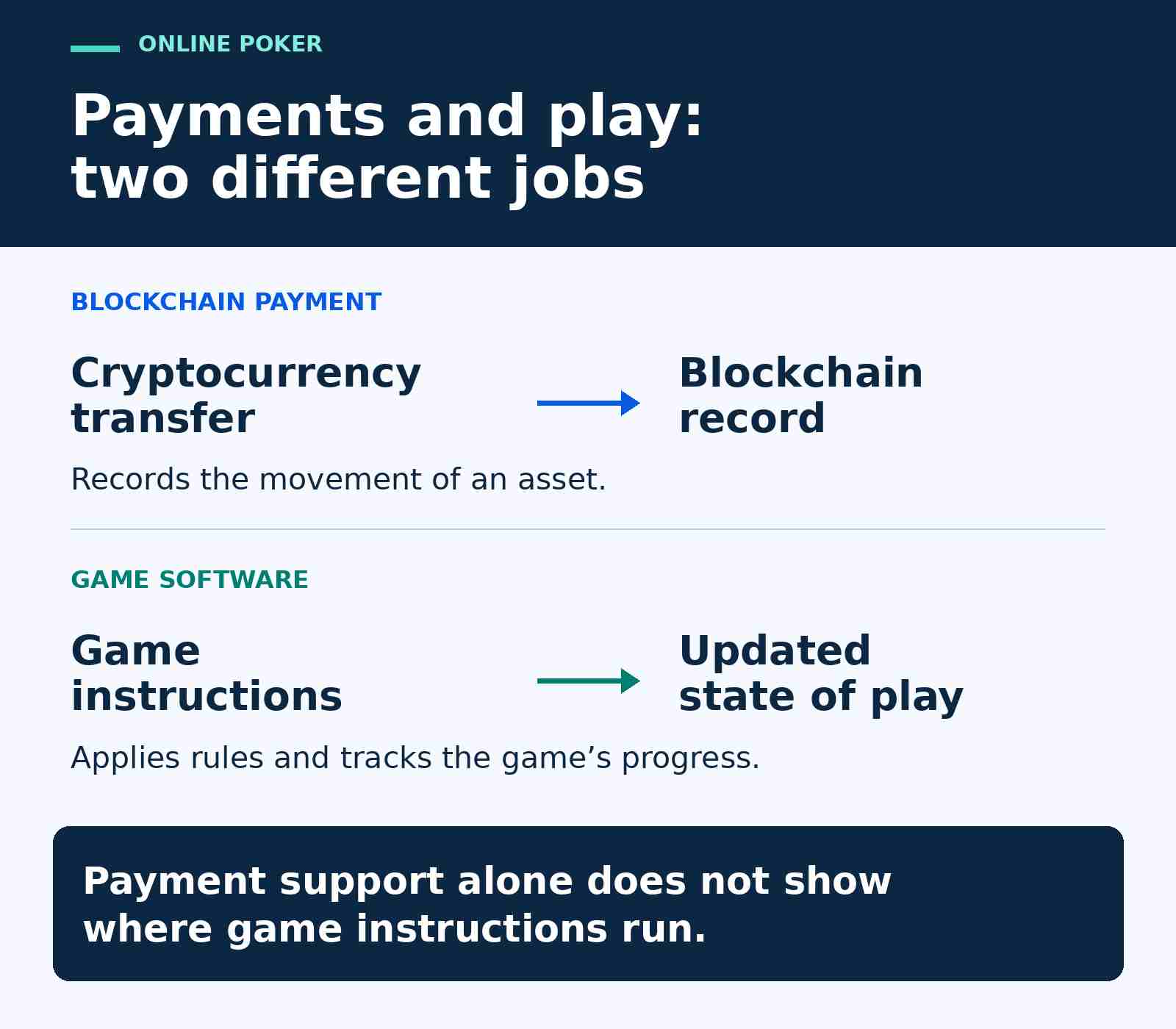
A cryptocurrency payment describes the transfer of an asset. A poker action describes something happening within a game. A payment record and a record of play therefore contain different kinds of information. The first concerns the movement of cryptocurrency; the second concerns events at the table and the position from which play continues.
The word “transaction” can make the distinction harder to follow. In cryptocurrency discussions, it refers to an operation submitted to a blockchain network. In everyday language, it often means a payment. Neither meaning automatically turns each action during poker into a blockchain transaction. The connection between an action and a network operation depends on how the relevant software has been implemented.
Australian dollar terminology offers another useful distinction. AUD identifies a currency denomination, just as a cryptocurrency name identifies an asset. An amount expressed in dollars tells us how value is being described, not where the software processing a poker game operates. Currency, payment method, and game architecture answer different questions, even when they appear together in a description of the same service.
What on-chain actually describes
Game software keeps both instructions and information. The instructions describe permitted actions and how play progresses. The information records the game’s current state, including whose turn it is and which actions have already occurred. These are related but distinct: stored information describes the present position, while the instructions govern how that position changes as play continues.
An on-chain component places a particular responsibility on the blockchain. Where game logic uses smart contracts, those contracts provide programmed instructions executed through the network. Off-chain components carry out their work elsewhere, through other software systems.
On networks supporting smart contracts, transactions can run instructions contained in a program as well as transfer assets. The purpose of a transaction depends on the operation being requested and the code handling it. A cryptocurrency payment is one possible use.
Off-chain also does not mean offline. A poker service can be available through the internet while its game software operates outside a blockchain. Online describes connectivity; on-chain describes a particular use of a distributed ledger. The terms refer to different properties.
How software connects to blockchain records
There are documented tools for making blockchain information available to applications. In its December 2025 description of the Blockstream Explorer API, Blockstream explains that the service provides access to Bitcoin and Liquid data covering blocks, transactions, addresses, and assets. An API, short for application programming interface, provides a defined way for one software system to request information or services from another.
Blockstream also describes its explorer website as the front end for data supplied through the API. A front end is the part people see and interact with. Here, the website presents information that the API makes available to software. These are two ways of accessing the same underlying data, and neither is the blockchain itself. The website gives the records a readable presentation, while the API makes them usable within other applications.
The distinction also separates reading information from carrying out an action. Retrieving an existing transaction record answers a question about recorded activity. Executing game instructions advances the application according to its rules. Both involve software, but they perform different jobs and require different evidence when describing a poker service’s design.
A precise description of online poker can therefore explain its crypto currency connection without making assumptions about the rest of the system. Payment support establishes how digital assets fit into the service. A claim about on-chain gameplay needs details about game execution. Keeping those descriptions specific gives blockchain a clear, understandable role alongside the software that organises play.