Why Is Crypto Market Down Today? BTC, ETH and XRP Price Drop


Bitcoin is down. Ethereum is barely holding green. And three small-cap tokens just got wiped out overnight. If you’ve opened your portfolio app today and felt your stomach drop, you’re not alone, and there’s a real, traceable story behind it.
Here’s the short answer to why is crypto market down today: a payment software security scare, a fresh political signal from China, a fast-moving $628 million hack on Tron, and large wallets quietly dumping Solana are hitting sentiment all at once.
Key Takeaways
- Why is crypto market down today in one line: Bitcoin sits at $77,837.74, down 0.1%, while total crypto value holds at $2.68 trillion, according to CoinGecko data.
- A BTCPay Server security flaw, a China crackdown announcement and ongoing Binance hack fund movements are the three biggest drags on confidence right now.
- Small-cap tokens Dessa, Akedo and Janction crashed between 21% and 42% in 24 hours, far steeper than Bitcoin or Ethereum.
Why Is Crypto Market Down Today? Bitcoin, Ethereum and XRP Price Check
Before the reasons, here’s where the top coins stand right now, straight from CoinGecko.
| Coin | Price Today | 24h Change | Market Cap | 24h Volume |
|---|---|---|---|---|
| Bitcoin (BTC) | $77,837.74 | -0.1% | $1.566T | $16.896B |
| Ethereum (ETH) | $2,283.11 | +0.7% | $279.264B | $8.511B |
| XRP | $1.25 | -0.4% | $79.119B | $1.056B |
Bitcoin dominance stands at 58.3% and Ethereum dominance at 10.4%, showing most value is still parked in the two biggest coins even as sentiment turns shaky. Trading volume across crypto in the last 24 hours sits at $48.5 billion.
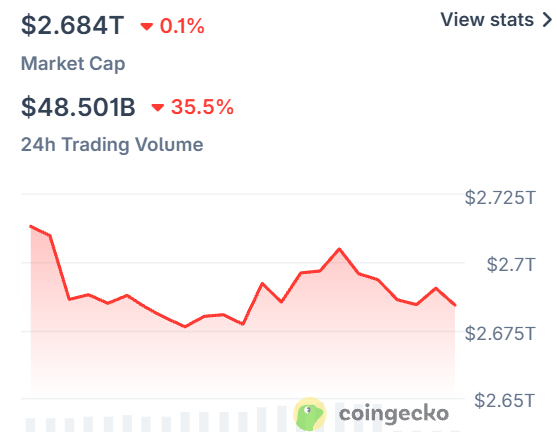
Source: CoinGecko Data
A Security Scare at BTCPay Server Spooks Bitcoin Holders
BTCPay Server, software many merchants use to accept Bitcoin payments without a middleman, pushed out an emergency update called version 2.4.7. In its official release note, the team said the patch fixes one critical and several medium-severity security bugs, flagged through Anthropic’s frontier open-source scanner.
The investigation found the attack path only targets instances still running version 2.4.1 from July 23, 2026, or older. BTCPay Server stated there are no credible reports of hot wallet drains on the latest 2.4.7 build, but it still urged every operator to update right away.
For everyday holders, news like this chips away at trust in Bitcoin’s payment rails, even though the core Bitcoin network stays untouched, and that nervousness is part of why is crypto market down today.
China’s Corruption Crackdown Puts Crypto Back in the Spotlight
On October 29[, China’s Communist Party] held the Fifth Plenary Session of its 20th Central Committee. Wu Blockchain reported the resolution adopted there called for resolutely fighting corruption carried out through the internet, virtual currency, cross-border capital and blockchain, plus stronger cross-border corruption investigations and asset recovery.
Traders read this as another sign that Chinese authorities are tightening their grip around crypto-linked money flows, not loosening it. Every time Beijing speaks this directly about virtual currency, it adds caution across Asian trading desks.
Binance Hack Funds Are Still Moving, and That Is Unsettling Traders
The fallout from the Binance hack is far from over. On-chain analyst SomaXBT reported the attacker moved about $242 million through Tron-related paths within two days of the breach, out of roughly $628 million stolen on Tron alone.
After Tether froze about $378.7 million USDT tied to the hacker, the funds got routed through Relay, THORChain, Chainflip and Symbiosis. Another $41.7 million flowed into a Bitget Wallet address whose final destination is still unknown.
Only about $7.5 million is left sitting on Tron, while more than $3 billion in stolen assets on other chains have barely moved. That much unmoved stolen capital keeps buyers on edge, since nobody knows when or where it lands next.
Whale Selling Adds Extra Pressure on Solana
Lookonchain data shows one large wallet has deposited 1.49 million SOL, worth about $148.77 million, into multiple exchanges over the past 10 days, a pattern that usually signals planned selling rather than holding.
Separately, the Binance hacker moved another $250,000 into Gate within the last 12 hours, adding fresh sell pressure right when confidence is already thin.
Top Crypto Losers Today
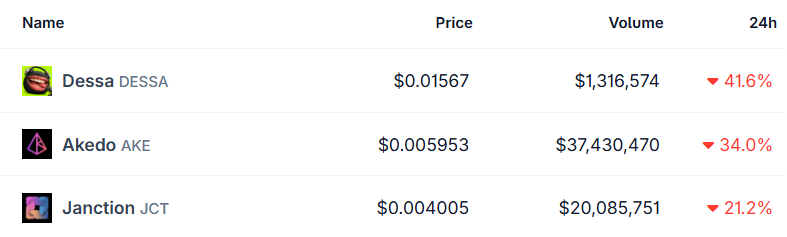
While Bitcoin and Ethereum moved in a tight range, a handful of small tokens got crushed, based on CoinGecko data:
| Token | Price | 24h Volume | 24h Crash |
|---|---|---|---|
| Dessa (DESSA) | $0.01567 | $1,316,574 | -41.6% |
| Akedo (AKE) | $0.005953 | $37,430,470 | -34.0% |
| Janction (JCT) | $0.004005 | $20,085,751 | -21.2% |
These kinds of double-digit crashes in low-liquidity tokens often happen when a wave of risk-off selling hits and thin order books can’t absorb it.
What’s Next for Crypto Markets?
Two scheduled upgrades could shift the conversation this week. On November 5, Cardano’s Amaru block-producing node goes live on mainnet, adding an independent node implementation and pushing the network toward stronger node diversity.
The same day, Zcash activates Network Upgrade 7, cutting block time from 75 seconds to 25 seconds and permanently disabling Sprout transactions, so any ZEC still sitting in the old Sprout pool needs to move to Sapling before the switch.
Neither upgrade changes total coin supply, but both give traders something concrete to watch beyond the hack headlines and sell-off charts.
Expert Opinion: Analysts tracking this week’s price action note the dip looks driven more by confidence and headline risk than by any single catastrophic event. Bitcoin and Ethereum losing only fractions of a percent, while thinly traded tokens like Dessa and Akedo crash 21-42%, points to selective risk-off behavior rather than a broad collapse.
The unresolved $3 billion in stolen Binance funds and the BTCPay Server patch remain the two factors worth watching most closely in the days ahead, since both carry potential to shift sentiment quickly in either direction.
Conclusion
So, why is crypto market down today? A software security scare, a political signal from Beijing, unresolved stolen funds and whale selling combined to rattle sentiment, even as Bitcoin and Ethereum held mostly steady.
YMYL Disclaimer: This content covers cryptocurrency prices and security incidents for informational purposes only. It is not financial, investment, legal or trading advice. Cryptocurrency prices are highly volatile and can change rapidly. Always do your own research and consult a licensed financial advisor before making any investment decision.






