XDAO Listing Date and TGE Preparation Begins: When to Expect??

XDAO's community has one question on repeat this week: when does the new token actually list? The team answered a lot in its latest update, Arbitrum as the new home, a fresh airdrop, a full snapshot of the old token, and a roadmap stretching into artificial intelligence. What it did not answer is the XDAO listing date itself, and that gap is exactly why this update matters.
Here is what the project confirmed, what it is still building, and why the real XDAO listing date sits somewhere between a working guess and a locked calendar date.
Key Takeaways
- XDAO is moving to Arbitrum, and the token will unlock every XDAO product while staking it inside a DAO lowers fees.
- The Legacy token snapshot closed on September 25 at 14:00 UTC across Ethereum, BNB Chain, Arbitrum and Polygon, and it decides exactly how much new XDAO each wallet gets.
- The XDAO listing date has no fixed day on the roadmap yet. 2027 is the working estimate, though 2026 stays possible if milestones land early.
XDAO Listing Date News: Snapshot, Airdrop and Roadmap Update
Three things moved at once this week: the Legacy token snapshot closed, the Arbitrum airdrop opened its wallet-linking step, and the team laid out where the roadmap goes next. None of it locks in an exact XDAO listing date, but together these moves tell you how close the project actually is.
What the Official X Post Reveals About $DAO on Arbitrum
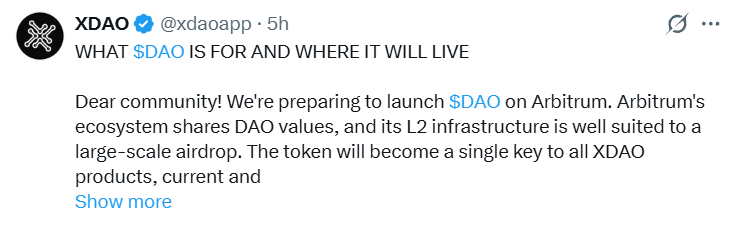
According to the project's official X post, $DAO is moving to Arbitrum. The team picked this network because Arbitrum's community shares XDAO's values, and its Layer 2 setup, a faster, cheaper chain built on top of Ethereum, fits a large-scale airdrop without heavy gas costs.
Source: X Post
The token is not just something to trade. $DAO becomes the single key to every XDAO product, current and future. Holding it unlocks each product's interface, and staking it inside a DAO lowers transaction fees.
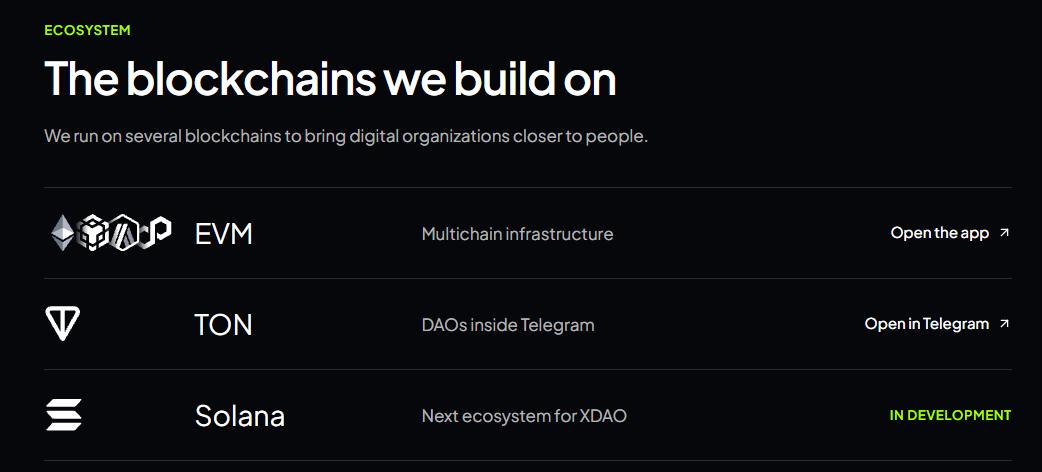
There's more coming too. XDAO ecosystem is building a new product on Solana that brings together AI, blockchain and legal tools. It's meant to let organizations set up legal entities, raise funds in stablecoins, accept payments, and hand out digital assets, all in line with the rules of whichever jurisdiction they choose.
This Solana product only goes live after the Token Generation Event (TGE), short for token generation event, the moment a token officially starts trading.
To connect Arbitrum with other chains, XDAO plans to use LayerZero, a cross-chain messaging tool, to link more EVM (Ethereum Virtual Machine) networks. Once the Solana product ships, part of the $DAO supply moves there too. The official post is clear that these cross-chain transfers will not increase the total supply of $DAO, so the numbers stay fixed no matter how many chains the token touches.
For the airdrop itself, you need an Arbitrum wallet linked to your account. The Airdrop section inside the project's Telegram bot, shows a Bound badge once your address is confirmed, and if you already see that badge, you don't need to link again. Some active community members still have the option open to link a wallet there too.
How the Legacy XDAO Snapshot Decides Your New Token
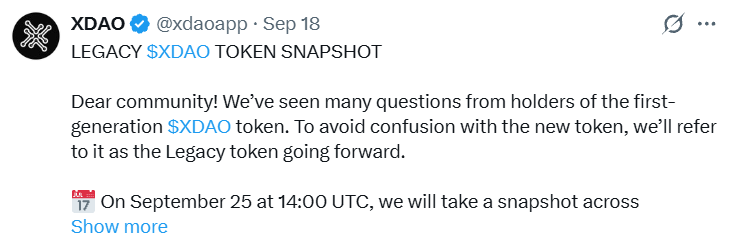
To keep the old coin separate from the new one, the team now calls it the Legacy token. On September 25 at 14:00 UTC, a snapshot was taken across the four networks where Legacy XDAO traded: Ethereum, BNB Chain, Arbitrum and Polygon.
Source: X Account
That single snapshot recorded every wallet holding Legacy tokens and the exact amount sitting in each one. The new TonXDAO, launching on Arbitrum, gets handed out strictly based on this data. In short, whatever you held at that exact moment on September 25 is what counts toward your new allocation, and nothing after that date changes your share.
What Comes After the Solana and AI Roadmap Phase?
Right now, the roadmap has the project sitting in its XDAO on Solana phase, which means the team is building the infrastructure, the technical groundwork like wallets, bridges and tools, that the Solana product needs.
Source: Roadmap Data
Once that phase wraps up, the roadmap moves into blockchain and AI integration. The plan brings AI agents into DAO operations, automated programs that can carry out complex tasks on a DAO's behalf, but only within the rules the DAO itself sets. That's a real jump from today's manual voting and treasury management toward organizations that run a lot more of themselves.
So When Is the Real XDAO Listing Date?
Here's the honest answer: the roadmap has no confirmed XDAO listing date or TGE date. Based on how the remaining phases line up, 2027 looks like the most realistic window, though this is a working estimate and not an official date from the team.
There's a faster path too. If the Solana build and the AI integration phase both land ahead of schedule, the TonXDAO listing date could move up to late 2026. Until the team locks either phase down with a confirmed finish line, treating 2026 as a possible early window and 2027 as the safer estimate is the more balanced way to read where things stand.
Anyone giving you an exact XDAO token listing date right now is guessing, because the project itself hasn't set one.
XDAO Roadmap and Listing Snapshot at a Glance
| Detail | What's confirmed |
|---|---|
| Legacy snapshot date | September 25, 14:00 UTC |
| Networks in snapshot | Ethereum, BNB Chain, Arbitrum, Polygon |
| New XDAO network | Arbitrum |
| Cross-chain tool | LayerZero |
| Next network for XDAO | Solana (after TGE) |
| Current roadmap phase | XDAO on Solana (infrastructure build) |
| Next roadmap phase | Blockchain and AI integration |
| Launch date | Not confirmed; 2027 working estimate, possible late 2026 if milestones land early |
Expert Opinion: Analysts tracking DAO infrastructure tokens see the Arbitrum move and the Solana expansion as a sign the project is building real utility before asking the market to price the token. Tying token access to actual products, staking discounts, legal tooling, and later AI agents, is a stronger base than a token with no clear job.
At the same time, a roadmap with an estimated window instead of a confirmed XDAO listing date carries real risk, since milestones can slip and the AI integration phase depends on work that hasn't started yet. Treating 2027 as the base case and late 2026 as the optimistic case keeps expectations realistic until the team confirms a hard date.
YMYL Disclaimer: This content covers a cryptocurrency project and is for information only, not financial, legal or investment advice. Crypto tokens, including XDAO, carry high risk, and prices, dates and listing plans can change without notice. Always verify details through official channels and do your own research before making any financial decision.









