XMR1 Hyperliquid Crash: Wrapped Monero Token Falls 99% in 35 Minutes

XMR1 Hyperliquid Crash: What Happened on November 20
Crypto news on November 20, 2026 centers on the XMR1 Hyperliquid crash. A wrapped Monero token on Hyperliquid lost about 99% of its value in roughly 35 minutes after a wallet sold part of a 5.2 million token transfer. Native Monero (XMR) kept trading near $470 to $480.
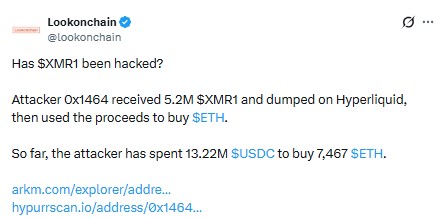
According to Lookonchain, a wallet starting with 0x1464 received 5.2 million of the wrapped tokens and sold it into the order book. Other on-chain reviews say the token’s deployer address sent the tokens in three transactions early on November 20 (UTC).
The wallet then sold roughly 283,000 to 364,000 tokens, depending on the cutoff used. The price fell from about $488 to $500 and down to between $0.90 and $1.
Key figures reported so far
Item | Reported figure |
Tokens moved | About 5.2 million |
Tokens sold | About 283,000 to 364,000 |
Price move | About $488 to $500 down to $0.90 to $1 |
Sale proceeds | About $13.2 million to $13.5 million in USDC |
ETH bought | About 7,300 to 7,467 |
Still unsold | About 4.83 million |
Figures differ slightly by analysis cutoff. Native Monero and the separate XMR perpetual futures were largely unaffected, so the wider crypto market showed little stress.
Where the Roughly $13 Million in USDC Proceeds Went
Sale proceeds came to about $13.2 million to $13.5 million in USDC. Lookonchain’s screenshot shows 13.22 million USDC spent on 7,467 ETH. Bitquery’s on-chain investigation also traces the tokens to the deployer address.
Reports say much of the ETH was bridged onward, including through Arbitrum to Ethereum. About 4.83 million tokens stayed unsold in the receiving wallet when many reports were written. That balance is the open risk, because any further sale would hit the same order book.
Wagyu Founder PerpetualCow Responds: What He Said So Far
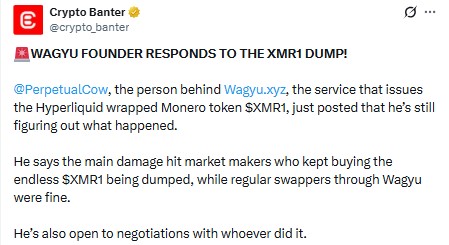
Perpetual Cow, the operator behind Wagyu, posted at about 09:36 UTC on November 20. He said he was not yet sure what happened and would investigate. He said market makers took the main hit because they kept buying the dumped tokens, while swappers lost nothing. He added that he is open to negotiations with whoever did it.
Crypto Banter also covered the news, and its summary matches that post. No technical explanation, full incident report, or formal Wagyu website notice had appeared in the immediate aftermath.
What XMR1 Is and How the Wagyu Bridge Issues It
Wagyu is a no-KYC swap and bridge service focused on Monero and Zcash, according to its site. Users deposit native Monero to receive the wrapped token on Hyperliquid, then redeem it for XMR later, subject to fees and availability.
The site lists a 0% deposit fee and a 2% withdrawal fee with a 0.01 XMR minimum. It also claims more than $1.5 billion in total volume. These are project claims.
The token is an IOU, not native Monero. Its value depends on Wagyu honoring redemptions. Unbacked minting or a compromised key would weaken that claim for remaining holders.
Hyperliquid does not appear to have been compromised as a crypto exchange. The problem sits on the issuer side. The bridge page still showed deposits and withdrawals as available in reporters’ checks.
XMR1 Hyperliquid Crash: Open Questions and What to Check
Several points remain unconfirmed:
The cause: a compromised private key, an insider action, or a bridge minting exploit. The on-chain trails look alike in each case.
Whether Wagyu will publish a full incident report.
What happens to the 4.83 million unsold tokens and the ETH.
Whether redemptions stay open.
Community reaction ranges from hack to rug pull. No source has settled that. Anyone holding the token should check on-chain data and Wagyu’s official channels directly, because secondary reports can lag.
This crypto news update reflects reports as of November 20, 2026. The XMR1 Hyperliquid crash remains fluid. This article is for information only and is not financial advice. Bridged tokens carry issuer risk.
Disclaimer: This article is for educational and informational purposes only and should not be considered financial or investment advice. Always conduct your own research before making investment decisions.






