Zebec Network Ecosystem: Payments, Products and Token Utility

Which Products Power the Zebec Network Ecosystem?
Most people hear Zebec and think of a token. The official site tells a bigger story: a platform for real-time payments that covers salaries, spending cards, staking and tools for developers. The Zebec Network ecosystem is easier to follow once each product has a clear job.
Zebec has built on-chain payment infrastructure since 2021. It started on the Solana blockchain and now supports 150+ tokens across several chains. This guide walks through each part and points back to the official pages.
Key Takeaways
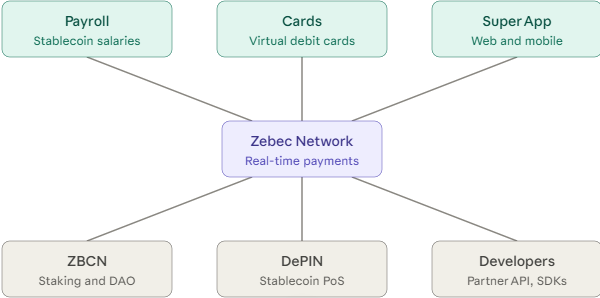
Zebec Payroll pays salaries by the second in stablecoins, and employers can pause or adjust streams.
Zebec Cards turn crypto into Mastercard-powered virtual cards in three tiers.
ZBCN connects the rest through staking, DAO voting and DePIN rewards.
What Is Zebec Network?
Zebec Network is a financial platform that moves money in real time. It offers stablecoin payroll, crypto debit cards and a mobile and web app for earning, spending and staking. The company has built decentralized payment infrastructure since 2021, and the official docs describe its goal as making financial transactions seamless, inclusive and empowering for all.
Source: official website.
What Makes Up the Zebec Ecosystem?
Think of Zebec as a few products that share one base. Payroll and cards cover everyday money. The Super App brings them into one place for users. ZBCN adds staking and voting, and the developer tools let other companies plug in. Each piece has its own page on the official site, and the table below shows where each product lives.
Zebec Network Ecosystem at a Glance
Zebec runs three apps: the Web Super App, the Mobile Super App and Enterprise Payroll. Each product lives in one or more of them.
Product | Web Super App | Mobile Super App | Enterprise Payroll |
Streaming payments | Yes | Yes | No |
Payroll | No | No | Yes |
Silver card | Yes | Yes | Yes |
Carbon card | Yes | Yes | Yes |
How Does Zebec Real-Time Payroll Work?
Normal payroll pays once a month. Zebec streams pay continuously, second by second. An employer opens a stream, and the employee can use what has built up so far.
Employers can open, pause or adjust streams at any time. The site says this is stablecoin payroll without surcharges or extra fees. It also says the encrypted, distributed setup lowers the risk of payroll fraud.
Employees can send pay to a wallet such as Phantom, MetaMask or Ledger. They can also off-ramp to a bank account. For USDC, the site notes it is backed by cash and short-dated US treasuries, and other compliant stablecoins are available.
Enterprise payroll runs through payroll.zebec.io. Zebec says it integrates with top HCM platforms, so teams can use real-time payments without replacing their HR tools.
What Is the Zebec Super App?
The Zebec Super App is the consumer side of the platform. Inside it, Zebec Pay handles salaries, bill payments and budget tracking.
It runs on the web and on iOS and Android. The site still labels it early access. The motto is “Pay. Stream. Stake.”, and those three actions all start here. Zebec calls this mix of payments and finance PayFi.
Zebec Cards: Spending Crypto Like Cash
Zebec Cards are virtual crypto debit cards powered by Mastercard. They work with Apple Pay and Google Pay. The site says they are usable at 60M+ merchants through those wallets, and it advertises acceptance at 100M+ merchants overall.
Card | How it works | Currency | Limits |
Silver | Single load, no fees | USD, EUR, GBP | $1K per card, $10K per day |
Carbon | Reloadable, no transaction fees | USD | Up to $10K per day |
Black | Reloadable | USD, EUR, GBP | No limit |
The Black card is temporarily offline for upgrades. The site expects it to resume in late 2026.
ZBCN Staking and Zebec DAO
ZBCN is the native token, and it does two main jobs.
ZBCN staking happens inside the Super App, on the stake page that the site labels “Stake, earn, grow”. Zebec DAO lives at dao.zebec.io, where holders vote on proposals. That is the DAO governance side of the platform.
DePIN rewards also use ZBCN, as the next section shows. Supply and allocation have their own guide on this blog, so they are left out here.
DePIN: Crypto Payments at the Shop Counter
ZePIN-powered point-of-sale systems accept stablecoin payments in USDC. The site says they are live at selected small and medium businesses in the United States, and it describes the programme as a pilot. People who contribute to ZePIN can earn rewards in ZBCN.
Zebec Partner API and Zebec SDK: Developer Tools
The Zebec Partner API is a B2B interface. Partners can issue Carbon cards, top them up and handle end-user 2FA on behalf of their users. Credentials come from Zebec admin, and a sandbox is available for testing.
The Zebec SDK line-up has three parts: Card Issuance, Streaming (on Solana and Stellar) and Staking. The docs mark all three as coming soon. Installation guides will follow once they are published.
Until then, the Partner API is the live route for developer tools.
Compliance and KYC
Zebec bought Gatenox, a compliance and identity platform. That brought KYC, KYB and AML checks into its own infrastructure. The site also lists a SOC II report from an independent auditor and a public trust center on Vanta.
The Zebec Network ecosystem leans on this because payroll is regulated work. The site adds that its ZAI layer screens for fraud and runs regulatory checks in real time.
What to Check Before You Start
The site gives some headline numbers: $500M in annual payroll volume, 250+ enterprise clients and 50K+ monthly users. These are Zebec’s own figures, so treat them as claims to verify.
Products are not available in every country, and features differ by app. The Black card is offline, and the SDKs are not out yet. Digital assets also carry risk, and you can lose funds.
Final Thoughts
The Zebec Network ecosystem is a set of connected tools: payroll that streams, cards that spend, a token that stakes and votes, and APIs for builders. Start with the Super App, then read the official Payroll, Cards and DePIN pages for current details.
Disclaimer: This article is for information only and is not financial advice. Always do your own research.