What Is DeXe (DEXE)? The DAO Token Posting a Rare Green Candle

How DeXe (DEXE) Works as a DAO Governance Token
What Is DeXe (DEXE)? The DAO Token Posting a Rare Green Candle is a question showing up often in crypto news today, because the DeXe governance token has printed a green candle on its price chart.
DeXe is a DAO project. A DAO, short for decentralized autonomous organization, is a group run on the blockchain where token holders vote on decisions instead of one company making them.
One green candle proves very little on its own. The real question is whether this is a quick bounce or a sign of stronger fundamentals. This article covers how the protocol works, what the token does, how supply is split, and where the risks sit. Market data was checked on November 13, 2026.
What Is DeXe (DEXE) and How Does It Work?
DeXe Protocol is an open-source set of tools for building and running DAOs. The official whitepaper says DEXE holders govern the DeXe Protocol DAO by proposing, voting on, and carrying out decisions.
Other DAOs can build their own governance on the same tools. The project says fees apply only to a few features, such as reward payouts, and those fees go into the DeXe DAO treasury.
The official DAO page describes four groups: holders, experts, validators, and council members. Experts receive delegated tokens and get more voting power. Validators check each vote after it ends. DAO treasury management therefore depends less on large wallets and more on active members.
Key Features of the DeXe Protocol
Token delegation: Holders can hand voting power to an expert and keep their tokens.
Nonlinear voting: The project says its formula reduces the weight of very large holders.
Contributor rewards: Members who propose, vote, and carry out decisions can earn rewards from the treasury.
Expert subDAOs: Experts can form small groups to manage treasury funds together.
Validator checks: Every vote gets a second review before it counts.
Why Is the DEXE Token Posting a Rare Green Candle?
A green candle means the price closed higher than it opened in that time window. That alone says little about strength until trading volume and follow-through are checked. DEXE prices also differ between data sites, so no single price level is treated as confirmed here.
A few reasons could explain the DAO price surge. Fresh attention on roadmap items like DEXE staking may have brought in buyers. Broader altcoin momentum often lifts smaller governance tokens together.
Low liquidity matters too, since small orders can move the price sharply. DeXe market performance has been uneven in recent months, so caution makes sense until buying holds.
What Is the Utility of the DEXE Token?
DEXE is the native governance and utility token of the DeXe Protocol DAO. It exists on Ethereum (ERC-20) and BNB Chain (BEP-20), as listed on the official token page. Anyone asking what is DeXe (DEXE) in practical terms is really asking about these roles:
Governance and voting rights: Holders and delegates vote on proposals that control the protocol and its treasury.
Participation rewards: Active contributors earn rewards for proposing, voting, and carrying out decisions.
Protocol fees: Fees from selected features are collected into the DAO treasury.
Grants and funding: The treasury can pay for research, education, and events when the community approves.
The whitepaper adds that holders can vote on extra uses.
DEXE Tokenomics: Supply, Distribution, and Market Value
Published tokenomics data shows a maximum supply of 100,000,000 DEXE and a total supply of about 96.5 million. The token allocation is split like this:
Pool | Allocation |
Foundation | 36.5% |
Team | 20% |
Partnership and ecosystem | 16% |
Staking rewards | 10% |
Trading school and tournaments | 10% |
Marketing | 5% |
Public sale | 1.5% |
Market liquidity fund | 1% |
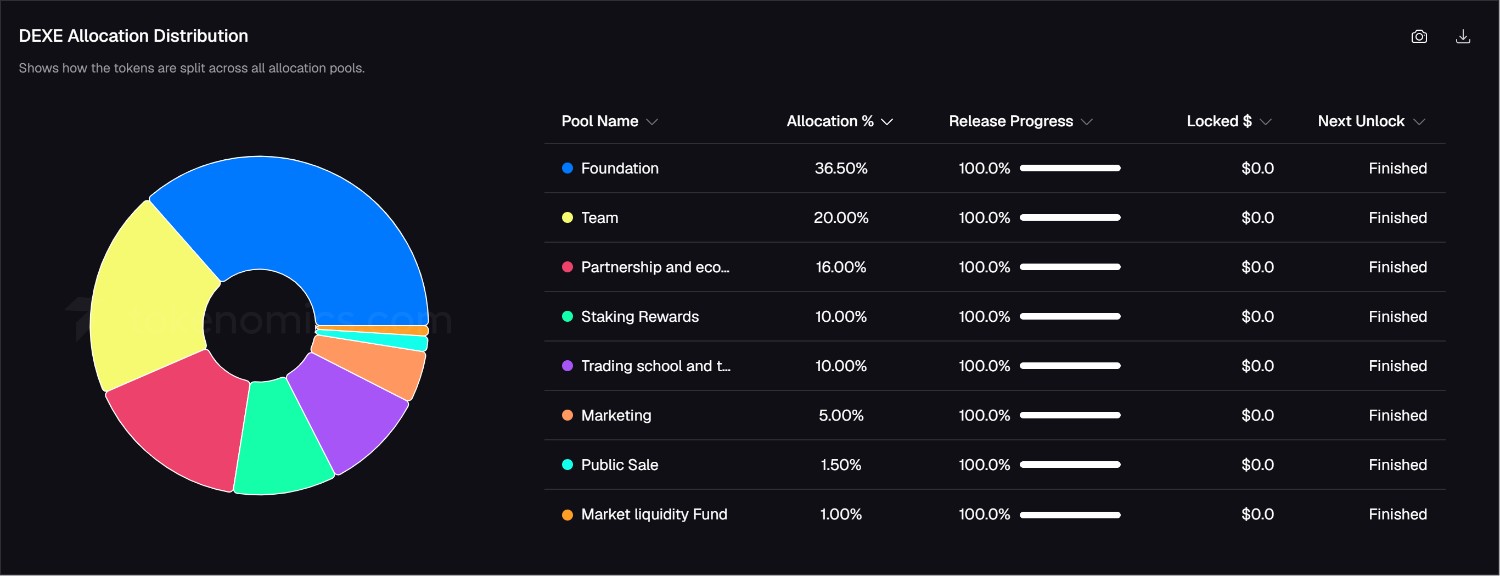
Every pool shows 100% released, so the vesting schedule, which controls when tokens unlock, is finished. The public sale was priced at $1.26 per token and raised about $1.9 million, based on the same data.
With vesting done, no big scheduled unlock remains. But the Foundation and Team pools, 56.5% of supply together, are fully free to move, so wallet activity on the official blockchain explorer is worth watching.
Circulating supply also differs between sites. That changes both market cap (price times circulating supply) and fully diluted valuation (price times maximum supply).
What Makes DeXe Different From Other DAO Projects?
Many DAOs run on one token, one vote, with a low quorum that lets a small group decide outcomes. DeXe tries a different route through expert delegation, nonlinear voting, validator review, and rewards for active members.
The project presents this as a fix for plutocracy, a setup where the richest holders control everything. These are project claims for now. True decentralization depends on how many holders actually vote, and adoption by outside DAOs matters most.
What Does the DeXe Roadmap Say About Growth?
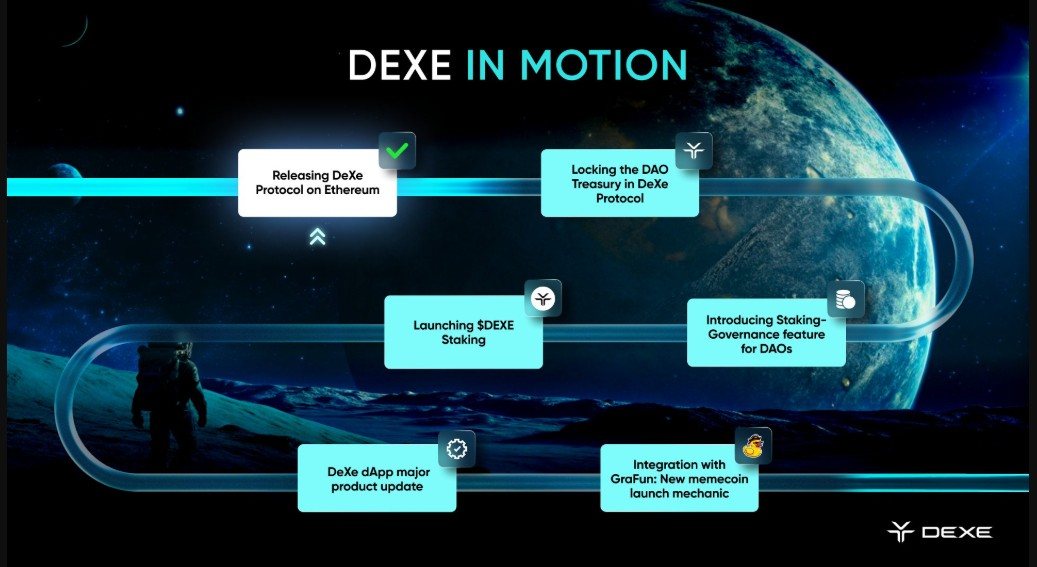
In a post dated January 6, 2025, the project announced the first milestone of a community-approved roadmap. The listed steps are:
Completed: Launch of DeXe Protocol on Ethereum.
Treasury: Locking the DAO treasury.
Staking: Launching DEXE staking.
Governance: Staking-based governance features for DAOs.
Product: Major dApp updates.
Integration: Grafun integration for memecoin launches.
Later steps should be confirmed on official channels.
Can DEXE Maintain Its Green Candle Momentum?
Traders usually treat the latest swing high as resistance and the earlier sideways zone as support. The bullish case needs a daily close above resistance with rising volume, ideally backed by real roadmap progress.
The bearish case starts when volume fades and the price slips under support, which would turn the green candle into a failed bounce. Short-term rallies also bring liquidity risk and sudden reversals.
Is DeXe (DEXE) Worth Watching in 2026?
DeXe has a clear purpose, a documented governance model, and a token with defined uses. Adoption, competition, voter turnout, and smart contract security are still open questions, and an audit lowers risk without guaranteeing safety.
Trying to understand what is DeXe (DEXE) and where it may go is better off checking official documents, treasury activity, and verified liquidity than following one candle.
Conclusion
What Is DeXe (DEXE)? It is a DAO-focused protocol whose token powers governance, rewards, and treasury decisions.
The tokenomics are fully released, and the roadmap is public, yet one green candle does not confirm a lasting bullish trend. Trading volume, roadmap progress, and real DAO adoption are the next things to check.
Disclaimer
This article is for informational purposes only and does not constitute financial advice. Crypto assets are volatile and high risk, so readers should verify data and consult a licensed advisor before making any decision.