Will Zenora Network KYC Rounds Shape the ZNR Price Outlook?

ZNR Outlook Meets a Busy Week of Pairing Deadlines
The project posted its event schedule on Nov 28, 2026, at 2:39 AM IST, and the Zenora Network KYC step sits at the center of it. The official X post lists pairing, selection and burn plans for the day. All times in it use local time, UTC+2.
For forecasts, the post matters because it touches supply. Free places, burns and the coin's value all connect to the same weekly cycle.
What Zenora Network KYC Changes for Node Supply
Members who reach 100 Activity Points in the Zenora app can enter a weekly draw for a free node, according to the node page. Zenora Network KYC follows selection, and unfinished checks cost a place.
Local time | Event in the post |
12:00 | Pairing deadline; unpaired places return to the pool |
14:00 | Week 3 verification closes; Week 4 selection starts |
20:00 | Week 3 nodes go out |
20:00 | Week 4 verification opens, due before Dec 5 at 14:00 |
About half of the 1,000 free nodes are now given, per the post.
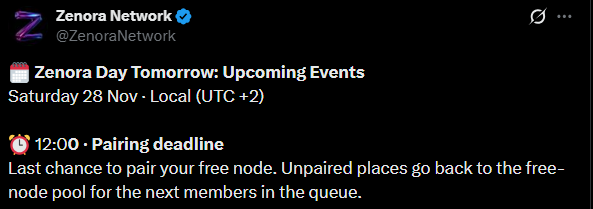
Source: Official X Post
How Rewards and Burns Feed Into ZNR Supply
Several flows touch the fixed one billion cap:
Daily reward: The node page lists 0.5 to 2 ZNR a day per active holder.
Server fee: Only members who clear Zenora Network KYC get the free server, which costs 5 ZNR a month for up to six months.
Contribution Day burn: For each USDT a contributor receives, the same amount is burned, per the post.
Premium places: The tokenomics page says half the coins spent on them are burned.
The server fee tops out at 30 ZNR per holder, which is 5 coins across six months.
The tokenomics page also says rewards begin after mainnet. So the timing of that flow remains unsettled.
Three ZNR Supply Scenarios for the Next Month
The weekly cap of 200 free places means the remaining half takes about three more rounds of Zenora Network KYC checks.
The table assumes the roughly 500 holders given so far are all active, which is an assumption. The burn figures are hypothetical, because the project has published no revenue.
Scenario | Monthly burn | Reward issuance | Net result | Share of 1B |
Light | 10,000 | 7,500 to 30,000 | 2,500 burned to 20,000 added | 0.00025% to 0.002% |
Moderate | 100,000 | 7,500 to 30,000 | 70,000 to 92,500 burned | 0.007% to 0.0093% |
Heavy | 500,000 | 7,500 to 30,000 | 470,000 to 492,500 burned | 0.047% to 0.049% |
Even the heavy case removes under 0.05% of supply in a month. A 1% burn would need 10 million USDT of matched payouts.
Why Supply Alone Is a Weak Driver for the ZNR Price
If total market value stayed flat, each coin's value would rise by about the share burned. The heavy case implies roughly 0.05%.
That is small beside normal swings for a newly listed token. Thin order books are common after a listing, so a few large orders could outweigh it.
So demand decides the outcome. Four items matter most:
Launch timing: The token is not listed, so no market value exists yet.
Premium demand: Pricing arrives in the mainnet prep stage, per the roadmap.
Mining activity: Higher use of the app feeds the weekly queue.
Ecosystem growth: More wallet and app use would widen reasons to hold.
Queue and Verification Risks That Could Cap ZNR
Several points could limit upside in any case:
A second missed Zenora Network KYC window removes a member from the list.
Unpaired free places go back to the queue, so active holders may differ from places given.
The project's P2P policy says the coin has no official price.
The Contribution Day plan carries no stated launch date, so burn volume cannot be dated.
Hardware specifications are described as planning targets before launch.
Final View on ZNR Price Paths Through Mainnet
The schedule shows steady growth in free places and a burn plan tied to payouts. On the numbers above, those flows are too small to set direction alone.
Price paths therefore depend on launch, listing and premium demand. Readers following Zenora Network KYC rounds should watch weekly counts. Until a venue lists the coin, every scenario stays conditional.
Disclaimer: This article is for educational and informational purposes only. It is not financial advice, and the scenarios are not guaranteed price predictions or returns. Crypto assets carry high risk, so readers should do their own research.