Zenora Network Smart Contracts: Tools, Lifecycle and Security

How Zenora Network Smart Contracts Will Work for Developers
Developers ask the same thing about every new chain: where do the contracts go? Zenora Network smart contracts are still a plan, not a product, and the project says so openly. That honesty makes the plan easier to judge. This guide explains what is planned, what is not live yet, and how the tooling is meant to work. The details come from the official website, the whitepaper, and the contracts preview.
Key Takeaways
No contract can be deployed yet, because Zenora's chain has not launched.
The planned lifecycle has four steps: write, test, deploy, and verify.
Verified source, visible upgrade paths, and upfront gas estimates are built into the plan.
What Is Zenora Network?
Zenora Network is an EVM compatible Layer-1 blockchain built with Polygon CDK, an open-source framework already used by production chains. The project is built in the open across five stages, and it starts with a community app that ships before the chain exists.
That app is Zenora Miner, and it is live. Users start a free 8-hour session in the browser and claim their blocks. The whitepaper is clear that this mining is a thematic engagement tool. It does not hash anything or produce blocks. Real block production belongs to validators, which are a separate system. The whitepaper is also a draft pending review, so details can still change.
Source: official website.
What Is ZNR?
ZNR is the network's native token. Its total supply is fixed at 1,000,000,000, with no ongoing issuance beyond the initial allocation. The whitepaper splits it into seven categories and weights 58% toward people who use and secure the network. The site states that ZNR is not yet listed or tradable.
One token covers every job:
Role | What it covers |
Gas fees | Every transaction and contract call |
Validators bond ZNR to secure the chain | |
Governance | Stake-weighted voting on upgrades and parameters |
App premium tier | Optional extras in the community app |
dApp fees | Apps settle their fees in ZNR by default |
Gas matters most for contracts, since every deployment and call is paid for in ZNR.
How Will Smart Contracts Work on Zenora Network?
Zenora runs the Ethereum Virtual Machine, so contracts are EVM bytecode written in Solidity or Vyper. The whitepaper says the existing toolchain should carry over, including Hardhat, Foundry, ethers.js, viem, and OpenZeppelin's audited libraries. Standards like ERC-20, ERC-721, and ERC-1155 apply as they are.
A deployed contract is an account with its own code and storage. It can create other contracts, emit events that apps can read, and hold ZNR like any other account. Two rules keep execution predictable. A contract call either commits all its changes or reverts them all, so no partial state is left behind. And every honest node must reach the same result from the same block.
Wallets such as MetaMask are meant to connect through the standard JSON-RPC interface. Zenora will publish its own chain identifier with the public testnet, which is what stops a transaction from being replayed on another network.
Source: official smart contract page.
Can You Deploy Smart Contracts on Zenora Network Yet?
No. The contracts preview states that there is nowhere to deploy yet because the chain has not launched. No deployable contract, address, or ABI exists. The chain ID, RPC endpoint, block explorer, and contract address all appear as blurred placeholders on the site. They are meant to be revealed with the public testnet. Until then, developers can only study the plan.
Zenora Network Contract Development Lifecycle
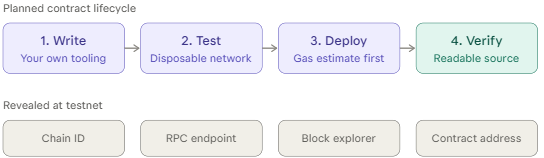
The Zenora smart contract lifecycle has four planned steps.
Step | What happens | Planned support |
Write | A developer authors the contract locally | Standard EVM tooling of choice |
Test | The contract runs against a disposable local network | Local test network |
Deploy | The contract is published | Gas estimate shown first |
Verify | Source is paired with the deployed contract | Verified source for anyone to read |
Zenora Developer Tools
The official whitepaper describes Zenora-specific SDKs as thin layers on top of the standard EVM toolchain. They would cover things like network settings, contract addresses, and helpers for the community app. That means developers do not have to learn a new toolchain. The same section of the whitepaper covers documentation, grants, and a testnet with a faucet. The site's developer menu also lists an API reference, guides, audits, and a bug bounty.
Zenora Gas Cost Estimates Before Deployment
Every operation on the chain is metered in gas, and fees are paid in ZNR. Storage is priced separately from plain computation, because stored data is a cost the network carries long after a transaction ends. A failed transaction still pays for what it used, which stops endless loops from draining validators for free.
The contracts preview says tooling is planned to estimate gas before anything is deployed or called, so there are no surprises afterward. The actual fee schedule and base fee are still being finalized. They are due before the public testnet.
Zenora Verified Source Code Contracts
Deployed contracts are planned to come with verified source by default. That lets anyone read exactly what a contract does instead of trusting its name. For users, this turns a vague promise into something they can check. For developers, it builds trust without a marketing campaign.
Zenora Upgradeable Contracts Explained
Some contracts need to change after launch. Zenora's plan is to make any upgrade path explicit and visible, never a hidden admin key that a user cannot see. This matters because whoever holds an upgrade key can change how a contract behaves. When the upgrade path is visible, users can judge that risk before they interact.
What Is Still Being Decided
Several choices are open. The whitepaper marks each one as being finalized and promises to publish them instead of guessing:
The EVM upgrade level at launch
The fee schedule and base fee
The chain identifier
The consensus and sequencing setup
Block time and finality targets
Security Plan Around Contracts
The whitepaper stages security review across the build. Internal review runs continuously, and structured adversarial testing comes before the Zenora testnet. Independent third-party audits are meant to finish before mainnet, and an open bug bounty begins once mainnet is live. None of that is complete yet.
What Developers Can Do Today
Waiting does not have to mean idling. Developers can read the whitepaper and the contracts preview, and follow the roadmap page for each stage's status. Since the plan relies on standard EVM tooling, existing Solidity skills are expected to carry over. The project also runs community channels on Telegram and X for updates.
Final Thoughts
Zenora Network smart contracts are worth following, but not yet worth building on. Developers can read the plan, watch the roadmap, and wait for the testnet to reveal the chain ID, RPC endpoint, and explorer. Until then, the planned tooling gives a clear picture of how the network wants to treat contract builders: test first, verify openly, and keep upgrades visible.
Disclaimer: This article is for information only and is not financial advice. ZNR is not yet listed or tradable, and the whitepaper is a draft that may change. Check Zenora's official website for the latest details. Last updated: November 2026.