Crypto Inheritance: Can Heirs Really Access Bitcoin Wallets?


What Is the Safest Way to Plan Crypto Inheritance Today?
A wallet can outlive its owner by decades, and the owner's silence can lock every coin inside it for good. Crypto inheritance fails less often because the law is missing than because the law, the keys, and the facts rarely meet in the same place. Heirs can hold a valid will and still face a locked wallet. A friend who knows a seed phrase may have no legal right to use it. Bitcoin passes to heirs only when all three reach the same hands.
Crypto inheritance works only when legal power, wallet access, and knowledge of the holdings arrive together.
Exchange accounts follow court paperwork, self-custody wallets follow whoever holds the keys, and no smart contract can confirm a death without outside data. A written plan with no secrets inside beats any clever tool.
What Does Crypto Inheritance Actually Mean for a Family?
Crypto inheritance is the transfer of digital coins to heirs after the owner dies. It covers both legal ownership and real control of the private keys. Ordinary property needs only the first part, since courts can order banks to pay.
A blockchain has no registry office and no help desk. Coins move only when a valid signature appears, and the network cannot tell a grieving widow from a thief holding the same seed phrase.
That gap turns a legal question into a tech question too, so a simple checklist falls short.
Which Three Keys Decide Whether Heirs Can Access Bitcoin?
CoinGabbar's own analysis splits the problem into three keys. The legal key is the power to act for the estate, proven by a will, a probate grant, or letters of administration.
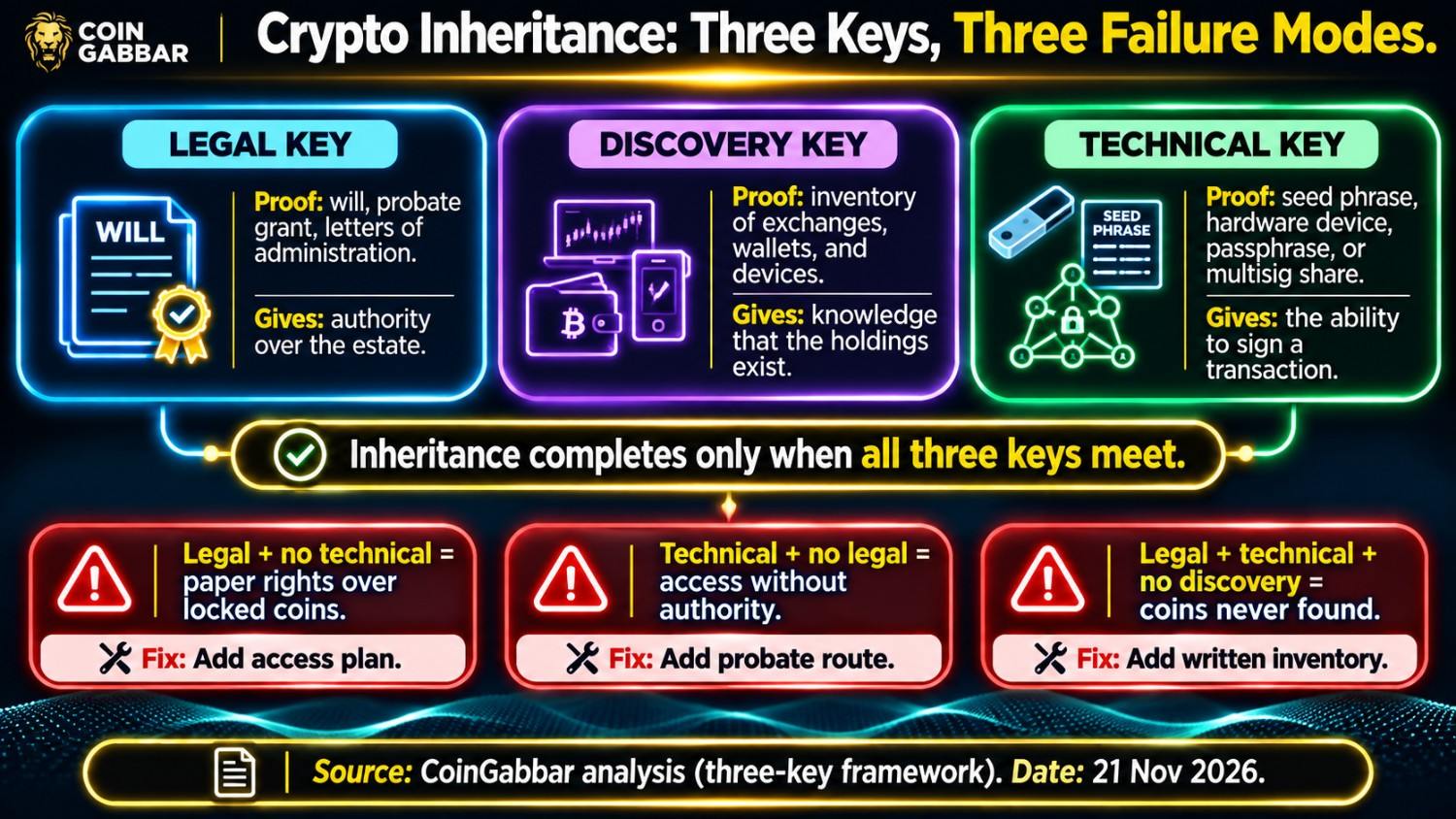
The discovery key is knowing that the coins exist and where the wallets sit. The technical key is the seed phrase or device that can sign a move, as the crypto wallets guide explains.
A missing key causes a different failure, and each failure needs its own fix.
Why Does Legal Entitlement Alone Fail Without Wallet Access?
Heirs with a legal claim but no access hold paper rights over coins that nobody can move.
A person with access but no legal power can move the coins, yet faces claims from the estate and from other heirs.
Heirs with both power and keys may still miss some coins when the owner never wrote down an exchange login or a second wallet. The on-chain analysis guide shows how addresses can sometimes be traced, although tracing never gives control.
How Do Exchange Accounts Differ From Self-Custody Wallets?
Exchange accounts follow the rules of the platform. Coinbase states that it does not let owners name a beneficiary on individual accounts. It asks heirs for a death certificate, probate papers, and a photo ID. Kraken also has no beneficiary option and asks for proof of legal appointment.
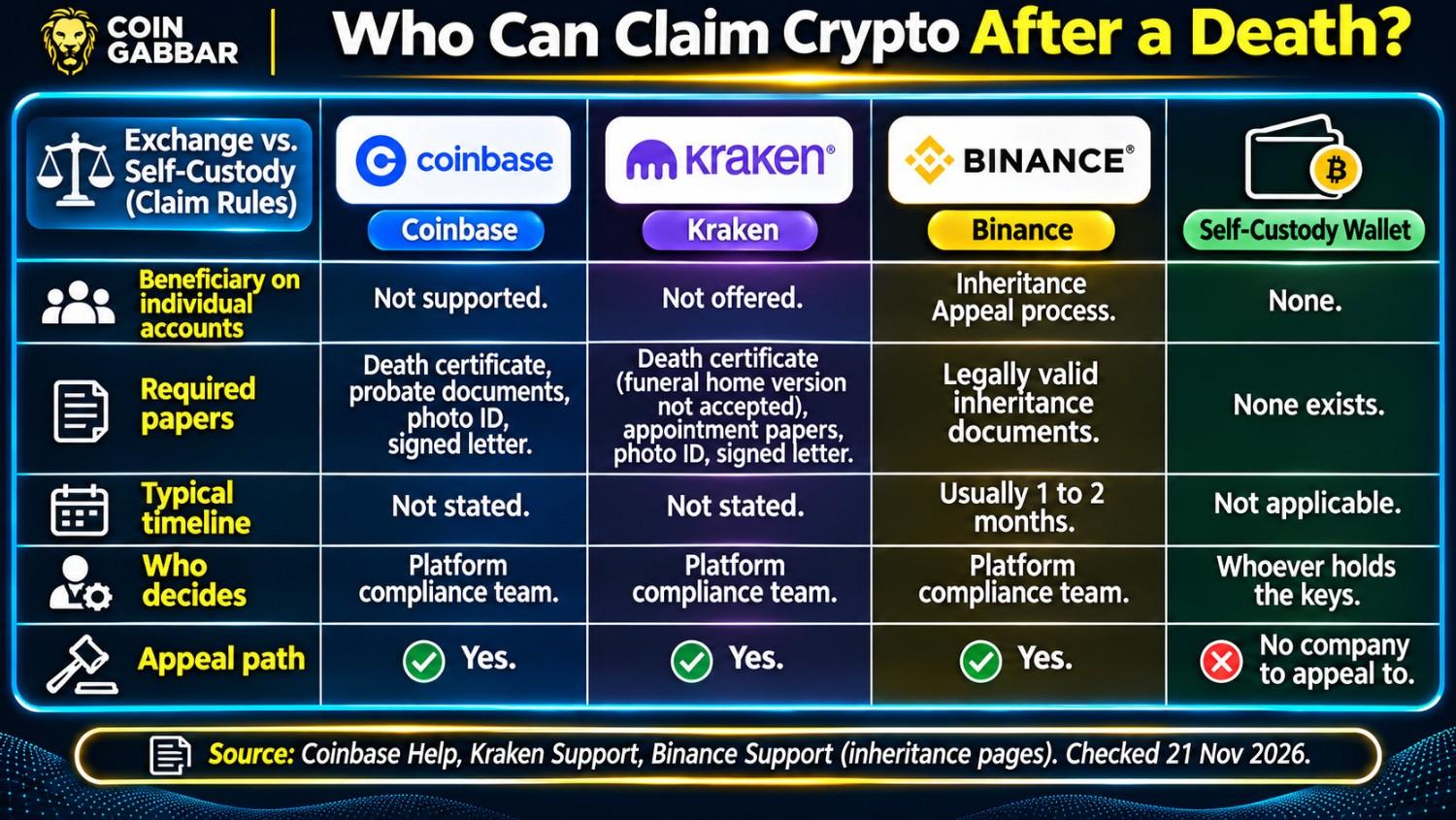
Binance runs an inheritance appeal process that usually takes 1 to 2 months.
A self-custody wallet has no such process. Whoever holds the keys controls the coins, and no company exists to appeal to.
What Did the Quadriga Collapse Reveal About Single-Person Access?
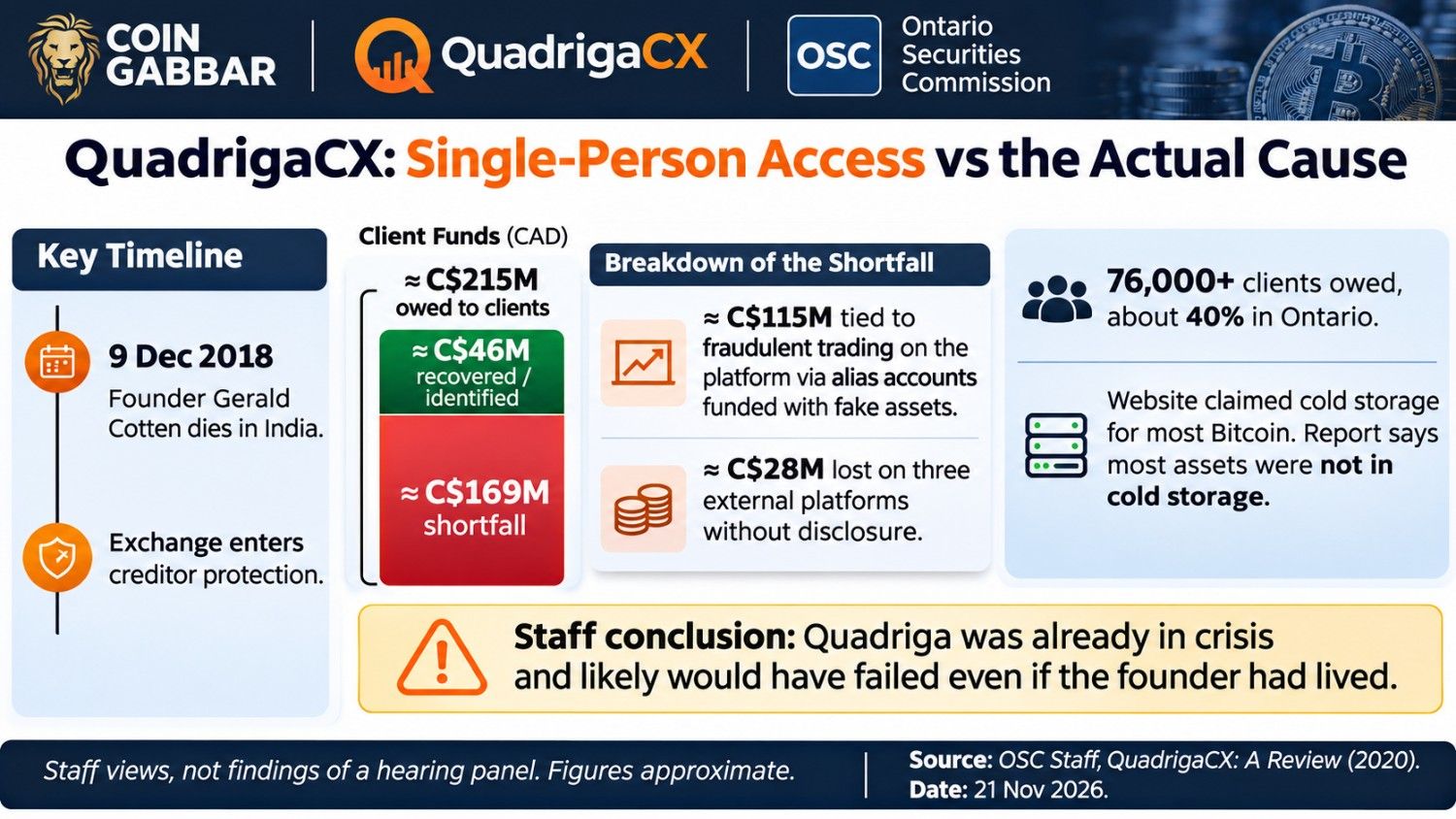
QuadrigaCX is often told as a lost-password story after founder Gerald Cotten died in December 2018. Ontario Securities Commission staff took a different view in a 2020 review.
The report says the exchange would likely have failed even if Cotten had lived. It also notes that these are staff views, not panel findings.
The smaller lesson still holds, since a single person with sole access is a single point of failure.
Which Legal Frameworks Now Cover Digital Assets After Death?
In England, Wales, and Northern Ireland, the Property (Digital Assets etc) Act 2025 became law on 2 December 2025. It says a digital thing is not barred from being personal property just because it fits no older class.
In the United States, a model law approved in 2015 ranks online-tool choices first, then estate papers, then terms of service.
In India, the Succession Act 1925 sets the general rules. CoinGabbar's review found no law written only for crypto inheritance.
Can a Smart Contract Know Whether the Owner Has Died?
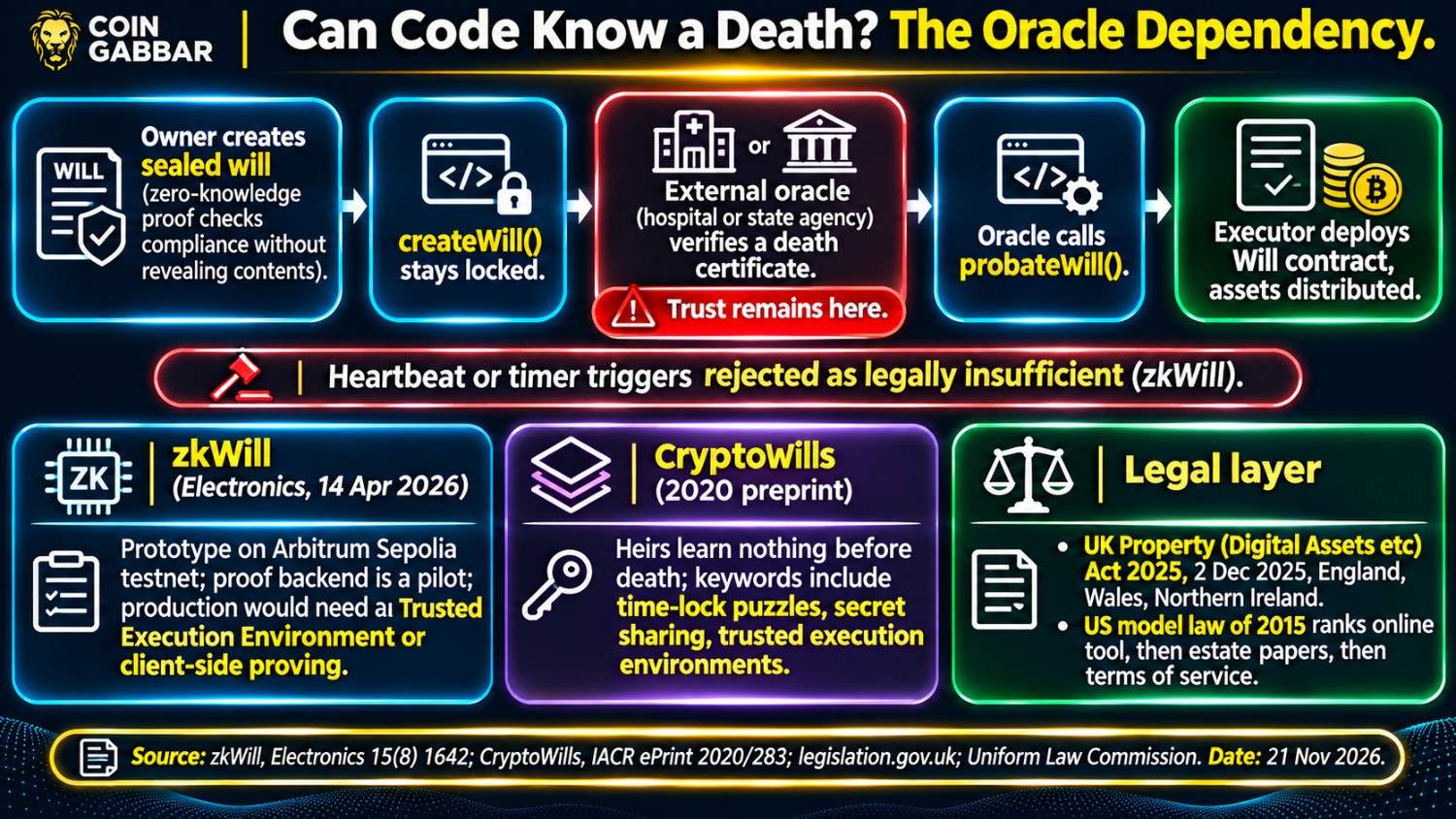
No, because a contract sees only on-chain data, so news of a death must come from outside. The zkWill paper, published in April 2026, relies on an outside oracle, such as a hospital or state agency, to check a death certificate.
That design cuts trust in the executor but keeps trust in the oracle, and the prototype runs only on a test network. The same oracle problem hits lending apps that use price feeds.
A missed check-in is not proof of death, so timer triggers fail in a different way.
Which Technical Setups Reduce Single-Point Access Risk?
Multisig splits signing power across several keys, so no single lost key stops the estate. A time lock can release funds after a delay unless the owner resets the clock.
CryptoWills, a 2020 paper by Seres, Shlomovits, and Tiwari, sets out schemes in which heirs learn nothing about a gift before death.
Each tool trades ease for risk, and none replaces a valid legal paper.
What Should an Estate Plan Record Without Exposing Secrets?
A digital file is not always a valid will. A 2018 Harvard Law Review chapter sorts electronic wills into three types: offline, online, and qualified custodian.
A sound plan notes that the coins exist, the type of wallet, and where recovery items are kept. It never lists the seed phrase itself, since a will can become public through probate in many places.
Recovery scams can target grieving families, so the AI crypto scams coverage applies here too.
What Does the CoinGabbar Expert Opinion Say About Estate Risk?
CoinGabbar analysis suggests that the discovery key is the weakest of the three in crypto inheritance, because heirs cannot recover what nobody wrote down.
The basis is the three failure modes above, the exchange rules reviewed, and the 2026 zkWill design, which still needs an outside oracle.
Disclaimer: This article is educational and is not financial, legal, or tax advice. Crypto assets carry risk and volatility, and no outcome is promised or assured.