Best Robinhood Chain APIs: 6 Tools for Blockchain Developers

Which Robinhood Chain APIs Are Best for Data and Transactions?
Tokenized stocks are moving onto blockchains, and Robinhood Chain is one of the places where that is happening. Anyone building a wallet, tracker, or dashboard on it needs data. That is where APIs come in.
The phrase "Robinhood Chain APIs" is vague, though. It can mean a node, an explorer, an indexer, or a data service. Robinhood Chain is an Ethereum Layer 2 built on the Arbitrum Orbit stack, so teams already working with an Ethereum API will find the setup familiar. It launched its public mainnet on July 1, 2026, uses ETH for gas, and has chain ID 4663. This guide lists six options, explains what each does well, and shows how to match a tool to a project.
Key Takeaways
-
CoinStats API is the best fit for market, wallet, and portfolio data, with a free tier.
-
RPC providers like Alchemy and QuickNode handle sending transactions and reading raw chain state.
-
Indexers like Bitquery and Goldsky cover chain-wide trades and raw events, while crypto wallet APIs track individual addresses.
Why does the choice matter so much? Because Robinhood Chain deals with tokenized stocks and ETFs, where prices, balances, and timing all count. A wrong data source can show stale numbers, miss a transfer, or leave out the USD values that users expect to see. Cost is another factor. Some tools charge by request, some by credit, and some are free up to a limit. Picking the right type early keeps the build simple and the bills predictable. The sections below follow the same order as the table, so readers can jump straight to the one that fits.
Best Robinhood Chain APIs
Here is the full list at a glance. Each one is explained below the table.
| # | API | Type | Best for |
| 1 | CoinStats API | Data API | Market, wallet, and portfolio data |
| 2 | Alchemy | RPC and Data | Production reads and writes |
| 3 | QuickNode | RPC | Fast endpoints and WebSocket streaming |
| 4 | Blockscout API | Explorer | Single lookups and light apps |
| 5 | Bitquery | Indexer | Trades, events, and custom datasets |
| 6 | Goldsky | Indexer | Custom data pipelines |
1. CoinStats API
CoinStats is a crypto API for market, wallet, and portfolio data. A developer sends an address and gets priced balances, history, and P&L in JSON. One key covers 120+ chains, so a multi-chain product needs a single integration.
Here is what it offers:
-
Market data: live USD price, market cap, and volume for 1,800+ Robinhood Chain tokens. That includes 200+ Stock Tokens such as NVDA, SPY, and GOOGL.
-
Wallet balances: one call returns ETH, Stock Tokens, USDG, and other ERC-20s with live prices.
-
History and P&L: every transfer carries its USD value at the time. Realized and unrealized P&L are included.
-
Portfolio analytics: total value, allocation, and performance in one view.
-
Prediction markets: the same key reads Polymarket and Kalshi markets.
-
AI agents: an MCP server gives Claude, Cursor, and other agents 20+ wallet and portfolio tools.
-
Free tier: 20,000 credits a month at 2 requests per second, with no credit card. Starter is $49 a month for 1M credits.
CoinStats’ Robinhood chain API is built for reading and pricing data. For sending transactions, teams pair it with an RPC provider below.
Best for: market prices apps, portfolio trackers, Stock Token dashboards, wallets, tax tools, and AI agents.
2. Alchemy
Robinhood's own documentation names Alchemy as a production RPC provider. Alchemy also offers Prices, Token, and Transfers APIs on the chain. That mix makes it a good pick for teams that need to send transactions and read raw state, with limits well above the public endpoint.
Best for: dApps that need reliable RPC plus extra data tools.
3. QuickNode
QuickNode runs dedicated Robinhood Chain endpoints with RPC and WebSocket URLs. It claims a 99.99% uptime SLA and support for more than 80 chains. Those numbers come from QuickNode's own guide, so treat them as vendor claims. Setup is quick. A team creates an account, adds a Robinhood Chain endpoint, and pastes the URLs into Hardhat, Foundry, or a wallet.
Best for: latency-sensitive apps, bots, and event-driven systems.
4. Blockscout API
The chain's block explorer lives at robinhoodchain.blockscout.com, and Blockscout also offers an API. It works well for one-off checks on an address, token, or transaction. Its main strength is that anyone can look at the same data in a browser. It is not built for portfolio math, so USD values and P&L come from a data API like CoinStats.
Best for: prototypes and simple lookups.
5. Bitquery
Bitquery is an indexer for Robinhood Chain trades, events, and custom datasets. It adds a chain-wide view, such as a feed of every DEX trade. Teams building charts, alerts, or research tools often need that wider view, since a single wallet lookup cannot show market-wide activity.
Best for: analytics dashboards and trading research.
6. Goldsky
Goldsky also works as an indexer, and Robinhood Chain provider guides list it alongside the RPC names covered earlier. Teams pick it when they want to design their own data pipelines rather than plug into a ready-made endpoint. Control is the upside, since the team decides exactly what gets indexed. Effort is the cost, because a custom pipeline needs more setup and ongoing care than a hosted data API.
Best for: custom indexing and data engineering.
How to Choose
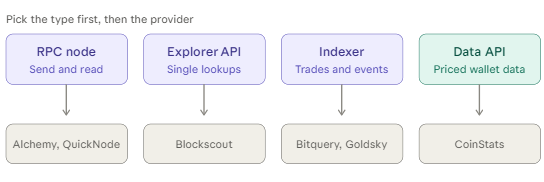
A developer should start with the question the product needs to answer, not with a brand name. A wallet app that shows balances in dollars has different needs from a bot that sends transactions.
-
Market data, balances, history, and P&L in USD. CoinStats API covers all of it with one key.
-
Sending transactions or reading raw chain state. An RPC provider like Alchemy or QuickNode is the right choice.
-
Every trade or event on the chain. An indexer like Bitquery or Goldsky fits best.
-
A quick check on one address or transaction. Blockscout is enough.
Most real projects end up using two tools. An RPC handles the writes, and a data API like CoinStats API handles the reads. A team can begin with the free tiers, test them against its own use case, and pay for more only when the limits start to matter. Teams that also support Solana can look at the Solana API as well.
Things to Know Before Building
The public RPC at rpc.mainnet.chain.robinhood.com is free but rate limited, so it fits testing better than live traffic. Any serious Robinhood Chain setup should move to a dedicated blockchain API provider before launch.
The chain also depends on one sequencer run by Robinhood for now, which matters for critical apps. Stock Tokens are not offered to U.S. persons, so any product that shows them needs regional limits.
Disclaimer: This article is for information only and is not investment advice. Features, pricing, and limits change, so check each provider's website before building.