Blockchain Software Monoculture: One Bug, Thousands of Validators


What Is Blockchain Software Monoculture, and Why Does It Matter?
A blockchain can have thousands of validators in dozens of countries. It can still carry one hidden weak point. That weak point is software. Blockchain software monoculture means many separate machines run the same code. One defect can then reach every machine at once. No hacker is needed. No private key has to leak. One flaw, hit by the wrong message, can slow a network or stop it from settling transactions.
Past outages, like those in the blockchain network outage guide, often trace back to one shared weak spot. This article looks at where that spot sits, what the evidence says, and what can cut the risk.
Node count measures size, not independence. When many nodes run one client, a shared bug can pull voting turnout below the two-thirds line that finality needs.
Ethereum's May 2023 incidents showed this. More client variety, rewards for minority clients, and split validator keys can cut the risk. Each adds cost.
What Is Blockchain Software Monoculture, and Why Does It Matter?
Blockchain software monoculture is a condition where most validators in a network run the same client software or share the same code base. A defect in that code can then hit many nodes together. An ordinary bug becomes a network-wide risk.
The idea comes from engineering, not crypto. Farms, power grids, and aircraft systems face the same problem. Identical parts tend to fail in identical ways. Engineers call this common-mode failure.
A validator is an ordinary computer. A client is the program that lets it follow the chain's rules. Different teams write different clients for the same rules. How many of those clients are in real use is the key question.
Why Does a High Validator Count Hide Real Failure Risk?
Node counts and stake spread are the usual decentralization scores. Neither says how many nodes would fail the same way. Blockchain software monoculture is the gap between those scores and real independence. A network of 10,000 nodes can be one failure zone or four.
Scenario | Client split of 10,000 validators | Largest share | Effective independent clients | If the largest client fails |
A: diverse | 2,500 on each of 4 clients | 25% | 4.0 | 75% still online; finality holds. |
B: mmonocultureonoculture | 8,000 on one client, 2,000 on another | 80% | 1.5 | 20% online, finality stalls |
Illustrative scenario with round numbers, not real validator data. Effective independent clients are CoinGabbar's own calculation: one divided by the sum of squared client shares.
The measure treats uneven shares fairly. Ten clients on paper can act like three if two of those hold most of the stake.
What Kinds of Software Failure Can Stall a Blockchain?
Not every bug can halt a network. Four patterns matter most:
Shared bug: nodes on one client hit the same flaw, then crash or process blocks wrongly.
Consensus disagreement: two clients read one rule differently and back different chains.
Loss of finality: blocks keep coming, but too few nodes vote to make the blocks final.
Cascading failure: one fault spreads to exchanges, wallets, and data services that rely on the chain.
Blockchain software monoculture raises the odds of the first pattern. A finality stall isn't a full outage. Users may still see transfers land, while apps that wait for finality pause deposits. The Solana network outage review shows how a harder stop plays out. On Ethereum, a long stall starts the inactivity leak. It slowly cuts the stake of offline validators.
What Happened in the May 2023 Ethereum Finality Incidents?
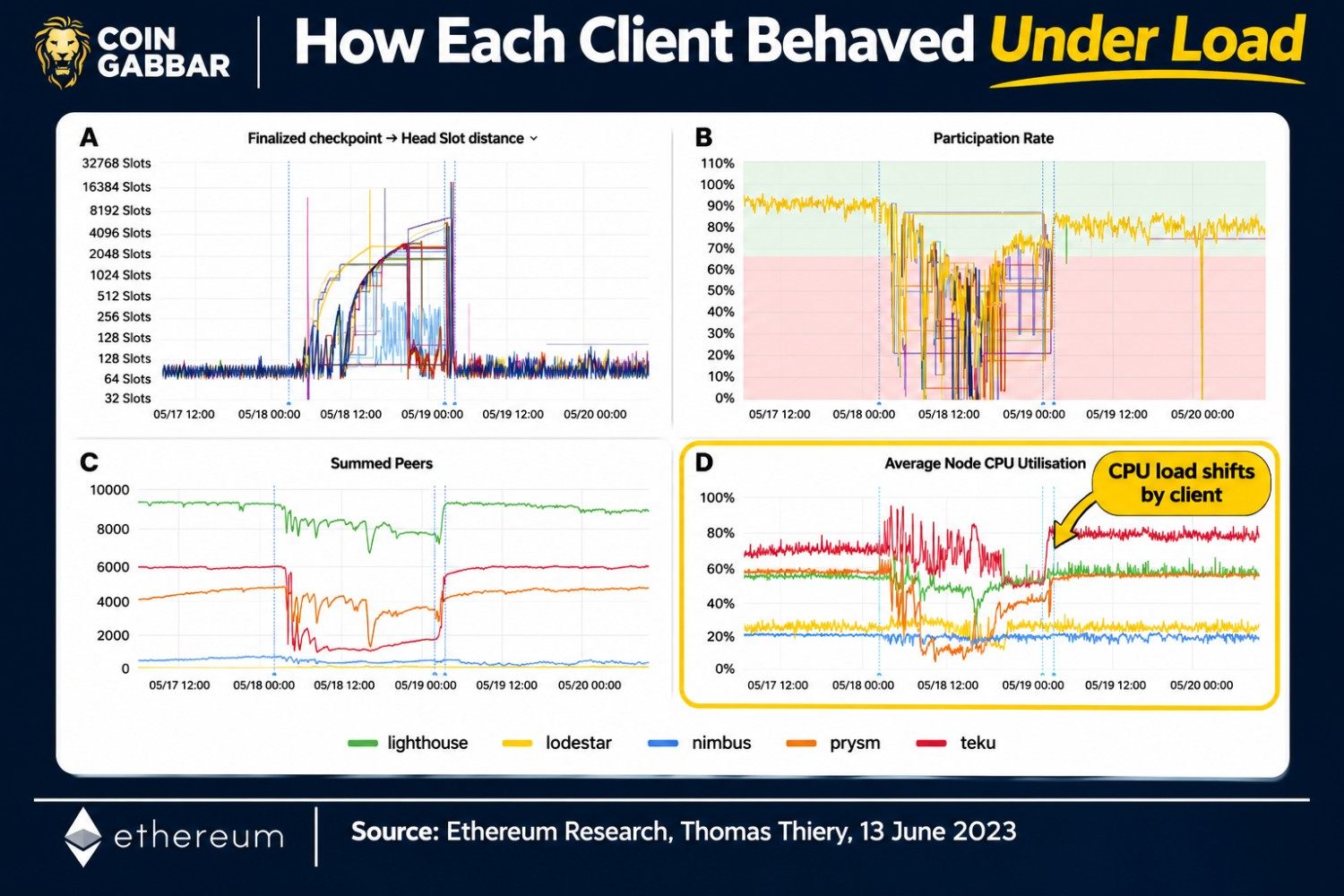
Ethereum's finality stalled twice in two days. Thomas Thiery's June 2023 Ethereum Research analysis timed both stalls. It traced the stalls to how Prysm and Teku handled votes that were valid but pointed to older epochs.
Episode | Time (UTC) | Epochs | Lowest participation | Median missed slots per epoch |
First | 11 May 2023, 20:13 to 20:38 | 200552 to 200555 | 40.9% | 10.5 of 32 (33%) |
Second | 12 May 2023, 17:20 to 18:24 | 200750 to 200759 | 30.7% | 15.5 of 32 (48%) |
Checking those votes forced clients to rebuild old states. That drained CPU and cache, and nodes missed duties. Blocks kept coming, but finality lagged. Fixes landed in Prysm 4.0.4 and Teku 23.5.0.
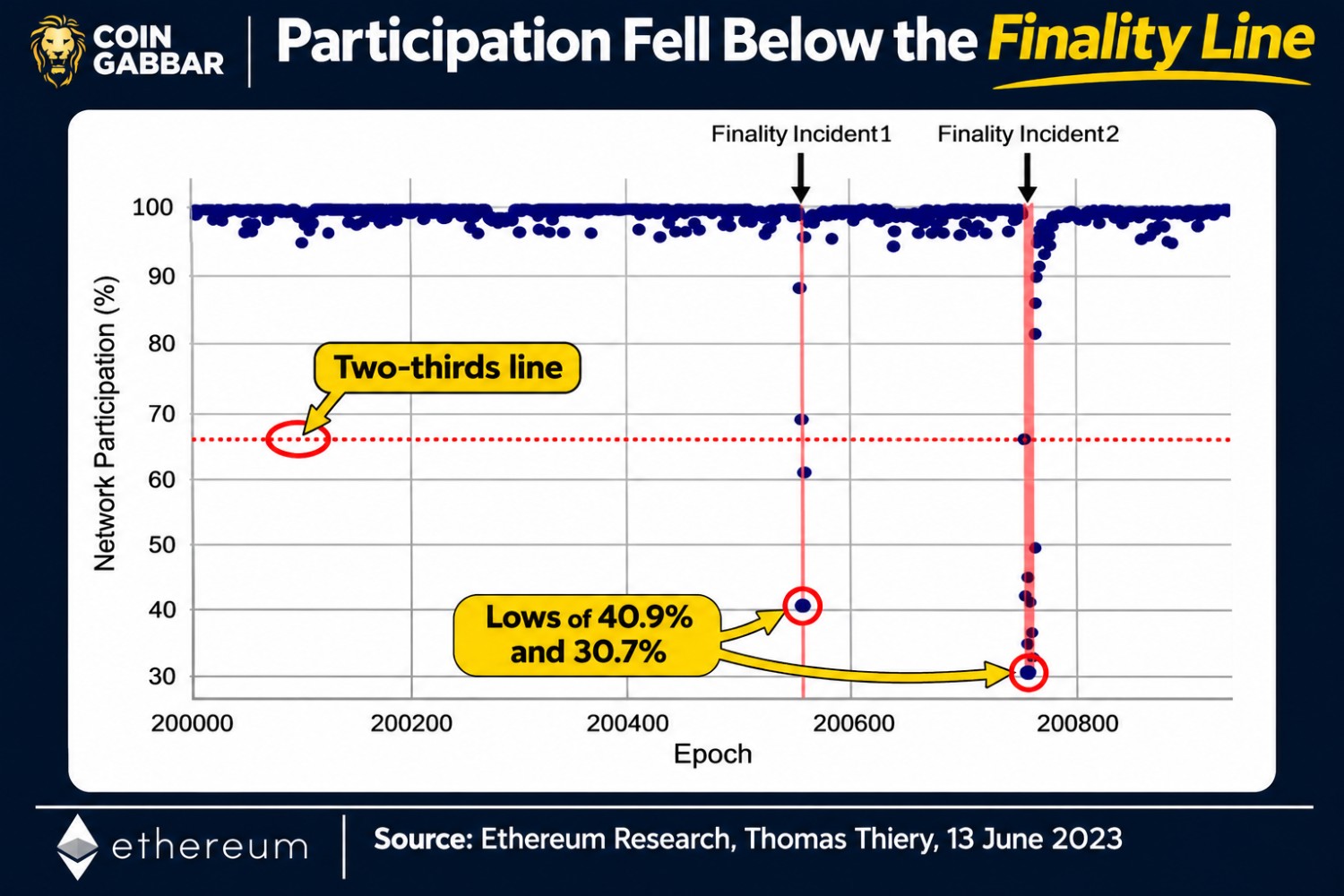
The cause was client logic, not a hack. Enough nodes ran those clients to pull turnout below the line.
Did a Similar Client Bug Hit Ethereum After the Fusaka Upgrade?
A preliminary post-Fusaka summary on Ethereum's public notes site describes a related episode. It followed the December 2025 upgrade. Prysm nodes halted when stale votes triggered the building of older states.
The note puts the vote rate at about 97% before the problem. It fell to about 77%, then recovered to about 96%. Affected operators restarted nodes with a config flag. The note also says the drop roughly matched the share of Prysm nodes on the network.
That episode fits the blockchain software monoculture pattern, though the note is preliminary. It gives no exact Prysm share. CoinGabbar analysis suggests the cause resembles 2023, but a final post-mortem should confirm it.
How Concentrated Were Ethereum Client Shares in October 2025?
The client diversity page on ethereum.org lists an October 2025 snapshot built from public estimates. Estimates vary by method, and the page warns that data can lag.
Layer | Largest client | Share | Effective independent clients | Clients listed |
Consensus | Lighthouse | 42.7% | 3.3 | 6 |
Execution | Geth | 41.0% | 2.9 | 5 |
The page treats 33% as the level where a consensus-client bug can stop finality. By that reading, Lighthouse sat above the line. Geth sat below the 66% level where a faulty one's could finalize a wrong chain. It was still above the 33% goal for execution clients.
The snapshot gives a rough read on blockchain software monoculture at the client level. A year-old snapshot needs a live check before anyone relies on it.
Are Separate Client Teams Really Independent of Each Other?
Separate code bases don't ensure separate failure modes. Clients follow one specification. A flaw in the rule itself, or a shared reading of it, can reach everyone.
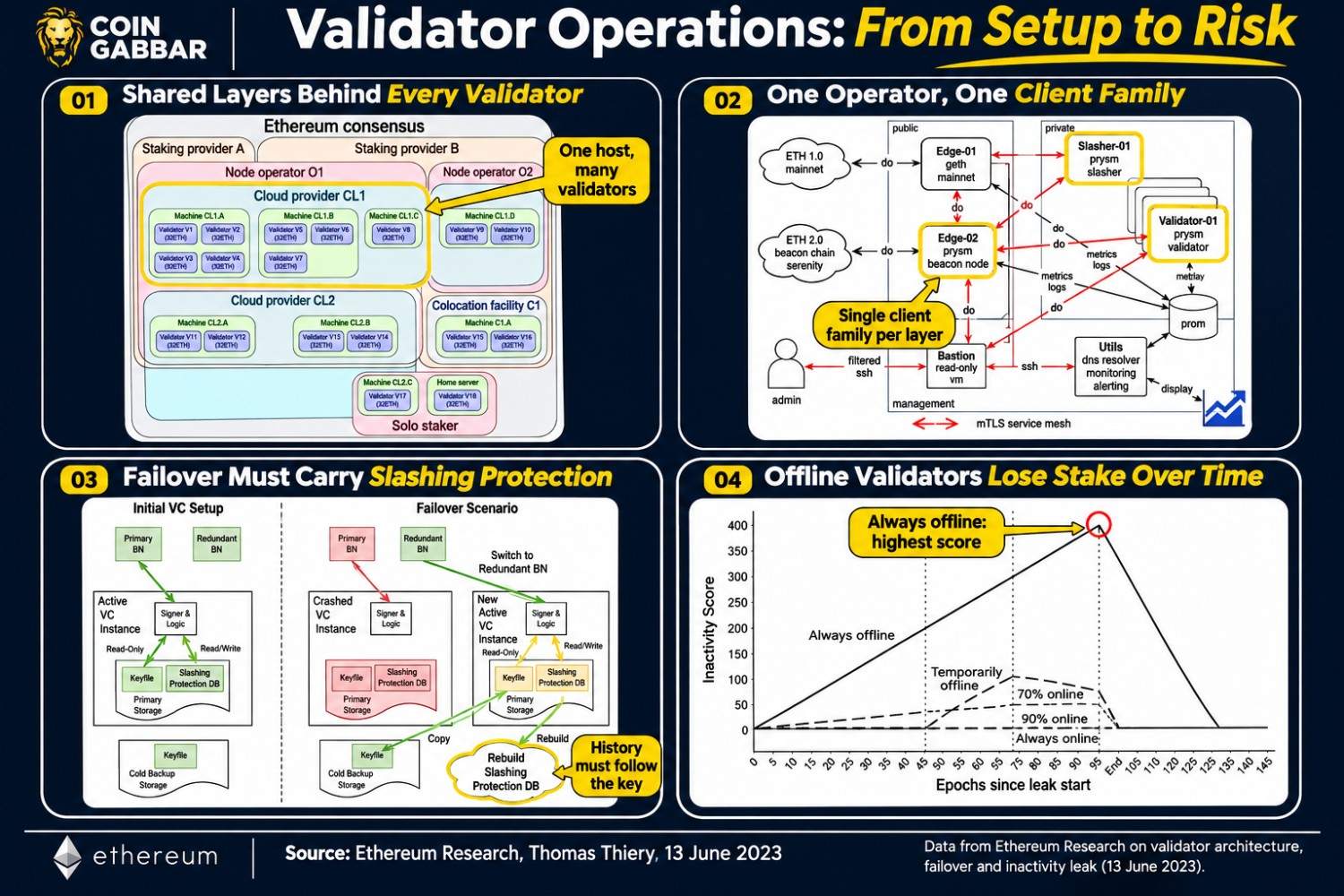
Hosting adds another layer. Nodes can sit with the same cloud host, staking firm or operator. The dependency diagram below shows how those layers stack. Blockchain software monoculture can hide in those layers too.
Solana's Firedancer project adds a second validator client. The Firedancer upgrade explainer covers the details.
What Can Reduce Blockchain Software Monoculture Risk?
Three approaches stand out. The first is paying for variety. A diversity reward research paper proposes rewards for nodes that run minority clients. Its authors are Javier Ron, Zheyuan He, and Martin Monperrus. Proofs would show which software ran. A prototype modified the Lighthouse client.
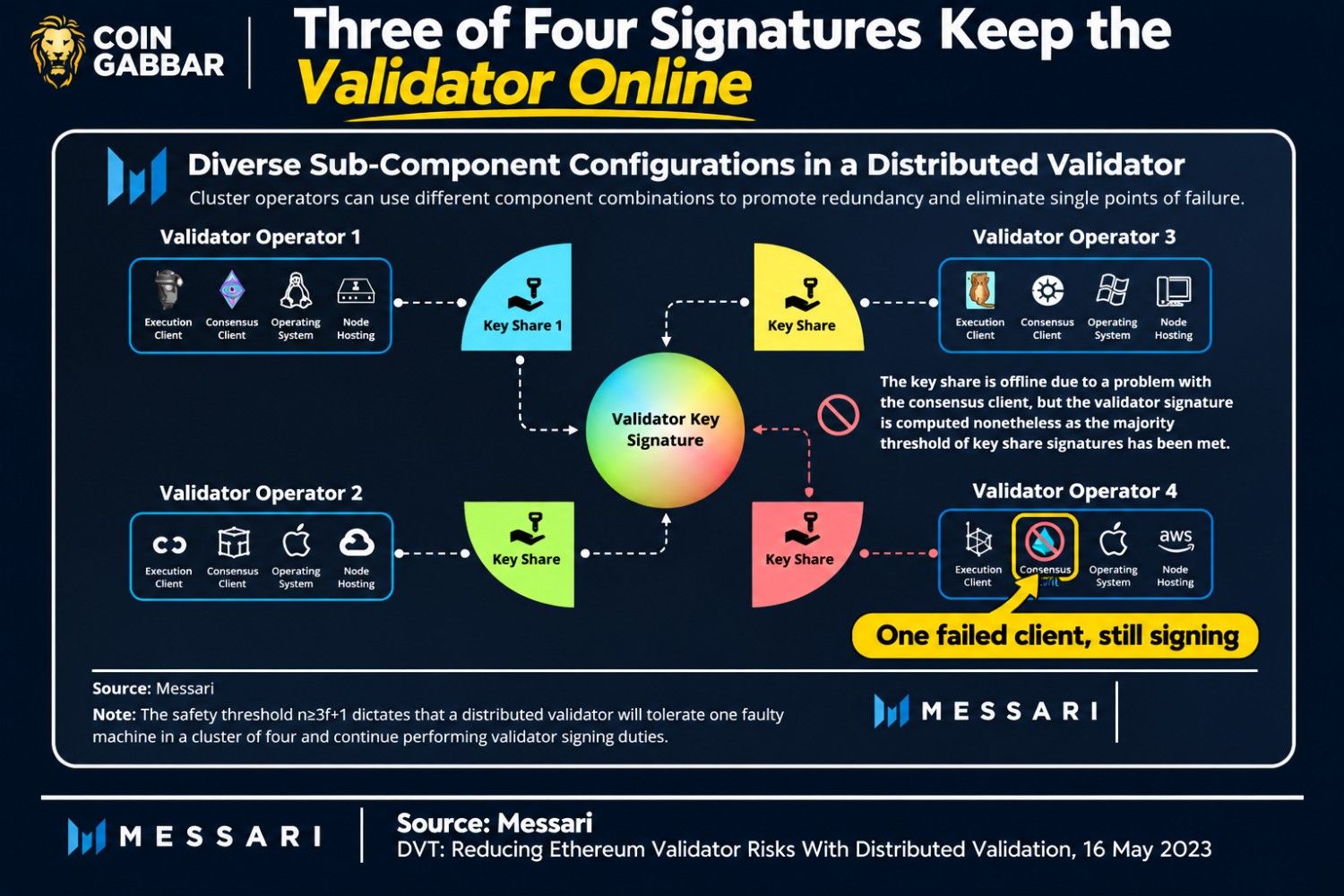
The second is split validator keys. A key is shared across several machines. A threshold of signatures is enough to sign. In Messari's four-operator example, three signatures suffice. One machine with a failed consensus client doesn't stop the validator.
The third is careful operations. A staker can mix clients across machines. Failover must also keep the slashing-protection history, or a validator risks signing twice. Every option adds testing and upgrade work.
What Does CoinGabbar Expert Analysis Say About This Risk?
CoinGabbar analysis suggests that blockchain software monoculture should be scored like any other concentration risk. Node count is a size metric, not a safety metric. A fairer scorecard would track four checks:
Largest client share against the 33% line.
Effective independent clients across code, hosting, and operators.
Overlap in cloud, staking provider, and operator.
Incident history, including how fast patches landed.
The 2023 and 2025 episodes recovered without lasting chain damage. The evidence shows a risk that played out briefly, not a collapse. A wider record of halts sits in the 2026 blockchain outage list.
What Do the Key Terms Around Software Monoculture Mean?
Client: the program a node runs to follow a blockchain's rules.
Finality: the point where a block can't be reversed without large penalties.
Participation rate: the share of validators casting valid votes in an epoch.
Attestation: a validator's signed vote on the chain's state.
Common-mode failure: several parts failing together for one shared reason, also called correlated failure.
Distributed validator: one validator run by a cluster of machines.
Slashing: a penalty for provably breaking protocol rules.
Disclaimer: This article is for information only and isn't financial, investment, or legal advice. Crypto assets are volatile and can lose value, and no outcome is certain. Readers should verify figures against the cited primary sources before acting.