BIT Group Techtanium MOU Aims to Advance Tokenized Assets

BIT Group Techtanium MOU Announced on X: What We Know
The latest crypto news has a Singapore angle. The BIT Group Techtanium MOU was announced on November 2, 2026. The two companies signed a strategic memorandum of understanding to advance tokenized assets and institutional digital finance.
The stated goal is to bridge traditional banking and digital asset markets.
The news first appeared in an official post by BIT Official on X. BIT also shared it on its LinkedIn page.
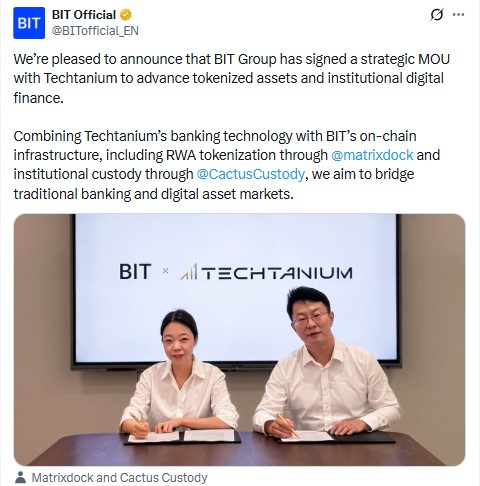
The post tags the group’s two infrastructure units, Matrixdock and Cactus Custody. Its photo shows two representatives signing documents with joint branding behind them. No formal press release had appeared at the time of writing.
Who Is Behind the Deal and What Each Side Brings
The group was formerly known as Matrixport. It was founded in 2019 and is headquartered in Singapore. Its official materials describe a digital asset financial infrastructure group. Services include custody, trading, wealth management, financing, and RWA tokenization.
Those materials also list regulated entities in Singapore, Hong Kong, Switzerland, the UK, and the US.
Techtanium is a Singapore-based fintech firm that helps traditional financial institutions modernize. Its website lists digital core banking, open banking, payments, wealth platforms, and account systems that support both fiat and crypto.
How Matrixdock and Cactus Custody Fit the Plan
Matrixdock is the group’s RWA tokenization platform. It issues XAUm, a tokenized gold product backed 1:1 by LBMA Good Delivery physical gold, and XAGm, a tokenized silver product. According to official materials, both carry independent audits and physical redemption options.
Cactus Custody handles institutional custody. Its services include segregated accounts, cold and warm storage, and DeFi access across several jurisdictions, including a recent Swiss launch.
Party | Role in the plan |
Techtanium | Banking technology |
Matrixdock | RWA tokenization |
Cactus Custody | Institutional custody |
What the Agreement Aims to Change for Traditional Banks
The firm positions itself as a bridge between Web2 banking and Web3. It says its modular, cloud-native tools extend existing bank systems into on-chain finance without a full core replacement.
Under the BIT Group Techtanium MOU, that approach would meet the group’s on-chain tools. If the plan moves ahead, it could mean:
Banks could offer or connect tokenized assets more easily.
Traditional payment and account rails could link to digital asset markets.
Institutional use cases could follow compliance-ready frameworks.
The companies have not published technical details, pricing, or a launch date.
No Binding Terms Yet: What to Watch After the MOU
An MOU is a non-binding framework that signals intent to cooperate. Products, commercial terms, and timelines usually come in later definitive agreements.
Neither company has shared those details yet. So this remains an early-stage plan, not a live product.
Digital asset products also carry regulatory and operational risks that vary by jurisdiction. Further statements may follow on the official press room and social channels of both companies.
The BIT Group Techtanium MOU shows banking technology and on-chain infrastructure starting to meet. Whether it produces real products depends on the next agreements. More crypto news updates will follow as details emerge.
Disclaimer: This article is for educational and informational purposes only and should not be considered financial or investment advice. Always conduct your own research before making investment decisions.






