Zenora Network Issues Urgent Warning: What Should Users Know?


Why Did Zenora Network Issue an Urgent Warning Now?
Zenora Network has issued an urgent notice about impersonators, fake links and unofficial groups. The Layer-1 project shared the message in an official X post, aiming to clear up who runs the project and which channels are genuine.
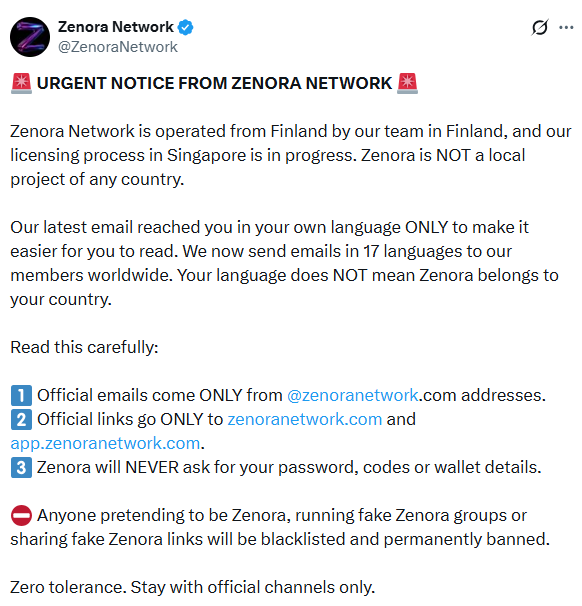
Source: Zenora Network Post on X
The notice follows a recent email sent to members in their own languages. The post addresses that point directly, along with a list of official sources. This security alert is short, but it covers location, licensing and account safety in one go.
Is Zenora a Finland Project or a Singapore One?
The project is operated from Finland by a team in Finland, and the licensing process in Singapore is in progress. The Zenora Network Finland base is stated plainly, along with a line that Zenora is not a local project of any country.
The company page adds detail on the Zenora Singapore licensing track. It says the operating company, a Pte. Ltd., is being incorporated in Singapore, and the entity is not yet registered.
Legal name, UEN and registered address all show as pending. The same page places the team in Finland and the primary servers in Canada.
Why Did Emails Arrive in Local Languages?
The team says the latest email reached members in their own language only to make it easier to read. Emails now go out in 17 languages to members worldwide.
The notice states that a member's language does not mean Zenora belongs to that country. The project's support center also lists 17 languages, including Korean, Hindi, Spanish and Arabic.
Which Zenora Official Channels Does the Notice Name?
The notice lays out three points on Zenora email security and links:
Official emails come only from zenoranetwork.com addresses.
Official links go only to zenoranetwork.com and app.zenoranetwork.com.
The team will never ask for a password, codes or wallet details.
The Zenora Network official website carries the roadmap, tokenomics and company details.
The miner sits on a separate address. Its page says rewards are claimed with a passkey, with no passwords or seed phrases involved, and the Zenora Miner app uses the second domain named in the notice.
What Happens to Fake Zenora Accounts and Groups?
The post warns that anyone pretending to be Zenora will be blacklisted and permanently banned. That covers people running fake Zenora groups, Zenora fake accounts and anyone sharing fake Zenora links. The team calls it zero tolerance.
Fake crypto groups and look-alike links are a familiar route for a Zenora impersonation scam, and the crypto latest news cycle often carries similar cases. This Zenora phishing warning follows that pattern, though the notice gives no count of reported cases.
Is ZNR Live Yet? What the Project Pages Confirm
The main site states that Zenora Coin (ZNR) is not yet listed or tradable. Total supply is fixed at 1 billion ZNR. The chain is described as an EVM-compatible Layer-1 built with Polygon CDK.
The miner page says ZNR earned pre-mainnet mining points, converted to on-chain ZNR at launch. That detail matters because pre-launch phases often attract copycat pages.
Expert Analysis: What Comes Next for Zenora Network?
The data suggests this is a brand-protection step more than a market event. Three details are still missing: the name of the Singapore licensing body, the registration date and a public contact address, which the company page lists as to be announced.
The main uncertainty remains the wording gap. The post cites a licensing process, while the company page says incorporation is pending. The notice also gives no figures on how many fake pages exist.
With ZNR not yet tradable, any claim of a ZNR listing or sale falls outside the project's stated position. Daily cryptocurrency news shows how quickly such impersonation attempts can spread.
Conclusion
The project has drawn a clear line between its official channels and everything else. The notice confirms a Finland-based team, a Singapore process still in progress and a ban policy for impersonators.
The notice was posted on the project's official X account, @ZenoraNetwork, and the miner page links to the same handle. Later updates on licensing and registration will show how far that process has moved.
Disclaimer: This article is for information only and is not financial advice. Crypto assets carry a high risk of loss, and pre-launch projects carry added uncertainty. Details here come from the project's own statements and have not been independently verified.






