Blockchain History Storage: Who Keeps the Past Alive?


Who Keeps Blockchain History Storage Alive After Pruning?
A blockchain never forgets, or so the saying goes. In practice, someone has to keep the old records on a disk and hand them over on request. That's the real question behind blockchain history storage.
What Are the Key Takeaways on Blockchain History Storage?
Permanent doesn't mean every node keeps every record. Ethereum clients can now drop old block data, and the chain keeps working. This guide uses Ethereum as the case study, because its roadmap tackles the problem directly.
Archive nodes are a separate matter. Their size depends mostly on the client, from about 2 TB to more than 20 TB.
The open risk is retrieval. If only a few providers serve old history, blockchain history storage becomes a question of who you can reach.
What Is the Difference Between Chain History and State?
Two kinds of data sit on a node. History is the record of past blocks, transactions, and receipts. State is the current snapshot of balances and contract data.
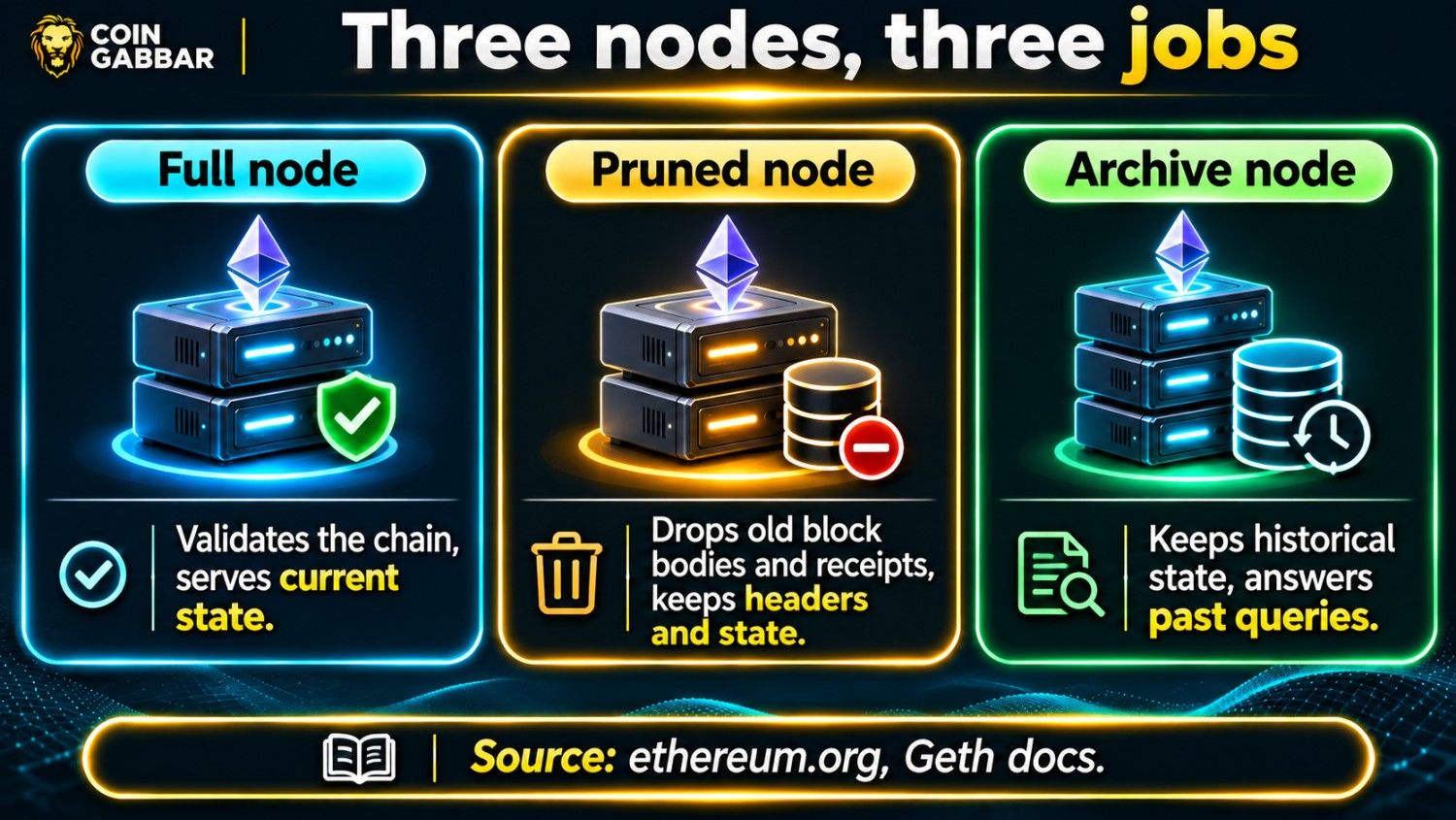
Full nodes validate the chain and serve today's state. Archive nodes also answer questions about the past, such as an account balance at a given block, according to ethereum.org. During the first sync, an archive client executes every transaction since Genesis.
Mixing these up causes most of the confusion. Old history and old state are different data with different costs, and both belong to blockchain history storage.
Do Ethereum Nodes Still Store the Entire Blockchain?
Until 8 July 2025, every Ethereum node stored every block from genesis to the latest one, according to the Ethereum Foundation. That gave a very strong message that anyone could download history at any time.
On that date, all execution clients added support for partial history expiry under EIP-4444. Partial means pre-merge history, the blocks before Ethereum moved to proof of stake. The proposal text notes that expiry only allows clients to drop data. It doesn't force them to.
Pruning is simple in practice. Geth's prune-history command removes old block bodies and receipts. It keeps headers and the state trie, so the node still validates the chain.
One side effect: dropping history would hide pre-Merge deposit logs from consensus clients, which EIP-6110 mitigates.
How Large Is an Ethereum Archive Node Right Now?
Geth's documentation says a legacy hash-based archive can exceed 20 TB and may take months to sync. Since version 1.16.0, a path-based archive needs about 2 TB and syncs in around two weeks. It also lets operators choose how many historical states to keep.
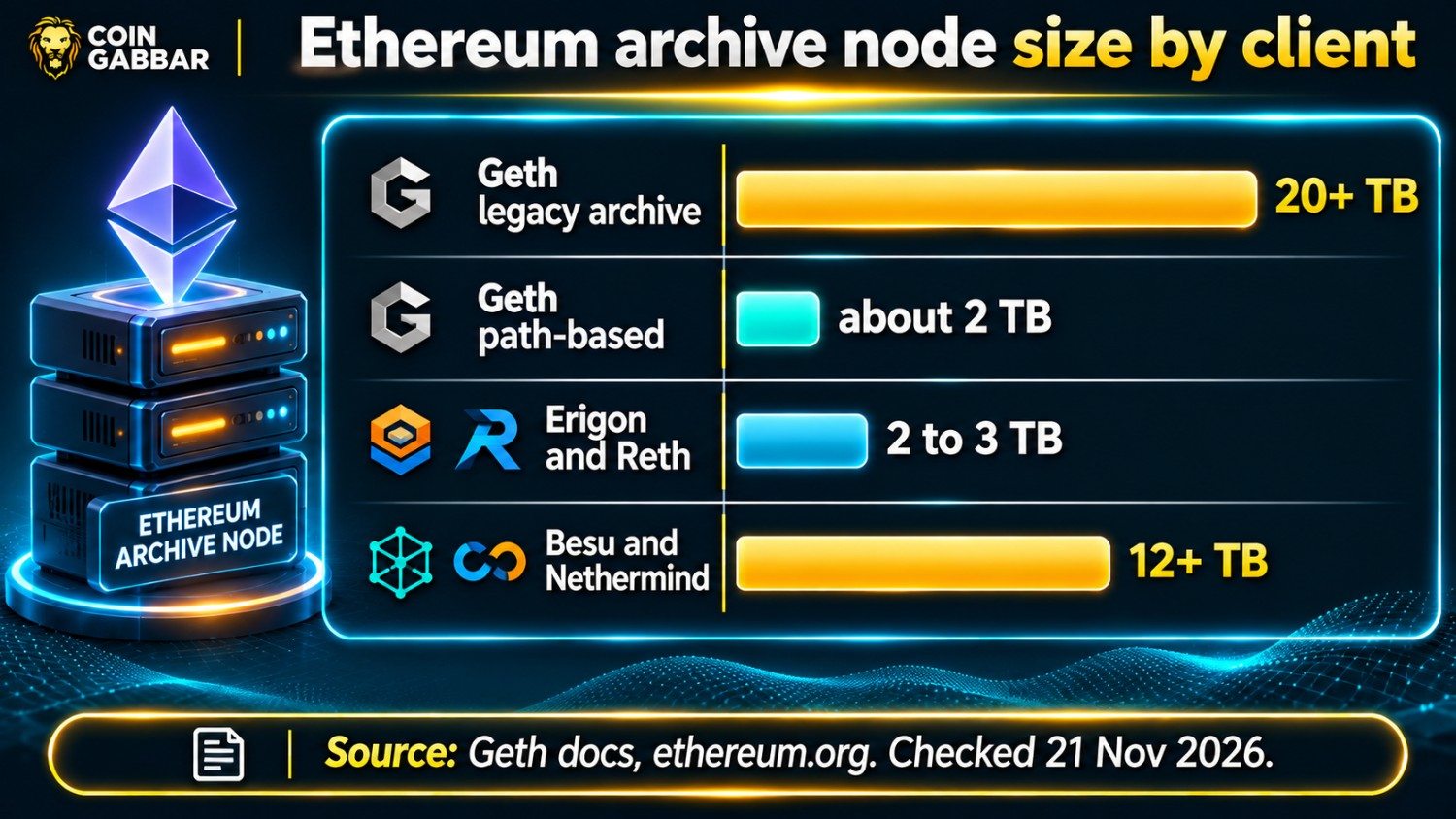
According to ethereum.org, Erigon and Reth land near 2 to 3 TB as well. Besu and Nethermind archives need 12 TB or more. If any term here is new, crypto dictionary covers it.
So the cost isn't simply rising. Blockchain history storage swings with each client's design.
Why Is Ethereum Dropping Old History From Nodes?
The Ethereum Foundation says most users never read old blocks. Checking a balance, trading, or borrowing won't be interrupted. Most clients no longer rerun the whole chain. Forcing every node to download over 1 TB of unused data made little sense.
Dropping pre-Merge block data alone saves 300 to 500 GB, according to an earlier Foundation post. That lets a node fit on a 2 TB disk. Work on full, rolling expiry is still ongoing.
Smaller nodes help decentralization at the edges. But shrinking what each node holds moves the weight of blockchain history storage somewhere else.
Who Will Store Blockchain History After Pruning?
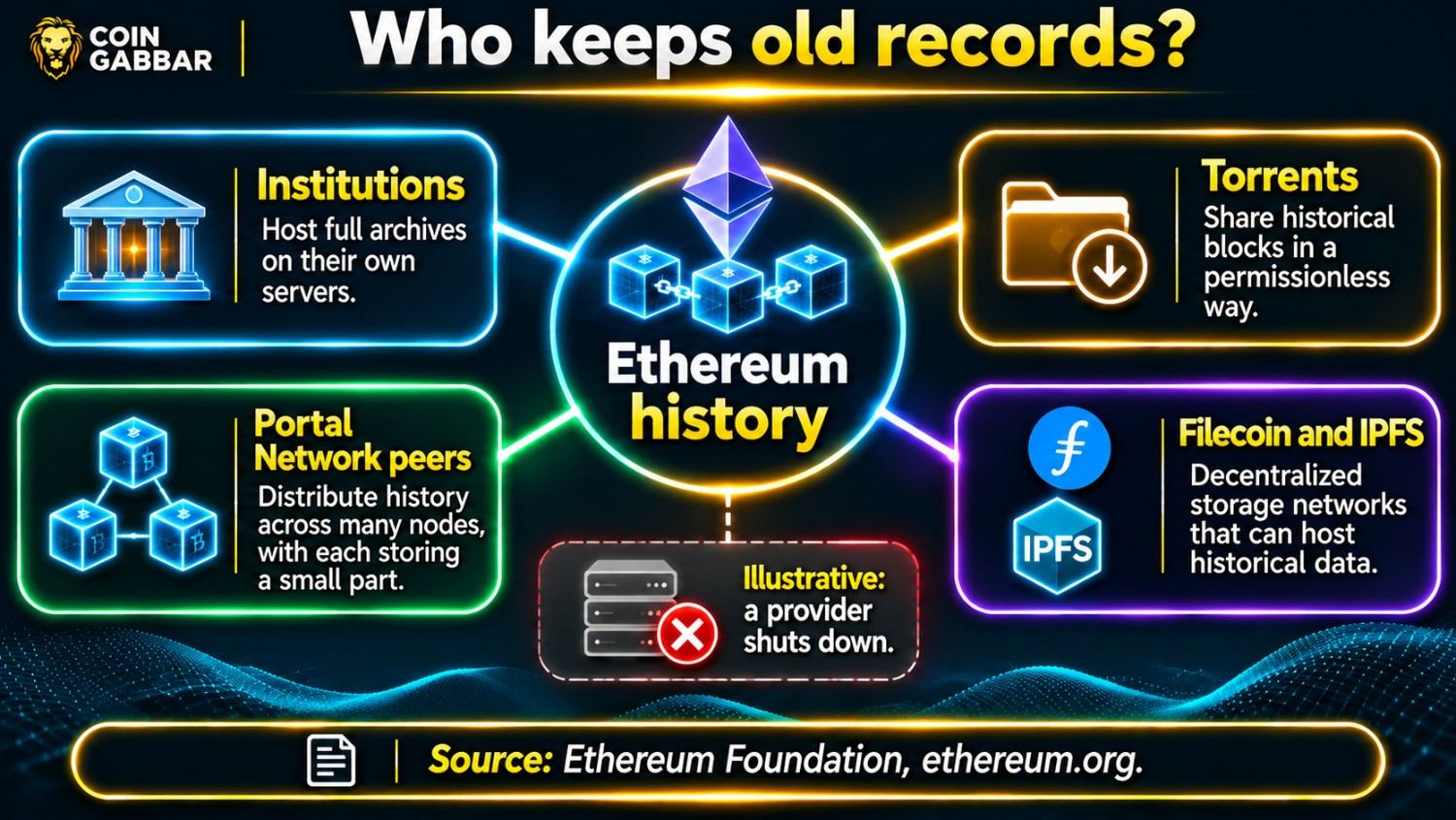
The Foundation names three kinds of providers. Institutions can host archives on their own servers. Torrents offer opt-in, permissionless hosting. Peer-to-peer networks serve data as before, though peers that skip storage dilute availability.
The design rests on a 1-of-N trust assumption. If at least one entity keeps the historical blocks, nodes can retrieve them by other means.
Ethereum's Portal Network aims to spread the load. Each node holds a small piece, so the full history exists across the network. Ethereum.org also lists Filecoin and IPFS as options.
Can a Record Be Permanent but Hard to Retrieve?
"Permanent," "stored," and "retrievable" are three different words. A record can stay part of the chain while no copy you can reach still exists.
The chain stays valid in that case. Ethereum.org stresses that expiry changes how old data is accessed, not how nodes handle state.
Now picture a purely illustrative case. A few archives lose funding and shut down. An old transaction still sits on the chain, but finding a copy takes real effort.
Could Historical Data End Up With a Few Providers?
That's the live concern. Ethereum's official website calls history expiry controversial because Ethereum has always implicitly guaranteed availability. It warns of new censorship risks if centralized organizations step in.
The roadmap adds a surprising detail. The hard part isn't mainly technical and it's community management.
Resilience matters here as much as raw storage. Our guide to network survival during outages covers the same layered-failure idea. Concentrated blockchain history storage would fail in the same way.
Who Should Pay to Keep Blockchain History Alive?
The sources reviewed here don't name a funding model. They do name who hosts. Institutions pay with their own servers. Torrent and peer-to-peer hosts give their disk space voluntarily.
That split is the heart of blockchain history storage as an infrastructure question. Free hosting works while volunteers stay interested. Paid hosting works while someone keeps paying.
Watch two signals: how many independent hosts keep full history, and how easily a new node can fetch it.
Expert Opinion: Is Permanence Now an Infrastructure Problem?
CoinGabbar analysis suggests blockchain history storage is shifting from a protocol guarantee to an infrastructure service. The chain stays valid, but who serves old records matters more each year.
This view draws on ethereum.org, the Ethereum Foundation's 8 July 2025 announcement, Geth's documentation, and EIP-7927. It covers Ethereum only, isn't based on hands-on testing, and sizes vary by client.
Disclaimer: This article is for information only. It isn't financial or investment advice. Technology plans can change, and nothing here promises any outcome.