FLOP Network Tokenomics: Supply, Block Rewards and Halving


How Does FLOP Network Tokenomics Shape Its Supply and Rewards?
A token with no sale and no investor allocation raises an obvious question: where do the coins come from? FLOP Network tokenomics answers it with one rule. Tokens are issued block by block, and they go to the people doing the work. This guide breaks down the supply, the rewards, and the halving plan. The details come from the official website and the whitepaper.
Key Takeaways
The FLOP token supply is projected at about 18.1 billion by year ten, with no token sale and no investor allocation.
Block rewards start at 96 FLOP, halve every 730 days five times, then stay at 3 FLOP.
The whitepaper is a draft, and the Yellow Paper will be the final word, so some details may change.
What Is the FLOP Network Project?
The FLOP Network project is a proof-of-inference blockchain built for AI agents. An agent pays a miner to run a task. The miner submits proof that the work was done, and validators place that proof in a block. Blocks arrive about once per second.
The name comes from floating-point operations, the standard measure of compute. According to the official site, the launch has no pre-sale, no VCs, and is a 100% fair launch. Two entities stand behind it. Flop Labs built the software, and the FLOP Foundation stewards the protocol.
Source: official website.
What Is the $FLOP Token?
The $FLOP token is the network's native currency, and one token does every job. It pays for compute, secures the chain through staking, and settles deals between agents. The site's tagline says it plainly: $FLOP is food for your AI agent. Spend it, and the agent gets inference back.
That single-token design ties demand to real use instead of splitting it across two coins.
Supply at a Glance
Item | Detail |
Token sale | None |
Investor allocation | None |
Launch style | 100% fair launch |
Supply at year 10 | About 18.1 billion FLOP |
Token burn | None |
Protocol fee | None |
Issuance | Block by block, in public |
Every $FLOP is earned through a role in the network. Nothing unlocks ahead of the people who use it.
What Is the FLOP Genesis Allocation?
The FLOP genesis allocation is 4.4 billion tokens, or 24.3% of year-10 supply. It is the only allocation not issued through block rewards.
It has two parts:
Testnet airdrop: up to 3.6 billion FLOP, earned by miners, validators, and agents. Each role has a 1.2 billion pool. The airdrop is earned through verified work on the testnet.
Ecosystem reserve: 0.8 billion FLOP for growth incentives, referral payouts, and creator rewards.
Where the Year-10 Supply Goes
Allocation | Amount | Share |
Miners | 8.8bn | 48.6% |
Genesis (airdrop and reserve) | 4.4bn | 24.3% |
Team and Foundation | 2.0bn | 10.8% |
Validators | 1.2bn | 6.5% |
Brokers and agents | 1.2bn | 6.5% |
Staking rewards | 0.6bn | 3.2% |
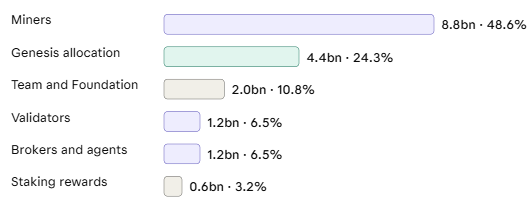
Figures are rounded. Miners hold the biggest slice, which matches the idea that the network pays for work first.
How Does FLOP Block Reward Halving Work?
Each block pays 96 FLOP at the start. Every 730 days, about two years, that number is cut in half. It happens five times: 96, 48, 24, 12, 6, and finally 3. After the fifth halving, the reward stays at 3 FLOP for good.
The whitepaper explains why. A permanent reward gives miners and validators a lasting security budget, so security does not depend on transaction fees alone.
The FLOP halving schedule is fixed at genesis. The long-run reward, though, can be changed through a governance proposal.
Who Receives Each Block Reward?
The reward is split four ways.
Group | Share |
Miners | 75% |
Validators | 10% |
Agents and brokers | 10% |
Stakers | 5% |
Miners: FLOP Network GPU miners earn the biggest share, based on verified compute delivered. Any GPU with 16 GB or more of VRAM can join.
Validators: the 10% is divided equally across seats. Half of each seat's share is added to its bond and unlocks over about ten years. The other half is liquid.
Agents and brokers: FLOP Network AI agents and brokers share a pool that funds a usage subsidy. It lets the network price compute below market without asking miners to sell at a loss.
Stakers: any holder can stake and earn a pro rata share. There are seven duration tiers, and staking carries no slashing risk.
Team and Foundation Emission
The company and the Foundation each mint 8 extra FLOP per block, on top of the normal reward. That amount halves on the same schedule and ends after year ten. Each entity reaches 5.4% of total supply by then, which adds up to the 2.0 billion shown in the table. The money funds development and upkeep.
Stake forfeited by dishonest operators goes to the Foundation as well.
How Inference Fees Work
Block rewards are only half the story. Agents also pay a fee in $FLOP for each session. The miner who served it keeps 85%, and the validators get 15%. Fees are priced in dollar terms against the open market and paid out in liquid tokens. In the early years, the block reward is the bigger source of income.
Risks and Limits
The official whitepaper is open about the weak spots:
$FLOP has no cash flows, no buyback, and no revenue share. Its value rests on demand for compute.
The reward subsidy halves roughly every two years. If demand is slow, miner income falls.
Token liquidity at launch is expected to be thin.
The document is a draft dated 25 September 2026, and the Yellow Paper is the definitive spec.
Final Thoughts
FLOP Network tokenomics is built around earning, not selling. Supply grows with the work the network verifies, and the rewards shrink on a fixed timetable. Readers should check the tokenomics section of the whitepaper directly, since the numbers may change before the final spec.
Disclaimer: This article is for information only and is not financial advice. Crypto assets carry risk, so research carefully before making any decision.