Brazil Crypto License Deadline: Is Any Firm Approved by BCB?


BCB Open Data Lists No Authorized Virtual Asset Provider Yet
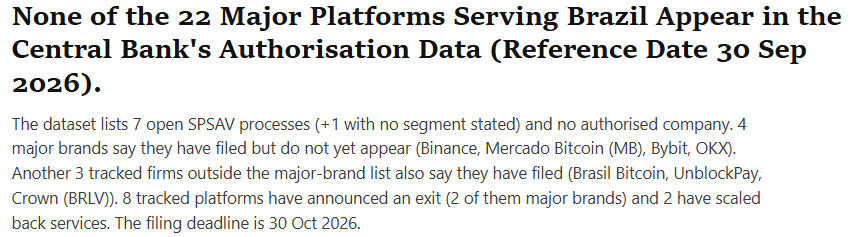
The Brazil crypto license deadline arrives on 30 October, and the latest BCB open data lists no authorized company. It shows seven open processes for virtual asset service providers (SPSAV), plus one with no segment stated.
According to VASP Tracker, none of the 22 major platforms it follows appears in that list.
Source: VASP Tracker
What the Brazil Crypto License Deadline Requires From Firms
The Central Bank published Resolutions 519, 520, and 521 on 10 November 2025, and the new crypto regulation took effect on 2 February 2026, opening a 270-day transition.
Central Bank Resolution 520 creates three SPSAV categories: intermediary, custodian, and broker, while Resolution 521 treats some virtual asset operations, such as international payments, as foreign exchange transactions.
Under those rules and Normative Instruction 704, providers already operating must file the first phase of their request by 30 October. Filing is not approval because the regulator reviews each application in later stages. Providers that do not file must stop services within 30 days afterwards.
Date | Event |
30 October 2026 | Filing deadline for phase one |
6 November 2026 | Ban on banks and payment firms dealing with unauthorized providers |
29 November 2026 | End of the 30-day stop period for non-filers (VASP Tracker calculation) |
Which Platforms Say They Filed and Which Are Leaving
Several firms say they have applied for a Brazil crypto license, yet none appears in the official list. VASP Tracker sorts platforms by public statements and official data, and it lists eight platforms that announced an exit and two that scaled back services.
Status | Platforms |
Says it has filed | Mercado Bitcoin, OKX, Bybit, Binance |
Says it will file | Foxbit, B3, Coinbase |
Open BCB process | Transfero, Onda Finance, Wynx Exchange, Mazzera, PFPay, Masterpay, W Brasil |
Why Recent Filings May Be Missing From the Official Data
The dataset carries a reference date of 30 September, and the regulator updates it monthly. A missing name does not show that a Brazil crypto license request was refused, since the filing may postdate the data or come through another entity.
Onda Finance appears in BCB Comunicado 45.986, dated 21 September, as an institution in the authorization process. VASP Tracker describes itself as an independent project, not affiliated with the Central Bank.
What Changes for Banks and Users After 6 November
Central Bank Resolution 589, published in the Official Gazette on 25 September, moved the start of the restriction from 30 October to 6 November, as announced in BCB’s 23 September note.
From that date, financial institutions, payment institutions, and other entities authorized by the Central Bank may not carry out or enable virtual asset operations with unauthorized providers, except in forms the rule expressly allows.
The resolution also widens reporting on custody, reserves, and staking, with those provisions applying from 1 January 2027.
Users of a local crypto exchange can run three checks:
Whether the provider appears in the BCB list of open processes
Whether it has announced an exit or a scale-back
Whether services continue after the 30-day period ends
The next monthly update of the data could show which filings reached the regulator. Until then, the status of each Brazil crypto license request rests on public statements and partial data, and banks will have to weigh it once the restriction starts.
YMYL Disclaimer: This article is for informational purposes only and is not legal or financial advice. Regulatory details and platform statuses may change, so readers should verify them with official Banco Central do Brasil sources.









