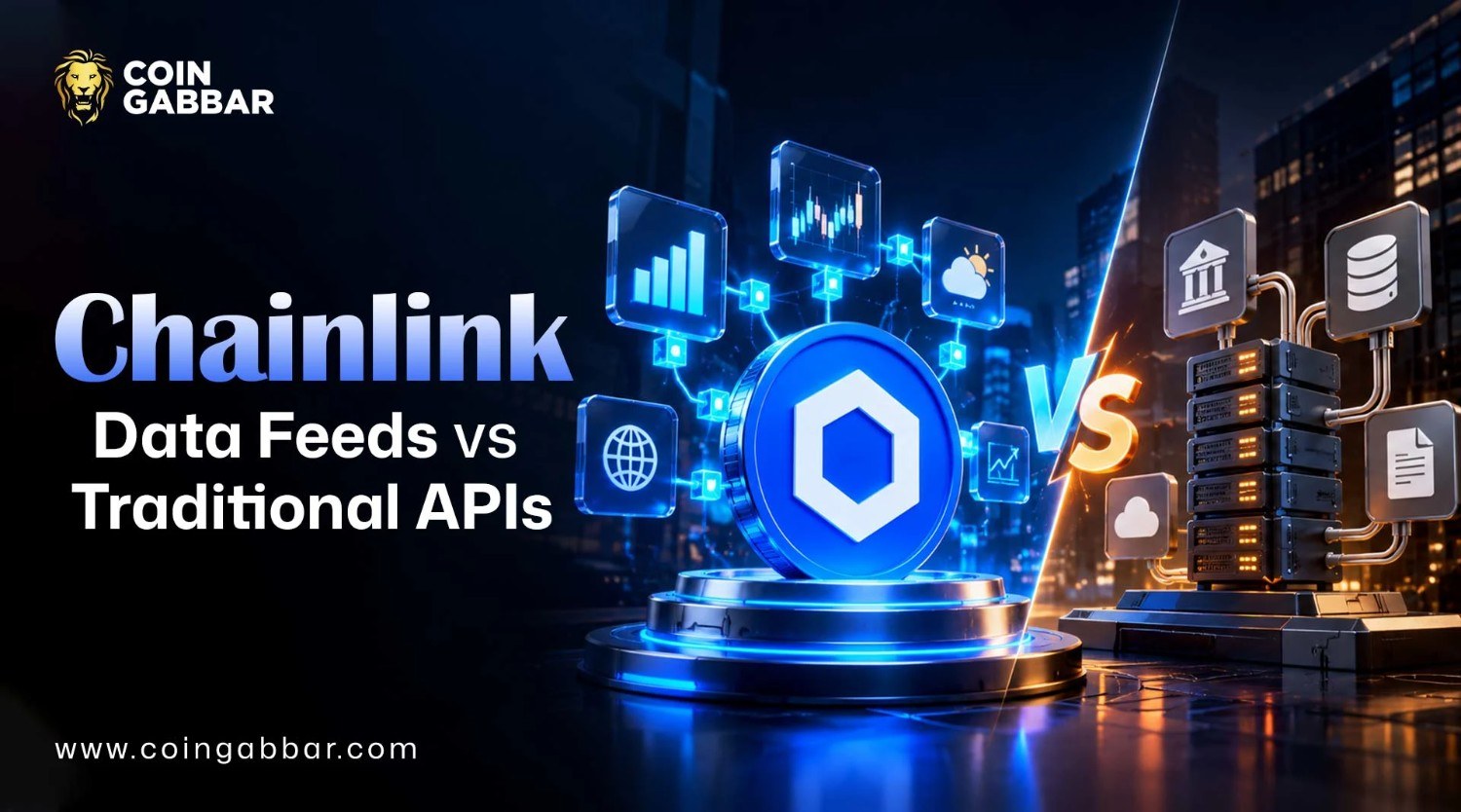
Chainlink Data Feeds vs. Traditional APIs Comparison

Why Smart Contracts Can’t Depend on Regular APIs Alone
Build a lending app, a stablecoin, or a tokenized asset, and one problem shows up fast. Blockchains can’t grab outside data on their own. That’s why Chainlink Data Feeds vs. Traditional APIs matters to every developer in this space.
Regular APIs are quick and easy in the Web2 world. But one server answering one request is a risk that money-heavy apps can’t carry.
This guide walks through how both models work, where they split, and which one fits smart contracts better. It’s based on official project material reviewed on October 22, 2026.
What Are Chainlink Data Feeds, and How Do They Work?
Chainlink is a decentralized oracle network. Think of it as a group of independent computers that carry real-world data onto blockchains.
Chainlink Data Feeds vs. Traditional APIs Data feeds are its best-known product. They hand smart contracts market prices, reserve balances, and other off-chain data.
The project describes three steps. Premium data providers first collect raw prices from many exchanges, then adjust for time, volume, and odd outliers.
Independent nodes then pull those prices from several providers and merge them into one value. Many nodes next combine their results off-chain into a tamper-resistant report that smart contracts can read.
A method called Off-Chain Reporting lets nodes agree offchain and publish a single report. The project says this cuts gas costs, the fees paid for onchain transactions, without weakening security.
Price feeds use volume-weighted medians. So a flash loan attack, where a trader briefly bends one exchange’s price to drain a protocol, struggles to move the final number.
Proof of Reserve checks that stablecoin or wrapped token reserves match the supply. Sequencer uptime feeds and SmartData serve layer-2 networks and tokenized funds.
Network security sits on three layers: data sources, node operators, and the oracle network itself. A few faulty nodes just can’t change the final answer.
What Are Traditional APIs and How Do They Work?
An API, short for application programming interface, is a set of rules that lets one app ask another system for data or services.
A developer sends a request to the provider’s server. The server sends back a price, a location, or a weather reading.
Providers make money through subscriptions. Some charge per request, some a flat monthly fee, and some use tiered plans. A legal contract holds them to agreed service standards.
It works nicely for a ride-sharing app that uses separate Chainlink Data Feeds vs. traditional APIs for maps, messages, and payments. But blockchains play by a stricter rule.
Every node must land on the same result. If each node called one API at slightly different moments, the answers could differ and break consensus, the agreement that keeps a blockchain secure.
And one API is still one point of failure.
Chainlink Data Feeds vs. Traditional APIs: Side-by-Side Comparison
This isn’t a fight on every front. Feeds themselves pull from premium Chainlink Data Feeds vs. Traditional APIs at the first layer.
The real gap is what happens to that data next.
| Factor | Chainlink Data Feeds | Traditional APIs |
| Data source | Many premium providers, combined | Usually one provider |
| Trust model | Decentralized node network | One company or server |
| Single point of failure | Removed by design | Present |
| Tamper resistance | Combined oracle report | Depends on the provider |
| Blockchain fit | Built for smart contracts | Can’t be called natively on-chain |
| Cost | Network and gas-based | Subscription-based |
| Best use | DeFi, tokenized assets, stablecoins | Websites, apps, analytics |
Speed is a different story. A direct API call usually replies fast, while standard feeds update on a push basis.
Fast traders may like Chainlink Data Streams better. The project calls it a pull model that delivers data in milliseconds.
What Are the Risks and Causes of Failure in Each Model?
Neither option is risk-free. Each breaks in its own way. So what happens to a lending protocol when its only price source freezes?
Traditional API Risks
-
Single point of failure: One outage at the provider stops every app that relies on it.
-
Manipulation: If there is a mistake in the price, then bad loans or unfair liquidations will result, and nobody will be there to double-check.
-
Mixed answers: Nodes request an API at different times and disagree, which leads to a lack of consensus.
Chainlink Data Feed Risks
-
Oracle dependence: If the network or feed setting fails, then all the protocols connected to it are affected.
-
Update delays: Push-based feeds can lag in fast markets, which hurts derivatives most.
-
Wrong feed choice: A protocol that picks the wrong feed can still take losses.
Analysts tend to see it this way. Decentralization shrinks single-source risk, but it pushes part of that risk into configuration choices.
Chainlink Ecosystem, CCIP, and What Comes Next
The Chainlink ecosystem now goes well past price data. CCIP, its interoperability protocol, moves data and value between public and private blockchains. The project has announced that CCIP 2.0 is live.
For Chainlink news today, the official newsroom is the best place to check. Product updates land often.
The Chainlink price follows the LINK token’s market. That’s a separate matter from how well the feeds perform, so no figure is quoted here.
Chainlink staking appears on the project’s ecosystem pages. Current terms should be confirmed there.
Scams deserve a warning too. Chainlink Data Feeds vs. Traditional APIs Official channels are the only ones to be trusted, as fake giveaways and cloned websites use the brand name.
From published product lines, the Chainlink future looks towards tokenized assets, stablecoins, and institutional usage. Don't talk about adoption as a plan, not a promise.
Anyone creating smart contracts on Chainlink can view read-only feeds from the Chainlink project dashboard.
Chainlink Data Feeds vs. Traditional APIs: Which Is Safer?
Cost can look like the deciding factor at first. But a cheap data source that fails during a liquidation costs far more than any fee.
For apps that hold or move value on-chain, decentralized feeds are the stronger pick. Mixing many sources removes the single point of failure and gives every node one agreed answer.
But traditional APIs still win for websites, dashboards, and analytics. No smart contract depends on the result there.
So there’s no universal winner. Decentralized feeds carry less single-source risk for onchain money, and feed details should be confirmed in the official documentation.
Disclaimer
This article is for information only and isn’t financial, investment, or legal advice. Crypto assets carry high risk, prices can fall sharply, and projects can change plans or fail. Readers should research independently and consult a licensed advisor before any decision.