CLARITY Act Midterms: Crypto’s $233M Push Hits a Senate Wall


CLARITY Act Midterms: Can Crypto’s $233M Push Bring the Bill Back?
The digital asset industry put record sums into this year’s election, yet the legislation it wants most has still not passed the upper chamber.
This CLARITY Act midterms story is about money, timing, and votes. According to an analysis of FEC filings, crypto firms gave $233M to political groups.
Here is a clear, source-based guide to what that means for the legislation. A super PAC is a political group that can raise and spend unlimited money, but it may not coordinate directly with a campaign.
How Much Did the Industry Put In?
The analysis covers contributions of $5,000 or more from for-profit companies to super PACs, using filings through 23 October 2026.
It puts crypto at $233M, or about 32% of the $737.3M that companies gave in total.
That is more than all corporate giving in the 2022 midterms, which was $184.1M.
| Company | Total given | Main recipients |
| Andreessen Horowitz | $76.2M | AI-focused group $50M; crypto-focused Fairshake $23.8M |
| $49.6M | Fairshake and affiliates $48.5M | |
| Crypto.com | $39M | MAGA Inc $35M |
| $37.2M | Fairshake $33.1M | |
| Gemini and Winklevoss Capital | $35.7M | Digital Freedom Fund $21.3M; MAGA Inc $14.3M |
Notice that the money went to both sides. Coinbase also gave $1M each to groups tied to Senate Republicans, Senate Democrats, House Republicans, and House Democrats.
The figure also differs from money spent on specific races, since it counts gifts to the groups.
The Bigger Picture
Corporate giving has climbed sharply since 2010. The chart in the analysis shows these totals:
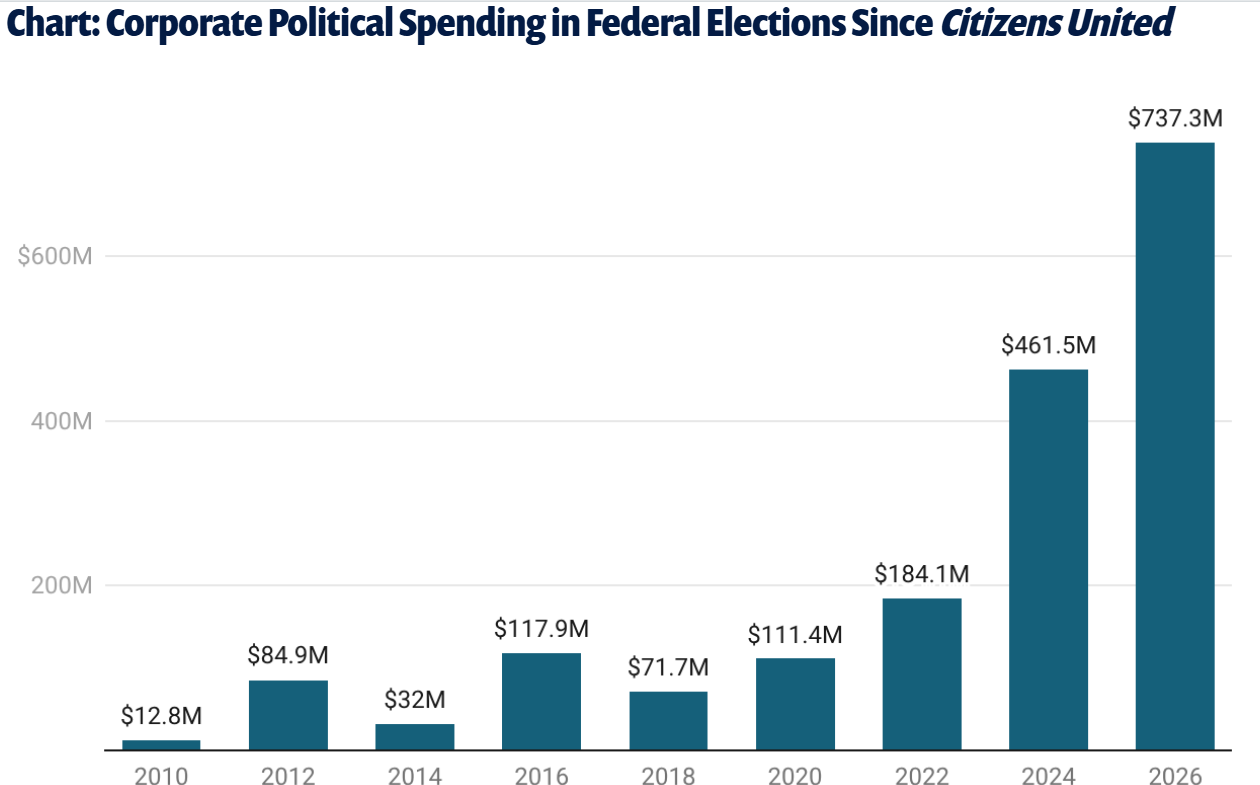
The analysis adds that not all corporate spending is reported, so the totals may undercount the real amount.
Where the CLARITY Act Midterms Debate Stands in Congress
Congress.gov lists the Digital Asset Market Clarity Act as H.R. 3633. Its path so far:
| Date | Step |
| 17 July 2025 | House passed it 294 to 134 |
| 14 May 2026 | Senate Banking Committee advanced it |
| 1 June 2026 | Placed on the Senate calendar |
| 15 September 2026 | A key vote in the upper chamber did not move it forward, according to reports. |
The measure would split oversight of digital asset markets between two regulators, the SEC and the CFTC.
The SEC mainly oversees securities such as stocks, while the CFTC mainly oversees commodity and futures markets, and the measure aims to draw a clear line between them.
It has not passed the full upper chamber. That is why the CLARITY Act midterms link matters: the next chamber vote will happen under new political conditions.
Why the Election Changes the Math
Election-night projections point to Democratic control of Congress, but final counts are still being confirmed.
If they hold, three rules shape what happens next:
-
Most Senate bills need 60 votes to move forward, so support from both parties is required. In simple terms, a small group can stall a measure even when most members support it
-
A bill that does not pass both chambers before the current Congress ends in early January must start again
-
The new majority would lead committees and set the schedule
None of this kills the measure. It means any deal must please enough members of both parties, which can mean changes to the text.
The sources reviewed do not list what those changes would be, so any specific demand being shared online should be treated as unverified.
Conclusion
The industry gave heavily to both parties, and the legislation has already cleared the House and a committee.
Still, the CLARITY Act midterms picture shows that money alone has not secured a final vote.
Readers should follow the official page for the next step, check committee websites for statements, and avoid relying on unverified claims about its price.
Disclaimer
This article is for educational and informational purposes only and is not financial or investment advice. Crypto assets are high risk, their prices can be very volatile, and you can lose some or all of your money. Always do your own research and consider speaking with a licensed financial advisor before making investment decisions.






