CLARITY Act News: Why Crypto Lobbying Falls but Still Tops $4M?


CLARITY Act News: Q3 Lobbying Dips, Spending $4M and Oct 20 SEC Letter
CLARITY Act News this week shows two sides of the crypto policy fight. Lobbying spending dropped in the third quarter after a Senate setback in September.
At the same time, six blockchain groups sent the SEC a joint letter on October 20. These two events are linked, but they follow separate paths. Here is what the reports say and what they do not.
At a Glance: CLARITY Act News and Key Figures
-
Q3 lobbying spending fell from Q2, as per reports.
-
Crypto groups still spent more than $4 million in the quarter.
-
The industry spent over $8 million in the first half of 2026.
-
Six blockchain groups asked the SEC to clarify digital commodity rules.
-
The CLARITY Act and the Securities and Exchange Commission proposal are separate processes.
Why Did Coinbase and Crypto Groups Cut Q3 Lobbying Spending?
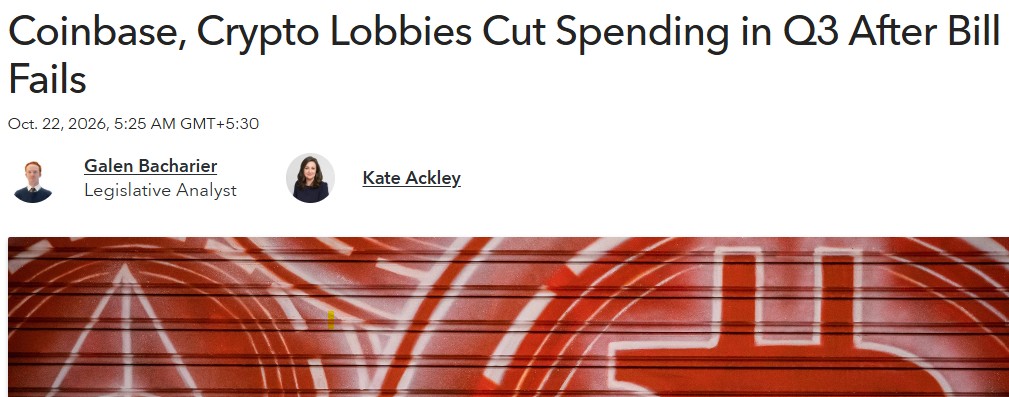
Bloomberg reported that Coinbase and several major crypto groups spent less on federal lobbying in the third quarter than in the second.
The drop came after the CLARITY Act failed to advance in a key Senate procedural vote in September. Even so, the groups spent more than $4 million in the quarter.
That is the sixth straight quarter above that level. Lower spending does not prove the industry has given up on its legislative goals. This CLARITY Act News points to a slower pace, not an exit.
Sources: Wu Blockchain Bloomberg (Galen Bacharier and Kate Ackley, Oct. 22, 2026); joint letter to the SEC dated Oct. 20, 2026.
From $8 Million in H1 to Q3 Cuts: What the Lobbying Figures Reveal
The first-half and third-quarter numbers cover different periods, so they should not be added or compared directly.
| Period/indicator | Reported figure | What it shows |
| First half of 2026 | More than $8M | Lobbying to advance crypto market-structure legislation |
| Q3 2026 | More than $4M | Spending stayed above quarterly threshold despite decline from Q2 |
| Consecutive quarters | Six | Crypto groups kept quarterly spending above $4 million |
| September 2026 | Senate setback | The CLARITY Act failed to advance in the reported key vote |
The figures show steady investment in federal advocacy despite the setback. Bloomberg also noted that some lobbying firms ended work with crypto clients in the third quarter. The reports do not explain why, so readers should not guess at motives.
CLARITY Act Timeline: From Senate Setback to the October SEC Push
-
H1 2026: Crypto groups spend more than $8 million pushing for market-structure legislation.
-
September 2026: The CLARITY Act fails to advance in a key Senate procedural vote.
-
Q3 2026: Lobbying falls from Q2 but stays above $4 million for a sixth straight quarter.
-
October 20, 2026: Six blockchain groups send the SEC a joint letter on digital commodity rules.
These are reported events. Any future senate vote action is still unknown.
Why 6 Blockchain Groups Asking the SEC for Digital Commodity Rules?
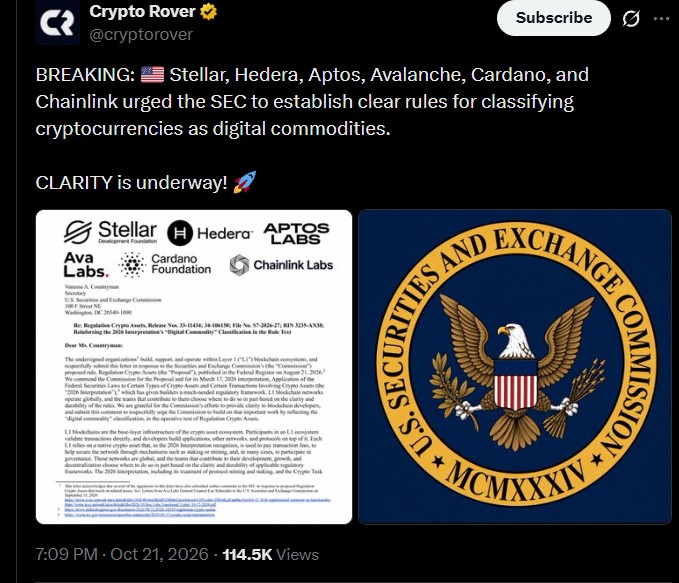
The letter came from Stellar Development Foundation, Hedera, Aptos Labs, Ava Labs, Cardano Foundation and Chainlink Labs.
They want the “digital commodity” classification written into the binding text of proposed Regulation Crypto Assets. Today, the non-security status appears only in the preamble.
The groups say that leaves developers and markets unsure about legal status and jurisdiction.
They also want clear treatment of blockchain networks, staking, and secondary markets. The letter was filed as the public consultation closed. It is a request. It does not show that the exchange commission has accepted the approach.
Source: Crypto Rover X Post
What Could These Developments Mean for US Crypto Regulation?
Congress and the SEC work in different ways. A market-structure law, such as the CLARITY Act, would set rules through legislation.
SEC rulemaking sets rules through a public comment process and a final rule. If clearer classifications are adopted, exchanges, developers, staking services and investors could face more predictable rules.
That is a possibility, not a forecast. No passage date, final outcome or price reaction can be stated from the facts available. Crypto news Readers following CLARITY Act News should treat each step as separate.
Conclusion: Is Regulatory Clarity Still Within Reach?
Lobbying spending fell, yet the industry kept talking to regulators. The next signals to watch are progress on the bill in Congress and the SEC’s response to the consultation. Until then, CLARITY Act News is best read as a pause in one process and movement in another.
Disclaimer: This article is for informational purposes only. It is not investment, financial or legal advice. Crypto assets carry high risk. Do your own research and speak with a licensed professional before making decisions.









