Best Crypto Metaverse Projects: Technology and Token Breakdown

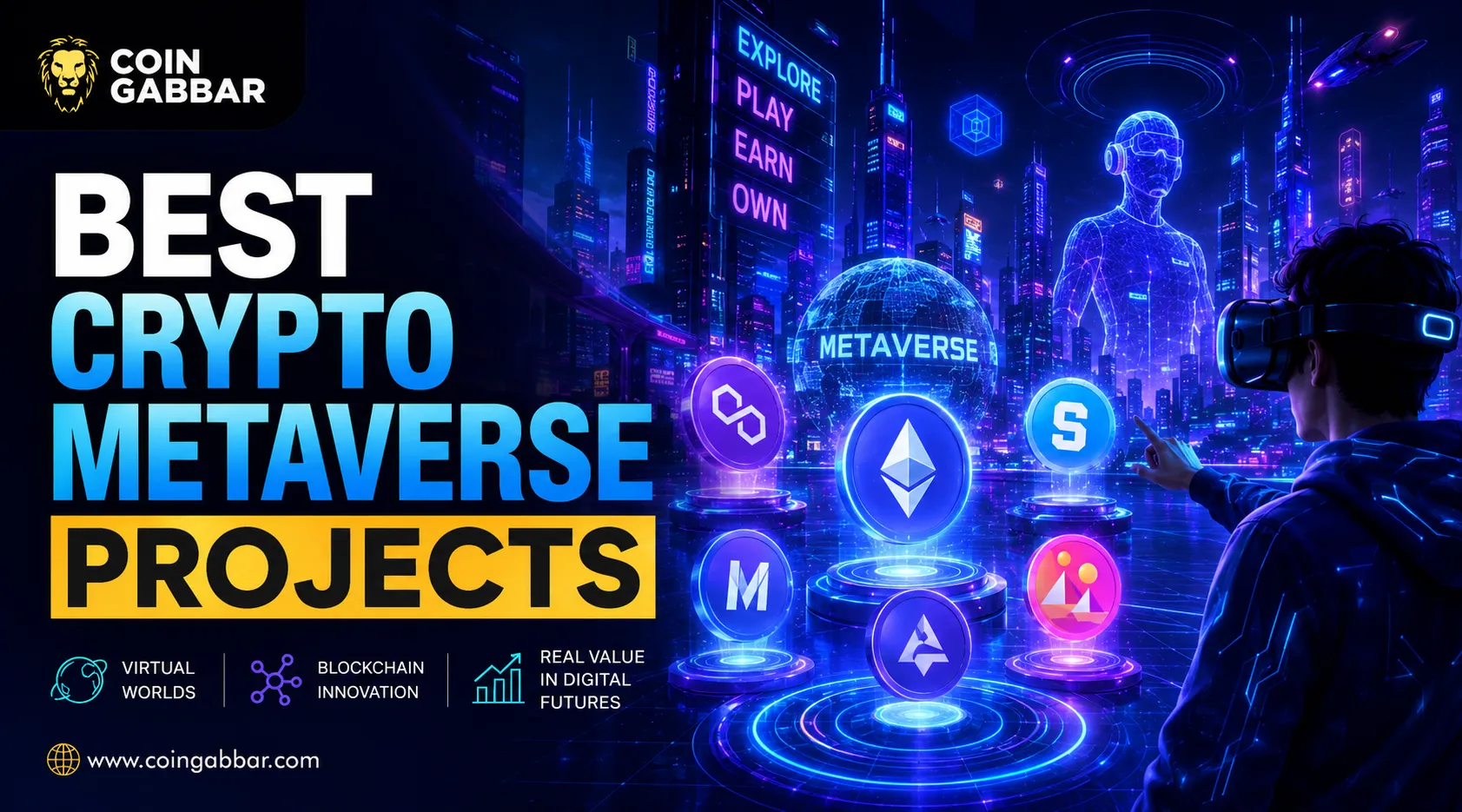
Best Crypto Metaverse Projects: 2026 Full Breakdown
The phrase best crypto metaverse projects covers a wide range of platforms. A space exploration game on Solana, a voxel creator world on Ethereum, a VR-first social universe, and a retail metaverse with physical product delivery are all called metaverse crypto projects. Yet their technology, token use, user base, and investment risks are very different.
This guide ranks and explains the best crypto metaverse projects by category, technology stack, token model, user adoption, commercial traction, and long-term relevance. It is designed for readers who want more than a basic list. You will see how social worlds, creator economies, blockchain games, infrastructure tools, and niche virtual platforms compare in 2026.
For readers new to the sector, this metaverse beginner guide explains the base concept. You can also track live prices, categories, events, and news through the CoinGabbar metaverse hub.
How We Categorise Crypto Metaverse Projects
Grouping projects by market cap alone can be misleading. Some platforms have strong token value but weak user activity. Others have active users but low token demand. The best crypto metaverse projects should be compared by what they actually do, not only by chart performance.
This guide uses five functional categories. Social virtual worlds focus on avatars, events, and community spaces. Creator economy worlds help users build and sell experiences. Play-to-earn gaming metaverses use gameplay and rewards to drive engagement. Infrastructure projects support other virtual worlds through rendering, NFTs, or tools. Niche vertical metaverses focus on use cases such as VR immersion, retail, space exploration, crypto education, or casino-style experiences.
Category Framework
- Social Virtual Worlds: Decentraland and Voxels
- Creator Economy Worlds: The Sandbox and Upland
- Play-to-Earn Gaming: Axie Infinity, Illuvium, and Alien Worlds
- Infrastructure and Tooling: Render Network and Enjin
- Niche Vertical Metaverses: Somnium Space, Star Atlas, Bloktopia, and Highstreet
Category 1: Social Virtual Worlds
Decentraland (MANA) — The DAO-Led Social World
Decentraland official site represents one of the oldest and most recognised blockchain-based virtual worlds. Launched in 2017 and opened publicly in 2020, it is built around social interaction, virtual land, avatar identity, events, and decentralised governance. MANA is the ERC-20 token used across the ecosystem, while LAND is the ERC-721 NFT that represents one of 90,601 fixed land parcels.
Decentraland is important because governance is handled through a DAO. Token holders and landowners can vote on platform decisions, grants, policies, and development priorities. This makes it one of the strongest examples of community-led virtual world governance. For deeper context on ownership and land value, read CoinGabbar's virtual real estate guide.
Technology: Ethereum mainnet, WebGL browser client, TypeScript SDK, and Builder tools. Polygon support helps reduce costs for some wearable transactions. Token model: MANA is used for payments and governance. LAND is finite, which creates scarcity. Commercial angle: Decentraland has hosted virtual fashion events, art galleries, brand activations, and conferences.
Why Decentraland Still Matters
Decentraland remains relevant because it has first-mover recognition, a fixed land supply, DAO governance, and a known brand presence. It may not be the most technically advanced world, but it remains one of the core names when discussing the best crypto metaverse projects.
Voxels — The Browser-Native Art World
Voxels, formerly CryptoVoxels, is one of the oldest blockchain virtual worlds. Its design is simple, colourful, and browser-first. Unlike large gaming worlds, Voxels focuses on digital galleries, NFT exhibitions, small social spaces, and accessible building. Users can visit without needing a complex game client.
Technology: Ethereum-based land ownership, browser-native access, and simple parcel-building tools. Token model: Voxels does not rely heavily on a native utility token. Parcels trade as NFTs, usually through ETH-denominated marketplaces. Commercial angle: It serves artists, NFT collectors, gallery owners, and small community builders.
Category 2: Creator Economy Worlds
The Sandbox (SAND) — Creator-First Gaming World
The Sandbox official site is one of the strongest creator economy platforms in the metaverse sector. Its value comes from three tools: VoxEdit for voxel asset creation, Game Maker for no-code experience building, and Marketplace for asset trading. This gives creators a full path from building digital items to monetising them with SAND.
The Sandbox has 166,464 LAND parcels and uses Ethereum with Polygon support for lower-cost transactions. Its brand roster is a key strength. Adidas, Warner Music Group, Snoop Dogg, The Walking Dead, and other major names have built or promoted experiences inside the platform. CoinGabbar has covered related developments in this Sandbox collaboration report.
Technology: Ethereum, Polygon Layer 2, voxel assets, creator tools, and marketplace infrastructure. Token model: SAND powers transactions, staking, creator rewards, LAND purchases, and governance. Commercial angle: The platform is strongest where brands, creators, and game builders overlap.
SAND Investment and Utility Angle
SAND's long-term relevance depends on creator output, active users, land development, token demand, and brand activity. It is often compared with Decentraland, but The Sandbox has a stronger creator-game angle, while Decentraland has a stronger DAO-social angle.
Upland (UPX) — Real-World Mapped Metaverse
Upland takes a different path. Instead of abstract land parcels, it maps virtual properties to real-world addresses. Users can buy, sell, and develop digital properties linked to cities such as San Francisco, New York, and Las Vegas. This makes the concept easier for mainstream users because it resembles a property game.
Technology: EOS blockchain, mobile-first design, map-based gameplay, and NFT property ownership. Token model: UPX is the in-game currency used for property activity. Commercial angle: Upland has stronger mainstream onboarding than many complex crypto-native worlds because the interface is closer to a familiar mobile game.
Category 3: Play-to-Earn Gaming Metaverses
Axie Infinity (AXS) — The Rebuilt P2E Pioneer
Axie Infinity created the first large-scale play-to-earn wave. At its 2021 peak, it introduced millions of users to NFT gaming and token rewards. The project later faced a major crisis after the Ronin bridge hack, but Sky Mavis rebuilt the network, improved security, revised the game economy, and expanded Ronin beyond Axie.
Technology: Ronin sidechain, Ethereum-linked infrastructure, low-cost transactions, and gaming-optimised performance. Token model: AXS is used for governance and staking, while SLP is used in gameplay. Commercial angle: Axie has one of the most battle-tested player-owned gaming economies in Web3.
Axie is still high risk, but it remains important because it proved that blockchain games can attract real users at scale. Readers interested in similar models can compare broader play-to-earn metaverse games.
Illuvium (ILV) — AAA Blockchain RPG
Illuvium is one of the most visually ambitious blockchain gaming projects. Built on Immutable X, it uses gasless NFT transactions and high-quality game design across multiple connected titles. Its ecosystem includes exploration, battles, collectible cards, and land-based resource management.
Technology: Immutable X, Ethereum Layer 2, gasless NFT transactions, and multiple game clients. Token model: ILV is used for governance and staking. Revenue-sharing mechanisms make it stronger than many reward-only gaming tokens. Commercial angle: Illuvium competes on production quality, not just token rewards.
Illuvium belongs among the best crypto metaverse projects because it targets real gameplay quality. If users play for entertainment rather than only rewards, the project has a better chance of lasting through market cycles.
Alien Worlds (TLM) — Multi-Chain Mining Governance
Alien Worlds runs across WAX, Ethereum, and BNB Smart Chain. This multi-chain setup makes it accessible to a wide user base. Players mine Trilium, complete missions, stake tokens, and compete for governance across six player-controlled planets.
Technology: WAX for gameplay, Ethereum for staking, and BNB Smart Chain for trading. Token model: TLM is mined through gameplay and used for governance participation. Commercial angle: Alien Worlds has historically ranked high by daily active wallets, showing real user activity beyond simple token speculation.
Category 4: Infrastructure and Tooling
Render Network (RNDR) — Computational Backbone
Render Network is not a virtual world, but it helps power the visual layer needed by virtual worlds, AI video, VFX, gaming, and 3D production. It connects creators who need GPU rendering with node operators who have spare GPU capacity. This makes it one of the most practical infrastructure projects linked to the metaverse economy.
Technology: Migrated from Ethereum to Solana, with cross-chain support. Token model: RNDR is used to pay for rendering jobs, creating direct utility demand. Commercial angle: Its demand comes from multiple industries, not only one metaverse platform.
Render Network is one of the best crypto metaverse projects for investors and builders who prefer infrastructure over virtual land speculation. It benefits from growth in AI-generated video, virtual production, 3D worlds, and immersive content.
Enjin (ENJ) — NFT Gaming Infrastructure
Enjin is one of the oldest blockchain gaming infrastructure projects. Its key idea is that ENJ-backed NFTs contain locked ENJ value. If the NFT is destroyed, the locked ENJ can be released. This gives NFTs a value floor that purely cosmetic items do not have.
Technology: Ethereum, Efinity on Polkadot, JumpNet, and developer APIs. Token model: ENJ is locked into NFTs and supports cross-game asset value. Commercial angle: Enjin has been integrated across many games and experiences, making it a broader NFT tooling layer.
For readers comparing token-level exposure, CoinGabbar's best metaverse tokens guide gives a broader breakdown of assets linked to this market.
Category 5: Niche Vertical Metaverses
Somnium Space (CUBE) — VR-First Immersive Universe
Somnium Space is designed around VR first. While many metaverse platforms treat VR as optional, Somnium focuses on full headset immersion. Users can own land, build experiences, attend events, and interact in a persistent virtual world.
Technology: Ethereum-based assets, VR-first design, C# scripting, and persistent world tools. Token model: CUBE supports in-world transactions, land activity, and builder rewards. Commercial angle: Somnium appeals to users who believe immersive VR will be central to the future of virtual worlds.
Star Atlas (ATLAS/POLIS) — Space Exploration MMO
Star Atlas is one of the most ambitious gaming metaverse projects. Built on Solana and using Unreal Engine 5, it aims to create a space economy with ships, factions, governance, resources, and player-controlled systems.
Technology: Solana, Unreal Engine 5, low-cost transactions, and large-scale game design. Token model: ATLAS supports commerce, while POLIS supports political governance. Commercial angle: Star Atlas has high upside if it delivers, but the execution timeline and development burden are significant.
Bloktopia (BLOK) — Crypto Education Skyscraper
Bloktopia is a 21-floor virtual skyscraper on Polygon designed for crypto education, networking, advertising, and events. Its structure is tied to Bitcoin's 21 million supply cap. Rather than trying to become a general world, it focuses on crypto-native users and brands.
Technology: Polygon, virtual real estate, advertising spaces, and event areas. Token model: BLOK supports ecosystem transactions and advertising-related activity. Commercial angle: Bloktopia is strongest as a B2B crypto marketing venue, not as a mainstream gaming world.
Highstreet (HIGH) — Retail Metaverse
Highstreet connects e-commerce and virtual worlds. Users can enter branded virtual stores, buy digital items, and in some cases receive physical products. This gives Highstreet a real retail angle that many metaverse projects do not have.
Technology: VR-compatible virtual commerce environment. Token model: HIGH supports transactions and governance. Commercial angle: Its thesis depends on whether brands use virtual stores to drive measurable sales and customer engagement.
Project Comparison Table
| Project | Blockchain | Category | Token | Key Differentiator |
|---|---|---|---|---|
| Decentraland | Ethereum | Social World | MANA | DAO governance and brand activations |
| The Sandbox | Ethereum + Polygon | Creator Economy | SAND | No-code tools and brand partners |
| Axie Infinity | Ronin | P2E Gaming | AXS | Rebuilt play-to-earn economy |
| Illuvium | Immutable X | P2E Gaming | ILV | AAA graphics and multi-game world |
| Render Network | Solana | Infrastructure | RNDR | GPU rendering and AI content demand |
| Enjin | Ethereum + Efinity | Infrastructure | ENJ | NFT value floor and game integrations |
| Somnium Space | Ethereum | VR World | CUBE | VR-first immersive design |
| Star Atlas | Solana | Space MMO | ATLAS/POLIS | Unreal Engine 5 and dual-token model |
| Alien Worlds | Multi-chain | P2E Mining | TLM | Cross-chain activity and planet DAOs |
| Bloktopia | Polygon | Crypto Hub | BLOK | Advertising and education model |
How to Evaluate Crypto Metaverse Projects
To identify the best crypto metaverse projects, look beyond hype. A useful review should include technology, users, token design, revenue, partnerships, developer activity, and risk. No project should be judged only by its token price.
User Activity
Check daily active wallets, marketplace volume, number of builders, event participation, and user retention. A metaverse with no repeat users has weak long-term value.
Token Utility
A token should have a clear role. It may power payments, staking, governance, NFT minting, land purchases, rendering, or access. If the token is not needed, its investment case is weaker.
Revenue and Commercial Demand
Projects with marketplace fees, land sales, rendering demand, brand activations, or gaming revenue are stronger than projects that depend only on future promises.
Roadmap Delivery
A serious project should ship updates. Review roadmap milestones, game releases, SDK updates, creator tools, and technical progress. Marketing should not replace product delivery.
Red Flags to Watch
Red flags include anonymous teams, no working demo, thin liquidity, fake partnerships, no token utility, aggressive unlocks, and unrealistic user-growth claims.
Investor Note
Metaverse projects can be promising and risky at the same time. Small position sizing, diversification, and regular review are essential.
Beginner Tip
Beginners should start with established platforms and avoid unknown presales until they understand wallets, tokenomics, and liquidity risk.
Presales, Airdrops, Events, and Listings
Some new metaverse projects launch through presales, ICOs, IDOs, or IEOs before exchange listing. These may offer early upside, but they are also highly speculative. Readers can compare best crypto presale metaverse projects and wider crypto presale metaverse coverage before considering early-stage entries.
Gaming-focused presales can be reviewed through CoinGabbar's gaming metaverse presales page. Upcoming token sales and launch events can be tracked on the metaverse token calendar.
Airdrops and exchange listings can also affect user interest. Watch the metaverse crypto airdrops section and the metaverse exchange listing tracker for new market signals.
Metaverse Investment and Risk Angles
The best crypto metaverse projects may appeal to users, builders, and investors, but each group has a different risk profile. Users care about gameplay and experience. Builders care about tools and traffic. Investors care about token demand, liquidity, and long-term adoption.
Readers looking at portfolio allocation can compare the best metaverse projects to invest in guide and the metaverse crypto potential breakdown. Casino-style virtual worlds and gambling-linked projects carry extra legal and responsible-use concerns, so readers should review the best metaverse casinos guide separately.
Glossary
ERC-721
The Ethereum token standard for non-fungible tokens. Each ERC-721 token is unique and cannot be exchanged on a one-for-one basis with another. LAND parcels in Decentraland and The Sandbox are ERC-721 NFTs.
Parachain
A blockchain that operates in parallel to the Polkadot relay chain while sharing its security. Enjin's Efinity is a Polkadot parachain focused on NFT transactions.
WebGL
A JavaScript API for rendering 3D graphics in a web browser without plugins. Decentraland and Voxels use WebGL to make their worlds easier to access.
SDK
A software development kit is a set of tools, libraries, and documents that developers use to build applications for a platform. Decentraland's SDK helps builders create interactive experiences.
DAO Treasury
Community-controlled funds held in a smart contract and allocated through governance votes. DAO treasuries can fund grants, events, tools, and ecosystem growth.
LAND NFT
A non-fungible token representing digital land inside a virtual world. LAND NFTs can be developed, sold, leased, or used for games and brand experiences.
Disclaimer
This article is published by CoinGabbar for informational purposes only. Project descriptions reflect publicly available data and are not endorsements. All crypto metaverse projects carry significant investment risk, including total loss of capital. Conduct independent research and consult a qualified financial adviser before making any investment decisions. CoinGabbar bears no responsibility for financial outcomes arising from this content.
Also read: