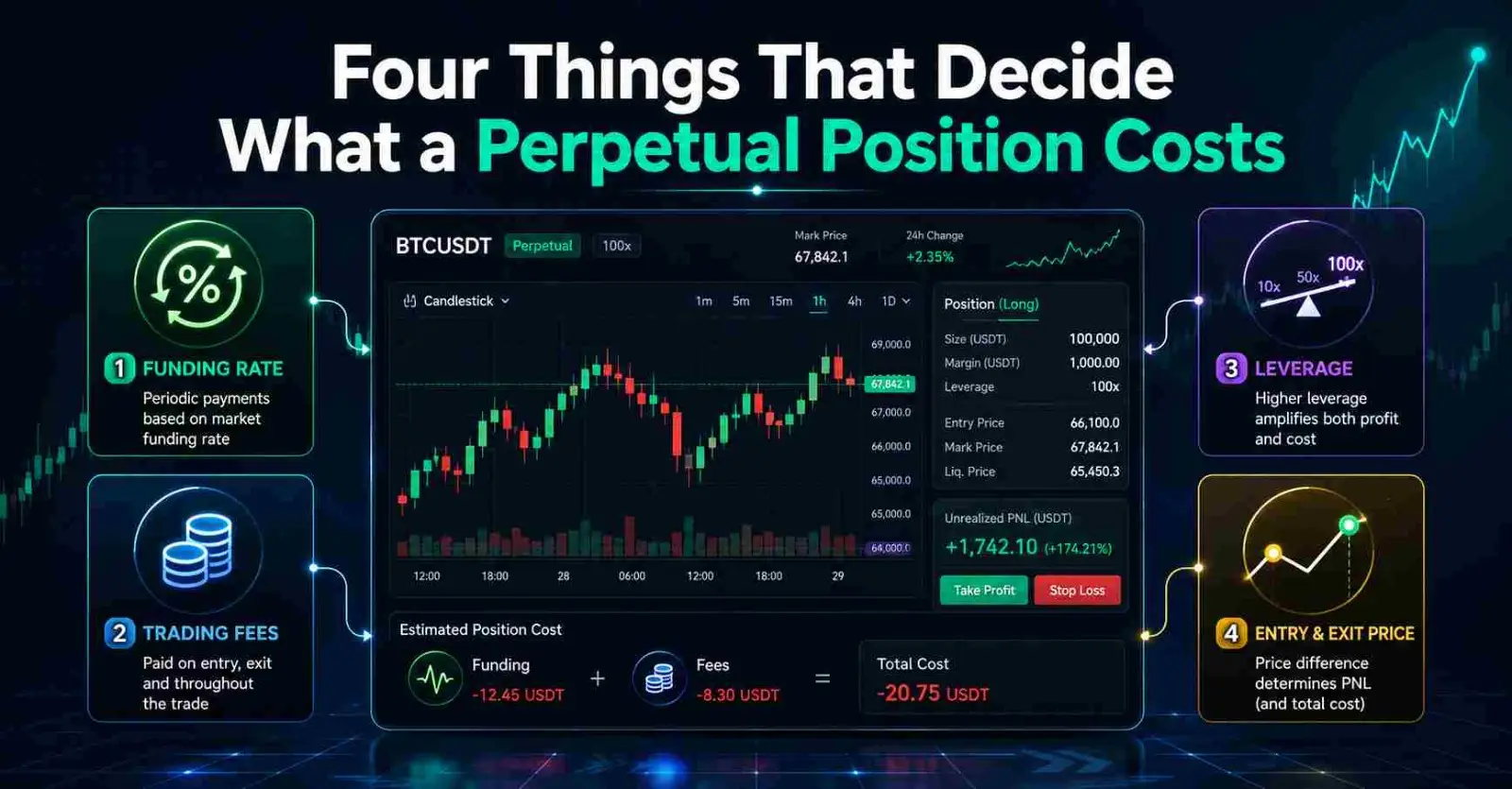
Four Things That Decide What a Perpetual Position Costs

Traditional futures have an expiry date. This date helps bring the contract price closer to the spot price. It also gives traders a clear deadline and makes the cost of holding the contract easier to understand.
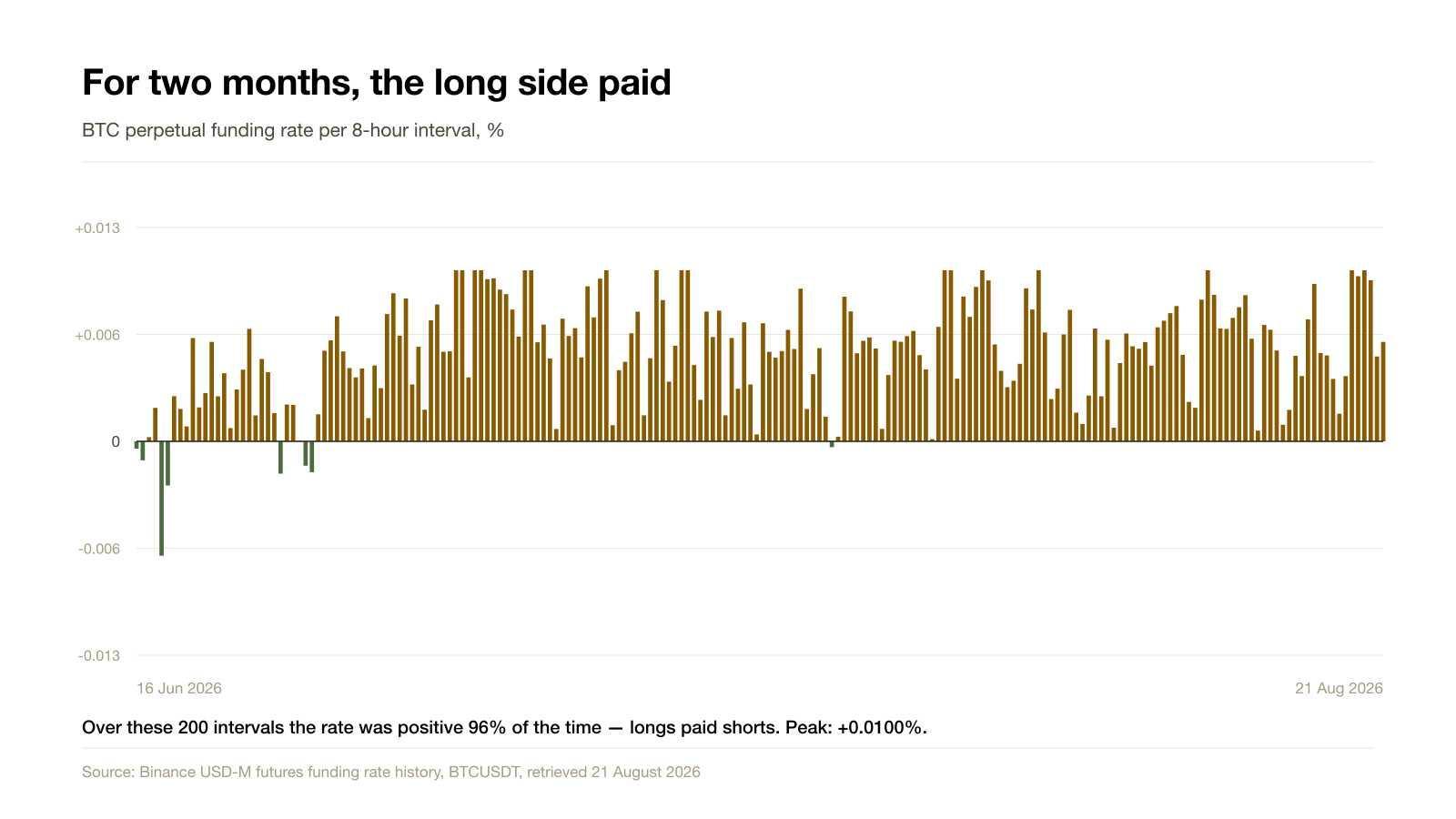
Two months of eight-hour funding intervals on BTC. Source: Binance USD-M futures, retrieved August 21, 2026.
Perpetual contracts remove the expiry date. The U.S. Commodity Futures Trading Commission describes crypto asset perpetual contracts as derivatives with no fixed expiration. These contracts are designed to stay close to the spot price of the asset they track.
Without an expiry date, another system is needed to keep both prices close. That system is a recurring payment between traders. It is known as the funding rate.
Whether you are trading on EVEDEX or using another perpetual venue, the basic idea is similar. When the final funding rate is positive, long positions usually pay short positions. When it is negative, shorts usually pay longs.
The rate changes with market conditions. Many perpetual contracts settle funding every eight hours. However, some contracts use four-hour, one-hour or continuous funding. Traders should always check the rules for the contract they plan to trade.
1. Why the Perpetual Funding Mechanism Exists
The main purpose of funding is to create market pressure that keeps the perpetual price near the spot index. It is not normally a standard fee collected as revenue by the exchange.
If a perpetual contract trades above the spot price, a positive funding rate can make long positions more costly. At the same time, short positions may receive funding. This can attract more sellers and reduce demand from buyers, helping the contract move closer to the spot index.
The opposite can happen when the perpetual price trades below the spot index. A negative funding rate may cause shorts to pay longs, creating an incentive for more traders to take the long side.
Funding payments normally move between traders. However, every platform can have its own calculation method, limits and settlement times. Readers can learn more about how a funding rate works before estimating the cost of a position.
2. How Funding Changes the Cost of a Position
A funding rate may look very small on a trading screen. The total cost can still become meaningful when it is applied to a large position several times each day.
Funding is normally calculated from the full notional value of the position. It is not calculated only from the margin used to open that position.
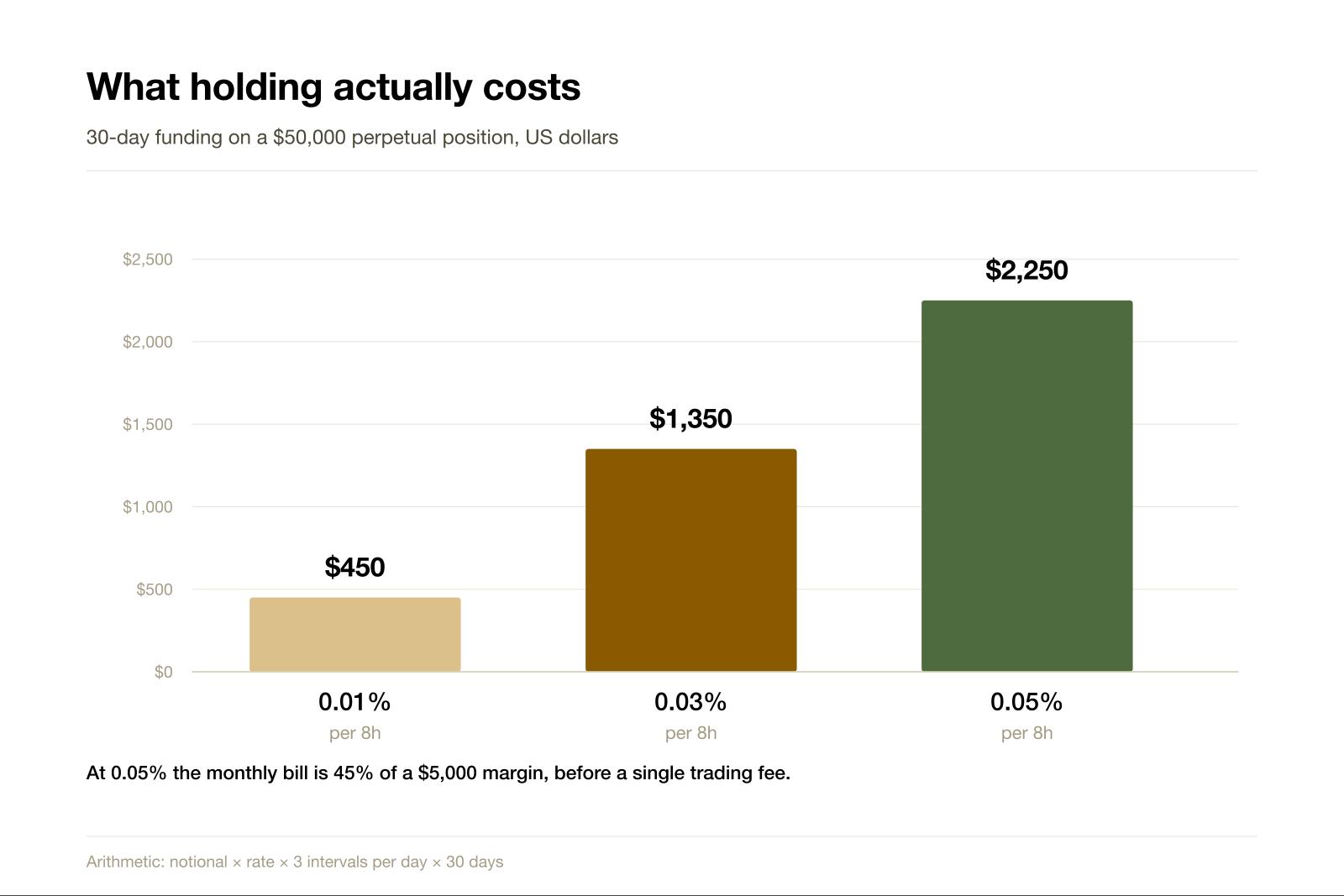
Example Using a 0.01% Funding Rate
Consider a $50,000 long position with a funding rate of 0.01% per interval. Assume that funding is paid three times per day.
-
Cost per interval: $50,000 × 0.01% = $5
-
Daily funding cost: $5 × 3 = $15
-
Thirty-day funding cost: $15 × 30 = $450
-
Share of the position: $450 equals 0.9% of $50,000
-
Share of the margin: $450 equals 9% of a $5,000 margin balance
The trader would spend $450 on funding over 30 days if the position size and funding rate stayed the same. This calculation does not include opening fees, closing fees, spread or slippage.
Real funding rates do not remain fixed. They can rise, fall or become negative. The actual funding cost must be calculated from every settlement that occurs while the position is open.
Example Using a 0.05% Funding Rate
Now assume that the funding rate rises to 0.05% per interval. The same $50,000 long position would cost $25 at each settlement.
-
Cost per interval: $50,000 × 0.05% = $25
-
Daily funding cost: $25 × 3 = $75
-
Thirty-day funding cost: $75 × 30 = $2,250
-
Share of a $5,000 margin: 45%
This is a calculation example, not a prediction that a 0.05% rate will continue for 30 days. It shows why traders should calculate the total expected payment instead of looking at one funding rate alone.
The reverse case is also possible. A short position may receive payments during a period of positive funding. However, funding income does not remove price risk. A sharp price increase can cause a loss much larger than the funding received.
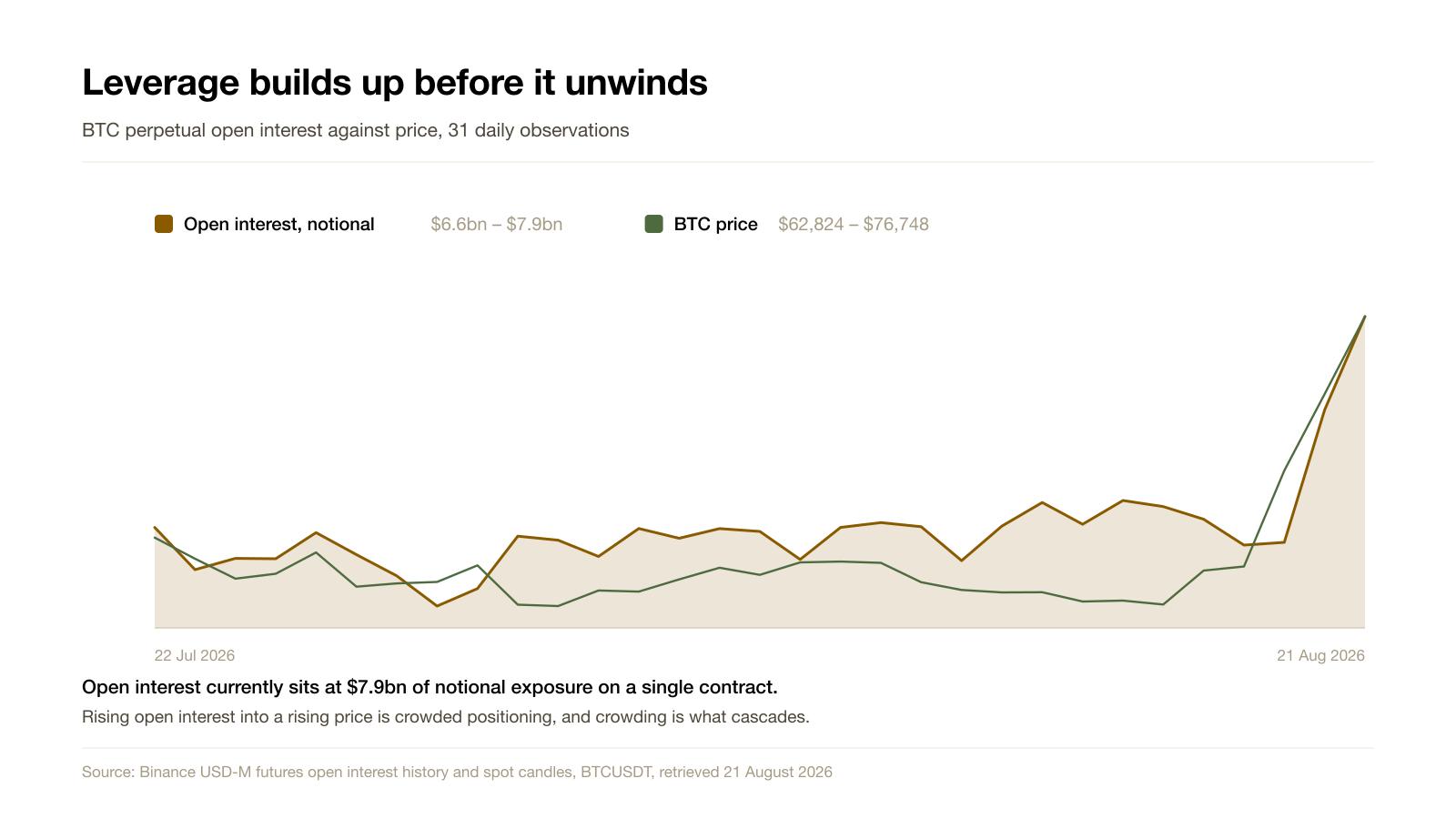
High positive funding may also show that long positioning is crowded. If the price begins to fall, forced closures can add more selling pressure and contribute to a liquidation cascade.
3. How Leverage Affects Perpetual Futures Costs
Funding builds slowly over time. Liquidation can close a position within seconds.
Leverage allows a trader to control a position that is larger than the amount of margin deposited. For example, $5,000 of margin can control a $50,000 position at 10x leverage.
A simple calculation suggests that a 10x position has about 10% of price room, a 50x position has about 2%, and a 100x position has about 1%. These figures show how fast losses can grow, but they are not exact liquidation thresholds.
The real liquidation price depends on several factors:
-
The exchange’s maintenance margin requirement
-
The mark price used to measure the position
-
The size and risk tier of the position
-
Funding taken from available margin
-
Opening, closing and liquidation fees
-
Extra collateral added by the trader
Because these rules vary, traders should use the platform’s own liquidation calculator. CoinGabbar’s guide to how crypto liquidation works provides a clearer explanation of forced position closures.
A trader can also review this crypto leverage trading guide to understand the connection between leverage, margin and risk.
Why Regulatory Protection Matters
Regulators have repeatedly warned retail traders about high-risk leveraged products.
The European Securities and Markets Authority introduced a limit of 2:1 on cryptocurrencies for cryptocurrency CFDs offered to retail clients under its 2018 product intervention measures.
ESMA also reported that national regulators found that 74% to 89% of retail CFD accounts typically lost money. These figures relate to CFDs and should not be treated as the loss rate for every perpetual futures market.
Platforms offering very high leverage may operate under different regulatory rules. The legal protections available to a trader depend on the provider, product and country. A venue that accepts users from one location may not be authorised to offer the same product in another.
4. How Crypto Volatility Increases Trading Risk
Volatility is the variable under every funding, leverage and liquidation calculation. Crypto prices can move sharply within a short time, especially when market liquidity is low.
A Bank for International Settlements working paper developed the idea of a crypto multiplier. It measures how strongly a cryptocurrency’s market capitalization can respond to inflows and outflows of investor funds.
The researchers found that the effect may be larger when a high share of the available coins is held as an investment instead of being used for payments. In such a market, a modest change in investor flows may lead to a much larger change in valuation.
For leveraged traders, this means a liquidation move does not always require major news. A normal rise in selling pressure can be enough to move a thin market quickly.
Slippage Can Add Another Hidden Cost
Slippage happens when an order is filled at a different price from the one a trader expected. It often becomes worse during fast markets or when an order book has limited liquidity.
A liquidation engine may try to close a position near a set price. However, there may not be enough buyers or sellers at that level. The position could then close at a less favourable price.
Depending on the venue, any remaining loss may be handled through an insurance fund, automatic deleveraging or another loss-management system. Traders should understand these rules before placing funds on a platform.
Perpetual Futures vs Traditional Futures Contracts
Both products provide price exposure through a contract. Their expiry rules, price anchors and holding costs are different.
| Feature | Perpetual Futures | Traditional Futures |
| Expiry | No fixed expiry date | Fixed settlement date |
| Price anchor | Funding and market incentives help keep the contract near spot | The contract normally moves toward spot as expiry approaches |
| Holding cost | Funding may be paid or received at set intervals | Time and basis are reflected in the contract price |
| Liquidity | Often concentrated in one continuing contract | May be divided across monthly or quarterly contracts |
| Main risks | Funding, leverage, liquidation, slippage and platform risk | Leverage, basis, liquidity, expiry and rollover risk |
How to Calculate the Full Cost of a Position
The advertised trading fee does not show the full cost of holding a perpetual position. Traders should calculate every possible charge before entering.
Estimated total cost = opening fee + closing fee + funding paid + spread + slippage
Funding received can reduce this total. However, it should not be treated as guaranteed income because the rate and market price can change before the next settlement.
Traders should also remember that a profitable price move does not always produce a profitable trade. Funding, fees and slippage can reduce or remove the gain.
What to Check Before Opening a Perpetual Position
Reviewing the contract rules before entering can reveal costs and risks that are not clear from the headline leverage or trading fee.
-
Calculate the funding total: Multiply the current rate by the position size and expected number of settlements.
-
Check the funding interval: Do not assume that every contract settles funding every eight hours.
-
Find the liquidation price: Check it before entering and monitor it while the position is open.
-
Review the mark price: Learn which reference price the platform uses to trigger liquidation.
-
Confirm the margin mode: Isolated and cross margin expose different amounts of collateral.
-
Include all trading fees: Calculate maker, taker, closing and possible liquidation charges.
-
Review available liquidity: A thin order book can increase spread and slippage.
-
Check the loss process: Understand the insurance fund and automatic deleveraging rules.
-
Understand custody: Review who controls the collateral and how withdrawals work.
-
Check smart contract risk: Self-custodial systems can still face bugs, pauses, oracle failures or network congestion.
-
Confirm legal availability: Check whether the product is authorised in your country.
CoinGabbar’s crypto derivatives platform guide explains how to compare fees, custody, margin rules and risk controls.
Conclusion: Know the Real Cost Before Trading
Perpetual futures are useful tools, but their full costs are not always clear on the trading screen. Four main factors shape the outcome: funding rates, position size, leverage and market volatility.
A small funding rate can become a large cost when it is applied to a high-value position several times per day. High leverage can also place the liquidation price close to the entry price. Fast markets may then add spread and slippage.
Before opening a position, calculate the total funding cost, review the liquidation price and check the platform’s margin rules. The advertised leverage and trading fee tell only part of the story.
Disclaimer: This article is for informational and educational purposes only and does not constitute financial or investment advice. Cryptocurrency derivatives and perpetual futures involve significant risk, including liquidation and loss of the margin assigned to a position. Readers should conduct their own research and consider their financial situation and risk tolerance before making trading decisions.
Also read: