GXT Exchange Presale 2026: Live Stages, Price & Full Guide

GXT Exchange Presale 2026: Live Stages and What You Should Know
GXT Exchange, a crypto trading platform offering spot, futures, P2P, and earn products, has opened its native token GXT for public purchase through a three-stage.
The sale follows a mining and airdrop phase that ran through the second half of 2026 and sits ahead of the project's planned Token Generation Event (TGE).
This article walks through the live GXT Exchange presale, pricing, and unlock terms based on GXT Exchange's official website and X account, along with the platform's broader tokenomics, product lineup, and the risk factors worth understanding before participating.
GXT Presale Stages and Live Pricing
The GXT Exchange Presale is structured in three price stages, with the price stepping up at each stage so early buyers pay less than later ones.
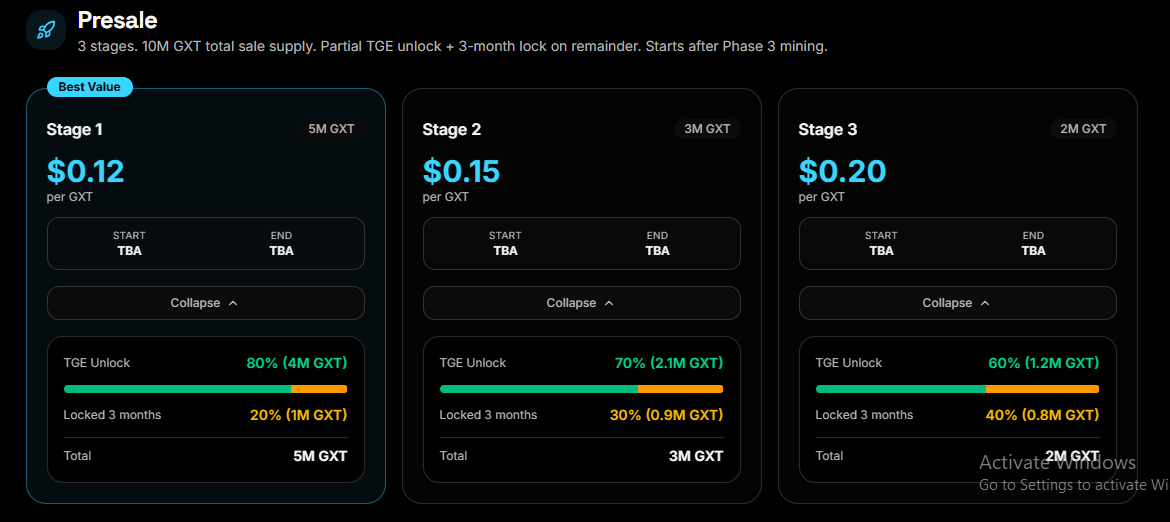
Source: GXT Exchange Roadmap
Stage | Price per | Supply Offered | TGE Unlock | Locked Portion | Status (as of Jul 22, 2026) |
Stage 1 | $0.12 | 5,000,000 | 80% at TGE | 20%, 3-month lock | Sold out (4,999,993.899 / 5,000,000 ) |
Stage 2 | $0.15 | 3,000,000 | 70% at TGE | 30%, 3-month lock | Live, 969,711.322 / 3,000,000 sold (about 32.3%) |
Stage 3 | $0.20 | 2,000,000 | 60% at TGE | 40%, 3-month lock | Upcoming |
At Stage 2's current price of $0.15, GXT is priced roughly 33% below the next stage target of $0.20.
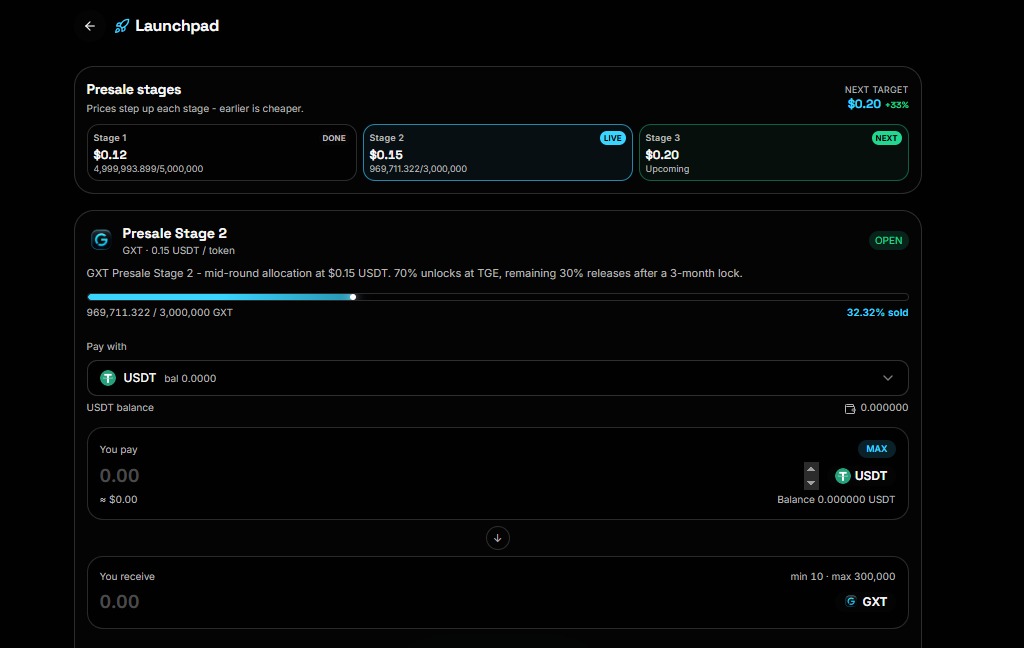
Source: GXT Exchange Launchpad
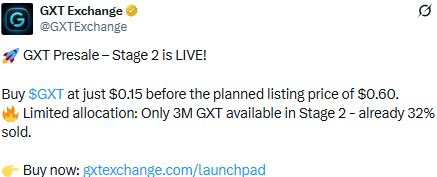
GXT Exchange's own marketing material lists a planned post listing price of $0.60, which would put Stage 2 buyers in at a 75% discount to that listing price if it holds.
Important note: A stated future listing price is a project target, not a guarantee, and listing prices frequently do not hold once a token starts trading on the open market, so this figure should be treated as promotional rather than predictive.
Buyers pay with USDT on the Launchpad page, and each Stage 2 purchase is capped at a minimum of 10 GXT and a maximum of 300,000 GXT per wallet.
The unlock structure also gets progressively less generous at TGE as the stages advance: Stage 1 buyers get 80% of their tokens immediately at TGE, Stage 2 buyers get 70%, and Stage 3 buyers get 60%, with the remaining balance in each case released after a three-month lock.
Presale Fund Allocation and Buyback Plan
Across all three stages, the presale is structured to raise up to $1,000,000 for a total of 10,000,000 GXT, broken down as follows:
Stage | Supply | Price | Raise Target |
Stage 1 | 5,000,000 | $0.12 | $600,000 |
Stage 2 | 3,000,000 | $0.15 | $450,000 |
Stage 3 | 2,000,000 | $0.20 | $400,000 |
According to GXT Exchange documentation, part of the funds raised in the presale is earmarked for a buyback-and-burn programme, where the exchange treasury matches presale proceeds 1:1 to repurchase and permanently burn GXT from the open market after launch.
The stated intent is to reduce circulating supply over time, though as with the listing price, this is a forward-looking plan rather than an executed mechanism at the time of writing.
GXT Tokenomics Snapshot
GXT has a fixed total supply of 300,000,000 tokens, with no additional minting planned according to the project. Of that, 100,000,000 GXT (33.3%) is set to be in circulation at TGE.
Allocation | Amount | Share | Vesting |
Community & Mining | 100M | 33.3% | 100% at TGE (includes 30M mining rewards) |
Team & Advisors | 60M | 20% | 48-month linear vesting |
Liquidity & Market Making | 50M | 16.7% | Exchange reserves, 0% at TGE |
Private Investors | 30M | 10% | 48-month vesting |
Marketing & Operations | 30M | 10% | 48-month vesting |
Reserve | 20M | 6.7% | Locked 10 years |
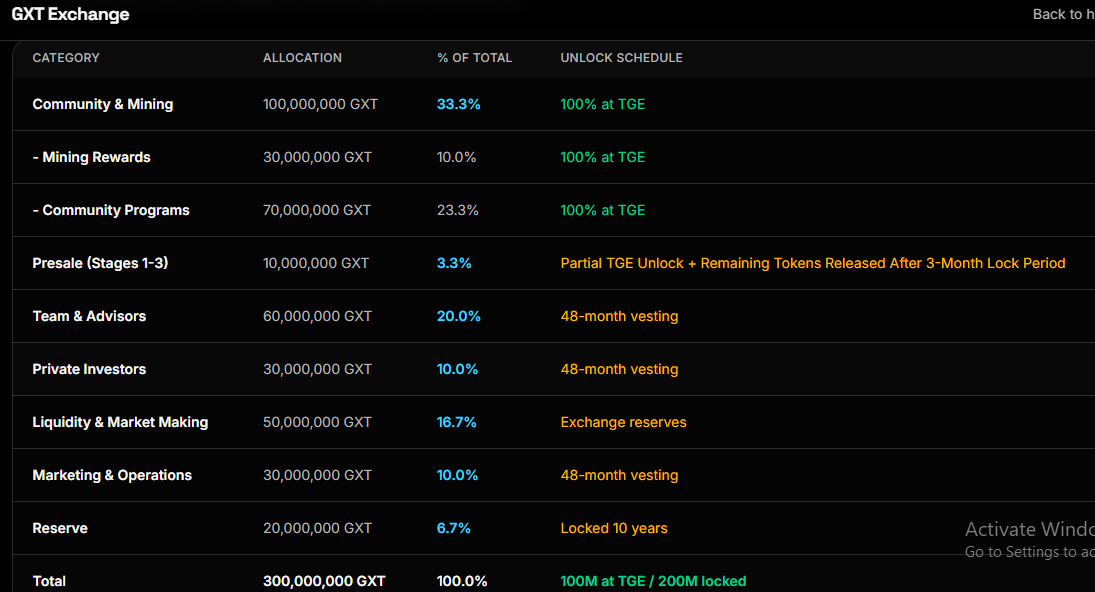
Source: GXT Exchange official roadmap
The 10,000,000 GXT allocation itself sits within the Community & Mining bucket in the project's supply breakdown and unlocks partially at TGE (80% / 70% / 60%, depending on the stage), with the remainder released after the three-month lock described above.
What GXT Is Used For
Per GXT Exchange's official materials (official website and X account), the token is positioned as a multi-purpose utility asset within the exchange ecosystem rather than a purely speculative asset. Stated use cases include:
Staking and earning rewards: GXT can be staked through the platform's Earn program.
Launchpad access: holding GXT is positioned as a gateway to future token launches on the exchange's launchpad.
Governance: GXT holders are meant to be able to vote on platform proposals as on-chain governance rolls out.
Mining rewards: GXT was distributed through the mining and airdrop phases that preceded the presale.
Ecosystem incentives: the token is also tied to staking rewards, liquidity programs, and community incentive campaigns.
These utilities depend on token building and maintaining the corresponding features (governance, expanded Earn products, and so on), most of which are listed on the roadmap as upcoming rather than live.
How the GXT Exchange Presale Fits Into the Wider Roadmap
The presale followed three mining phases where users could earn token through daily mining and airdrop tasks, running from late June through early August 2026 for a combined 30,000,000 GXT in rewards, unlocked 100% at TGE.
GXT Exchange presale has stated they open once mining concludes, followed by the TGE and mainnet token distribution. Project has set the TGE for August 28, 2026, according to its official X account.
Beyond the token launch, the project's public roadmap lists several items as upcoming with no fixed dates: listings on major centralized and decentralized exchanges.
On-chain governance for token holders, a "GXT Pay Card" spending card offered free to the first 1,000 Stage 1 buyers, a self-custody GXT Wallet with built-in DEX and NFT support, institutional and OTC services, and a planned native Layer 1 blockchain.
Because these are all listed as future milestones without confirmed dates, they should be treated as intentions rather than commitments when evaluating the project.
CoinMarketCap Listing: Submitted and Pending
Project announced on its official X account that token has been submitted for listing on CoinMarketCap, with Ticket ID #1434053.
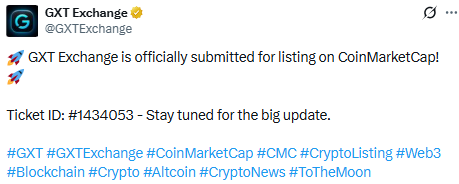
Source: GXT exchange X post
Note: A CoinMarketCap listing submission is pending as of this writing, dated as of July 22, 2026, and is not yet approved; treat it as in-progress, not confirmed
How to Buy token in the Presale
Go to the official Launchpad at gxtexchange.com and create an account.
Complete identity verification (KYC) if prompted.
Open the live presale stage on the Launchpad page.
Select USDT as your payment currency and deposit or fund your balance.
Enter the amount of token you want to buy, subject to the stage's minimum and maximum purchase limits.
Confirm the purchase. Your TGE-unlocked portion and the remaining locked portion (released after the three-month lock) will be tracked against the wallet or account used to buy.
Only use the official gxtexchange.com domain and the project's verified X account and Telegram to avoid phishing pages that mimic presale sites.
Note: Presale scams commonly use lookalike domains and cloned interfaces, so double-check the URL bar before connecting a wallet or sending USDT.
Risks to Consider
The team is not individually named
GXT Exchange's "About" page describes leadership only as "an international team of veterans from global exchanges" without naming specific individuals, founders, or executives.
There is no publicly linked whitepaper or team page identifying who is behind the project.
This makes independent background checks on the team difficult, and buyers should factor that lack of transparency into their own risk assessment.
Presale tokens carry lock-up risk
A meaningful share of each stage's allocation (20% to 40% depending on stage) is locked for three months after TGE.
The majority of the total token supply, covering Team, Investors, Marketing, Liquidity, and Reserve allocations, is subject to multi-year vesting or long-term locks.
Token price behavior around unlock events is uncertain and can put downward pressure on price as previously locked supply enters circulation.
Name collision with unrelated tokens
The ticker "GXT" is also used by at least two unrelated older projects, Gem Exchange and Trading and Global X Change Token, that appear on platforms like CoinMarketCap and Coinbase.
Buyers should confirm they are interacting with the correct contract address and official channels before sending funds, since ticker confusion is a common vector for mistaken purchases.
The listing price is not guaranteed
Marketing material references a planned $0.60 listing price.
Source: GXT exchange X post
But presale participants should treat this as a target rather than a certainty.
Since open-market prices are set by supply and demand once a token is tradable, plenty of presale tokens have been listed below their presale price historically.
Self-reported progress and licensing
Product completion percentages and licensing status published on the roadmap and about pages are self-reported by project rather than independently audited.
The project states it holds or is pursuing VASP registrations and digital-asset licenses across multiple jurisdictions but does not list the specific licenses or jurisdictions on its public about page.
General presale risk
As with any presale, funds are committed before the token is listed or trading, and the outcome depends on the project delivering its stated roadmap, including exchange growth, TGE execution, and exchange listings, on schedule.
Glossary
Presale: A pre-launch token sale that lets buyers acquire tokens before they are listed on exchanges, usually at a discount.
TGE (Token Generation Event): The event at which a project's token is created and initially distributed on-chain.
Vesting: A schedule that releases tokens gradually over time rather than all at once.
Circulating supply: The number of tokens actually available and tradable in the market at a given time.
Buyback and burn: A mechanism where a project repurchases its own tokens from the market and permanently removes them from supply.
VASP: Virtual Asset Service Provider, a regulatory classification used in many jurisdictions for crypto exchanges and related businesses.
Conclusion
Project enters its sale backed by a trading platform that is already live and operational, not a promise to build one later.
That distinction matters for evaluating the token's underlying utility.
The Presale tiered structure, transparent allocation math, and treasury-funded buyback mechanism also give it more disclosed detail than many comparable sales offer, and the fixed, non-inflationary supply cap removes one common source of long-term dilution risk.
None of that substitutes for independent due diligence, and the transparency gaps noted earlier in this piece still apply, but a functioning product suite alongside a documented token structure is a meaningfully different starting point than a presale with nothing behind it yet.
Disclaimer: This article is for informational purposes only and does not constitute financial advice. Presale participation carries risk, including price volatility, lock-up periods, and the possibility of loss. Do your own research and never invest more than you can afford to lose.
Also read: