InterLink Labs: Securing the Human Layer of the Digital Future

InterLink Labs: Post-Quantum Technology and Dual Tokenomics
Interlink Labs is developing a human-centric blockchain ecosystem designed to bring verified real people into Web3. It focuses on privacy-preserving cryptography and quantum-resistant design for developing security architecture, and its approach is to combine blockchain digital identity, blockchain infrastructure, AI payments, and privacy technologies in one ecosystem.
Alongside its identity-focused architecture, this emphasizes post-quantum security—an approach intended to prepare cryptographic systems for a future in which powerful quantum computers could threaten some of today's widely used cryptographic methods. Its current website describes its Chain as an EVM Layer-1 with quantum-resistant infrastructure.
What is InterLink Labs?
Interlink Labs is building what it calls a Decentralized Human Network. Users verify that they are real people through its ID, which uses technologies including biometric verification, liveness detection, and privacy-preserving cryptography. Verified participants become Human Nodes within the ecosystem.
This digital asset approach focuses on Proof of Personhood (PoP) and bot-resistant participation. It creates an environment for users where users verify their identity and is accessible for blockchain applications, payments, mining, and mini-apps.
The network includes several major components:
InterLink ID – Human identity and Proof of Personhood
InterLink App – User gateway to the ecosystem
InterLinkChain – EVM-compatible Layer-1 blockchain
ITLX Wallet – Non-custodial wallet
Mini Apps – Decentralized applications and services
InterLink Card – Real-world payment infrastructure
AI infrastructure – AI model development and decentralized participation
What is Post-Quantum Security?
Post-Quantum Security (PQS) refers to security technologies and cryptographic methods designed to protect digital systems from the potential threat of quantum computers.
Quantum computers could eventually become powerful enough to break or weaken some of the encryption and digital-signature algorithms widely used today. Post-quantum security aims to solve this problem by using quantum-resistant cryptographic algorithms that are designed to remain secure against both traditional computers and future quantum computers.
Interlink New Approach for Post-Quantum Security
Its approach is to store project biometric information directly in an encrypted representation and privacy-preserving proofs.
Quantum-Resistant Cryptography: The project's material reference post-quantum algorithms such as Kyber, Falcon, and Dilithium as part of its security approach.
Zero-Knowledge Proofs: Its ID uses zero-knowledge proof technology to support identity verification, while reducing the need to expose sensitive personal information.
Encrypted Biometric Information: Digital assets state that biometric information is encrypted when captured and that raw biometric information is not stored or exposed.
AI-Based Liveness and Deepfake Detection: The identity architecture combines AI-based biometric verification with liveness and deepfake detection. The objective is to make it more difficult for attackers to create fake identities and use manipulated media to bypass verification.
Research into Quantum-Resistant ZKPs: Interlink documentation also identifies quantum-resistant zero-knowledge proofs as a future research direction, alongside improvements in proof size, verification speed, and privacy-preserving technologies.
Why Does Post-Quantum Security Matter
The modern blockchain network depends heavily on cryptography to protect wallets, transactions, identities, and digital assets. The future scale of large-scale quantum computers could potentially weaken some existing cryptographic algorithms.
Post-Quantum cryptography, or PQC, focuses on cryptographic techniques designed to remain secure against attacks from both conventional and quantum computers.
This project's security architecture is particularly interesting because it combines post-quantum cryptography with decentralized identity and zero-knowledge technologies rather than treating blockchain security and identity as separate problems.
Key Features of InterLinks Labs
Proof of Personhood: It connects humans with Proof of Personhood-verified mechanisms and reduces the risk of fake identities and Sybil attacks.
Human-Centric Digital Identity: Its ID provides a framework for decentralized identities, which includes biometric verification and privacy-preserving proofs.
EVM-Compatible Layer 1: It has been positioned as an EVM-compatible Layer 1, supporting real-world payments, tokenized assets, and digital commerce.
Mobile Mining: The App allows users to participate through mobile devices without specialized crypto mining hardware. The current website describes mining as free and mobile-based.
Mini App Ecosystem: Mini Apps provide applications and services inside the ecosystem, allowing users to interact with different Web3 experiences through the environment.
InterLink’s Dual Tokenomics Model
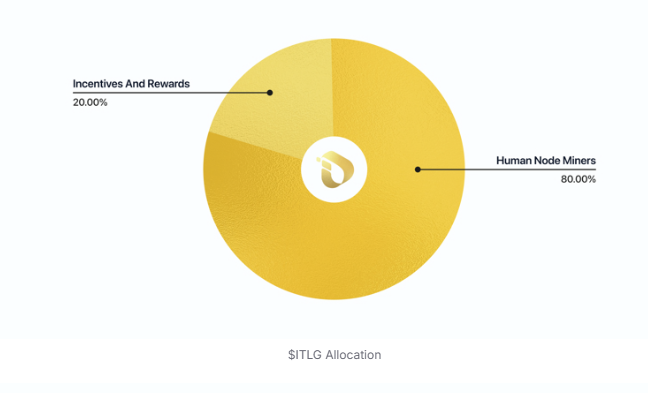
$ITLG - InterLink Genesis Token
ITLG represents participation by verified human users. According to the whitepaper, it is associated with DAO voting, ecosystem incentives, launchpad access, and payments within Mini Apps.
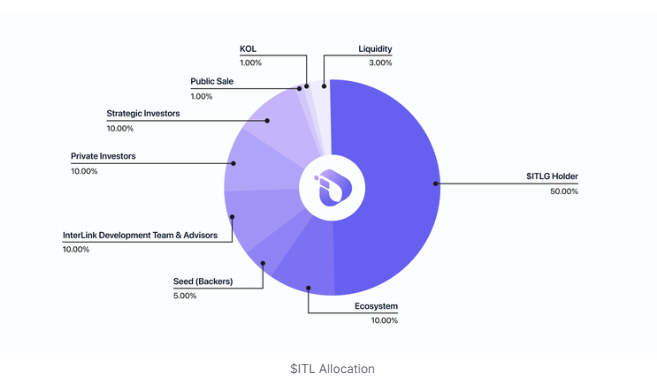
$ITL - InterLink Token
ITL is positioned more toward ecosystem-level utility. Its described functions include staking to access the Human Layer and supporting the Foundation's strategic reserve and coordination activities.
The project describes the model as separating community participation and governance through ITLG from broader utility and institutional functions through ITL.
InterLink Roadmap: Key Milestones
This is an interlink roadmap for our next five years:
Building the Foundation - 2025
InterLink focuses on launching its core products, including InterLink ID, App, Chain, SDK, Wallet, and ITLX. The project also targets advanced AI facial-recognition technology, 10 million verified users, and the rollout of InterLink Card for global payments.
AI and Global Expansion - 2026
The focus shifts toward AI development, personalized AI agents, and proprietary LLM technology. Blockchain also plans to expand its tokens to major global exchanges, grow its developer ecosystem, and increase token adoption through AI-funded UBI initiatives.
Global Humans Network - 2027 - 2030+
The project aims to build a network of 1 billion verified human users and expand $ITLG for financial aid, micro-grants, and inclusive employment rewards. The project also plans to grow its Mini-App ecosystem, increase global token adoption, and develop decentralized verification infrastructure that could reduce reliance on traditional KYC, CAPTCHA, and SMS OTP systems.
What Makes InterLink Different?
The interesting aspect of the project is the combination of human identity and post-quantum security.
Many blockchain projects primarily focus on scalability, smart contracts, interoperability, or transaction performance. Mining places greater emphasis on creating a network where verified humans are at the center of the ecosystem, while simultaneously exploring cryptographic technologies designed for the quantum era.
This approach could become particularly relevant for applications involving:
Digital identity
Financial services
Blockchain payments
AI agents
Governance
Airdrops
Reputation systems
Privacy-sensitive applications
Conclusion
The project's most interesting proposition is its attempt to combine human-centric identity with post-quantum and privacy-preserving technologies. By exploring post-quantum cryptography, zero-knowledge proofs, biometric verification, AI-based liveness detection, and blockchain infrastructure together, this asset is attempting to prepare a Web3 launchpad for a future where both digital identity threats and quantum computing risks may become more significant.
The project is therefore not simply focused on building another blockchain. Its broader vision is to create a secure, privacy-conscious, and human-centered Web3 environment designed with the quantum era in mind.
Disclaimer
This article is for informational purposes only and does not constitute financial, investment, trading, cybersecurity, or legal advice. Post-quantum technologies are an evolving field, and the effectiveness, implementation, and availability of specific technologies may change as research progresses. Readers should verify the latest information through Labs' official documentation before making decisions based on the project.
Also read:







.webp)