What Is Zcash? How ZEC Shielded Transactions Work

What Makes Zcash a Privacy-Focused Cryptocurrency?
ZEC just had its best run in years. A new exchange-traded product built around the coin, launched in August 2026, sent the price to levels not seen since 2016, and it brought a wave of new eyes to a project most people had filed under "old privacy coin" and forgotten about.
Before getting into what's driving that, it's worth answering the more basic question first: what actually is Zcash, and what does it let you do that other cryptocurrencies don't?
What Is Zcash (ZEC)?
Zcash, ticker ZEC, is a privacy-focused cryptocurrency that gives users a choice most blockchains don't offer: send a transaction that's fully public, or one that's shielded from view.
That's the whole idea behind it. Most blockchains, Bitcoin included, put every transaction on a public ledger anyone can inspect. Zcash keeps that option too, but it also lets you encrypt the details using zero-knowledge proofs, math that can confirm a transaction is valid without showing who sent it, who received it, or how much moved.
Zcash launched in October 2016 as a fork of the Bitcoin codebase, built by the Electric Coin Company. It kept Bitcoin's basic monetary design and added the option to hide transaction details using cryptography. The short version: Zcash is a cryptocurrency network, and ZEC is its native coin. Every ZEC transaction can go through a transparent address or a shielded one, and shielded transactions are the network's main privacy feature.
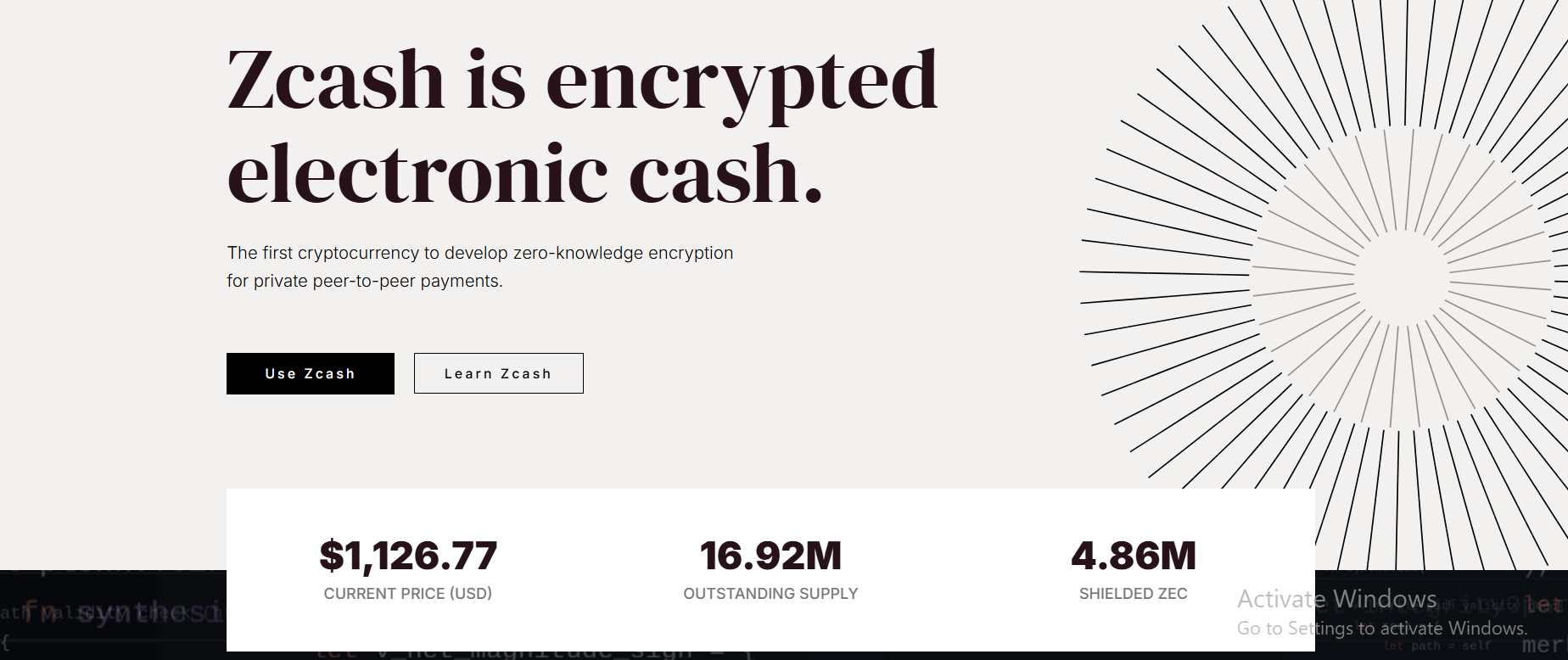
How Does the Zcash Network Work?
New coins enter circulation through mining, under a proof-of-work system. The network runs on Equihash, a mining algorithm built to lean on memory as much as raw computing power. Miners compete to add a new block roughly every 75 seconds, and each block pays out a fixed ZEC-reward.
A transparent address, or t-address, behaves the way a Bitcoin address does: anyone can look up its balance and history. A shielded address, or z-address, keeps that information encrypted on-chain. You can move ZEC between the two, but each move carries its own privacy trade-offs, covered next.
How Do Zcash Shielded Transactions Work?
This is the part most people actually want to know, so let's keep it simple.
Shielded transactions use a bit of clever math called zk-SNARKs. In plain terms, it lets the network check that a transfer is real and valid, without showing who sent it, who got it, or how much changed hands.
There are three ways a ZEC-transfer can go:
Transparent Shielded: funds move from a public address into a private one. People can still see the money leave, just not where it lands.
Shielded Shielded: the private option. Funds move between two private addresses, and nothing about the transfer is visible.
Shielded Transparent: funds move back out into the open. The receiving end becomes visible again, even though the sending side was hidden.
That last one is the catch. Privacy only holds as strong as its weakest link, so sending ZEC back out to a public address gives up a lot of the cover you just had.
One thing worth saying plainly: shielded doesn't mean anonymous. Your wallet, your exchange account, and how you got your-ZEC in the first place can still connect back to you, even if the transaction itself stays hidden on-chain.
Zcash's privacy tech has improved over the years too, most notably with an upgrade called Orchard, which also brought unified addresses, one address that works for both transparent and shielded payments.
What Makes Zcash Different From Bitcoin?
Since Zcash started life as a Bitcoin fork, it's worth laying the two side by side.
Feature | Bitcoin | Zcash |
Main focus | Digital money | Privacy-focused digital money |
Ledger | Fully transparent | Transparent and shielded |
Privacy | Public transaction data | Optional shielded transactions |
Consensus | Proof-of-work | Proof-of-work |
Maximum supply | 21 million BTC | 21 million ZEC |
The supply cap and mining model are nearly identical. What sets Zcash apart is the zk-SNARK privacy layer on top of that familiar structure. Bitcoin gives every user the same transparency by default; Zcash lets each user pick their own level, transaction by transaction.
What Does Zcash Tokenomics Look Like?
There was no presale and no founder premine for ZEC. Early supply came entirely from mining, starting with a brief slow-start period in 2016.
According to Zcash's own network page, block rewards currently split three ways:
Recipient | Share of Block Reward | Purpose |
Miners | 80% | Pays for network security under proof-of-work |
Zcash Community Grants (ZCG) | 8% | Funds independent teams building wallets and infrastructure |
Protocol lockbox | 12% | Accumulates in-protocol; no disbursement method decided yet |
The split matters because it decides how newly issued ZEC-gets divided between the people securing the network and the people building on it. An earlier model, active from 2020 to 2024, sent that 20% directly to the Electric Coin Company, the Zcash Foundation, and community grants instead of a lockbox.
How Does the ZEC Halving Schedule Work?
Like Bitcoin, Zcash cuts its mining reward in half on a roughly four-year cycle. Here's how that's played out so far.
Milestone | Approximate Date | Block Reward |
Network launch | October 2016 | 12.5 ZEC per 150-second block |
Blossom upgrade | December 2019 | 6.25 ZEC per 75-second block |
First halving | November 2020 | 3.125 ZEC per block |
Second halving | November 2024 | 1.5625 ZEC per block |
Third halving (expected) | Late 2028 | 0.78125 ZEC per block |
In simple terms, each halving slows how much new ZEC enters circulation through mining. As of early September 2026, market data platforms put circulating supply near 16.9 million ZEC, meaning roughly 80% of the eventual 21 million cap is already out there.
Why Is ZEC Getting Attention in 2026?
The short answer is an ETF. Grayscale converted its Zcash Trust into a listed exchange-traded product on August 25, 2026, and ZEC's price climbed sharply afterward, trading above $1,100 for the first time since 2016.
Market trackers have reported the ETF product holding several hundred million dollars in net assets within its first couple of weeks, alongside a ZEC market cap estimated around $19 to $20 billion. None of that guarantees the rally holds. Crypto prices move fast in both directions, and a run built heavily around one catalyst can cool off just as quickly.
What Are the Main Risks of Zcash?
Privacy is opt-in, not automatic: Most ZEC-still moves through transparent addresses, so the privacy features only help the people who actually use them
Regulatory pressure on privacy coins: Some exchanges have restricted or delisted privacy coins in certain countries, which can affect access.
A possible consensus change ahead: The team behind Zcash has talked about shifting to a hybrid model called Crosslink. Nothing's confirmed, and it still needs community approval.
Quantum-resistance work isn't done yet: An upgrade for this has been mentioned for 2026, but these things tend to take longer than planned.
Price is riding on one story right now: The recent rally is tied to a single ETF launch, which makes it shakier than growth built on broader demand.
What Should Users Know About Zcash Privacy?
If privacy is the reason you're looking at Zcash, a couple of practical points matter.
Shielded transactions protect what's visible on-chain, but they don't erase every trace of your activity. An exchange still knows who bought your ZEC. A wallet provider may still log your IP address. None of that shows up on the blockchain, but it can still connect your identity to your holdings.
Shielded and anonymous aren't the same word, either. Zcash is designed to provide transaction privacy, but that doesn't mean every user or transaction is automatically anonymous. Treat shielded-ZEC as one part of a broader privacy setup, not the whole thing.
Conclusion
Zcash set out to answer a fairly specific question: can a blockchain give users a real choice between a public ledger and encrypted transactions, without giving up on verifiable money? Its zk-SNARK-based shielded pool, its 21 million ZEC-supply cap, and its community-directed funding model are the pieces that make that possible.
The renewed attention in 2026 traces back to one clear catalyst, the Grayscale ETF conversion, but the underlying technology has been running quietly since 2016. Open questions remain, including how far its proposed consensus changes go and how much daily activity actually moves through shielded addresses. Those basics say more about Zcash than any single price chart can.
Disclaimer
This article is for informational purposes only and does not constitute financial advice. Crypto assets, including ZEC, are volatile and carry risk of loss. Always do your own research before making any investment decision.
Also read: