Zaviron Token Review 2026: ZVR Price, Risks and Tokenomics

A Closer Look at Zaviron’s Price, Plans and Risks
Zaviron is one of the more detailed presale pitches out there right now: a full whitepaper, a live dashboard, and a plan to combine e-commerce, payments, and loyalty rewards under one token. That level of documentation is worth something, but it's also just a starting point.
The real question for anyone searching for a Zaviron token review is simpler: does the project hold up once you check its own numbers against itself?
ZVR is being sold right now through a presale on the project's own site. This update goes through the whitepaper, the live presale dashboard, and outside research to lay out exactly what's confirmed, what's still a project claim, and what buyers should verify themselves before sending any funds.
What Is Zaviron and What Does the ZVR Token Do?
Zaviron describes itself as a digital commerce ecosystem. The stated plan combines an online marketplace, a payments network, a loyalty rewards system, a mobile wallet, and a contactless "Touch & Pay" card under one platform.
ZVR is the token that ties these pieces together. According to the whitepaper, ZVR is meant to serve as a governance token, a staking asset, a reward currency, and a payment method inside the ecosystem. The token runs on Ethereum as an ERC-20 asset, with multi-chain support listed as a future plan.
Total supply is fixed at 10,000,000,000 ZVR. The project states the supply cannot be increased once minted.
How Does the Zaviron Ecosystem Work?
None of the ecosystem's consumer products are live yet. What exists today is the presale itself. Here's what the whitepaper says each planned component will do:
Component | Stated Purpose |
Zaviron Marketplace | Commerce layer for physical and digital goods |
Zaviron Pay | Payment rail aimed at instant settlement |
Zaviron Rewards | Non-expiring loyalty rewards paid in ZVR |
Zaviron Wallet | App for holding, sending, and staking ZVR |
Touch & Pay Card | Contactless card linked to the wallet |
Open API | Toolkit for merchant and developer integrations |
The wallet is targeted for a beta release in Q4 2026, per the project's published roadmap. The marketplace and payment rail are not expected until Q1 2027 at the earliest, based on the same document.
What Does the ZVR Presale Look Like?
Presale terms on zaviron.io change stage by stage, and different pages have shown different figures within the same month. As of the most recent check:
Detail | Stated Figure |
Current Stage | Stage 10 |
Token Price | $0.0292 per ZVR |
Projected Listing Price | $0.15 – $0.185 |
Minimum Transaction | 11,100 ZVR |
Soft Cap | $5,000,000 |
Hard Cap | $30,000,000 |
Accepted Currencies | BTC, ETH, BNB, XRP, SOL, USDT, USDC |
The listing price above is a project target, not a confirmed exchange price. ZVR is not currently listed on any exchange, so this figure cannot be independently verified.
It's worth comparing this against coverage from earlier in the presale, which recorded a Stage 9 price of $0.0286 and a different tokens-for-sale figure. Presale stages do move fast, but the pace and direction of these changes are exactly what a cautious buyer should confirm live, on the dashboard, before sending funds.
How to Buy ZVR in the Presale
The project outlines a fixed process on its how-to-buy page. Here's what it involves:
Sign up on zaviron.io with an email address and accept the platform's legal agreements.
Choose a payment currency from the accepted list: USDT, USDC, ETH, BNB, BTC, SOL, or XRP.
Enter the ZVR amount to buy, respecting the 11,100 ZVR minimum transaction.
Send payment from a wallet you control to the address shown for the correct network.
Paste the transaction hash into the confirmation step so the payment can be verified.
Wait for confirmation. Once verified, the ZVR balance updates inside the presale dashboard.
Contact support at support@zaviron.io if anything doesn't confirm as expected.
What Does Zaviron's Tokenomics Model Show?
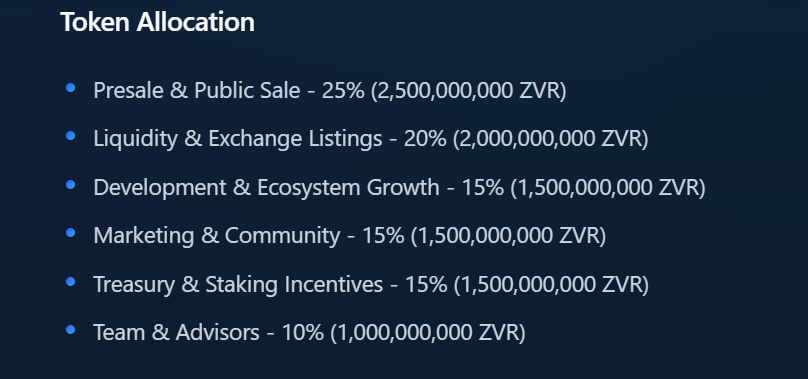
The whitepaper's tokenomics section lays out how the 10-billion-token supply is meant to be split across the presale, liquidity, development, marketing, treasury, and the team:
Allocation | Share | Tokens |
Presale & Public Sale | 25% | 2,500,000,000 |
Liquidity & Exchange Listings | 20% | 2,000,000,000 |
Development & Ecosystem Growth | 15% | 1,500,000,000 |
Marketing & Community | 15% | 1,500,000,000 |
Treasury & Staking Incentives | 15% | 1,500,000,000 |
Team & Advisors | 10% | 1,000,000,000 |
The presale and liquidity buckets together account for 45% of supply, which is meant to fund the token sale itself and support trading liquidity once ZVR reaches an exchange. The remaining 55% is split across development, marketing, treasury, and the team.
On vesting, the whitepaper states the Team & Advisors allocation follows a 12-month cliff with 48-month linear vesting after that. Development, treasury, and marketing allocations are described as releasing on multi-year, milestone-based schedules. Readers can check the full whitepaper for the complete breakdown.
What Does the Zaviron Roadmap Promise?
The stated roadmap runs in six phases, from the current token sale through multi-chain governance:
Phase I (Q3 2026): Complete the token sale, run audits and security reviews, prepare exchange listings.
Phase II (Q4 2026): Launch a wallet beta, initial staking, and the rewards engine.
Phase III (Q1 2027): Marketplace MVP, Zaviron Pay beta, first merchant integrations.
Phase IV (Q2–Q3 2027): Touch & Pay card launch, expanded loyalty programs.
Phase V (Q4 2027): Fiat on/off-ramps, open API, developer portal.
Phase VI (2028): Governance portal, on-chain voting, multi-chain expansion.
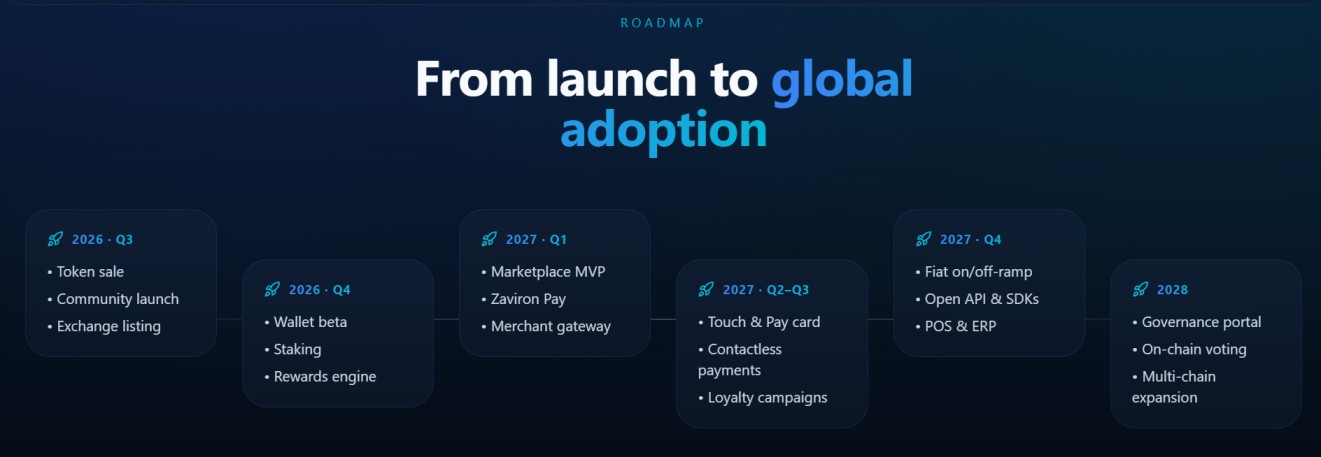
Every phase past Phase I is a stated plan, not a confirmed delivery. Crypto roadmaps commonly slip, so treat these dates as directional rather than guaranteed.
Key Risks to Consider
No exchange listing yet: ZVR only trades through the presale right now, so there is no open market price to check the project's own figures against.
Audit claims aren't independently confirmed: The homepage shows an "Audited Contract" badge, but no published audit report from a named security firm, such as CertiK or Hacken, was located through independent research.
The team remains unidentified: The whitepaper's team section describes general areas of expertise without naming a single founder, executive, or advisor.
Core products, including staking, aren't live yet: The marketplace, payment rail, wallet, card, and staking are all still roadmap items, not working products, so none of the token's stated utility can be tested today.
Look-alike tokens circulate elsewhere: A separate, unrelated token using similar branding trades on another network.
Is Zaviron Safe to Use in 2026?
There's no single yes-or-no answer here. The project publishes a detailed whitepaper, a working presale dashboard, and stated eligibility rules covering age and legal capacity, which are signs of at least basic operational structure.
Set against that: no independent audit report has surfaced, the team is not named anywhere, and ZVR has no exchange listing to verify its price against. None of the ecosystem's actual products, including the wallet, marketplace, card, and staking, has launched.
The stronger signal right now is caution rather than confidence. Anyone considering the presale should confirm the audit status and contract details directly with the project first, and seize any position with the risk of total loss in mind.
Conclusion
Zaviron is a presale-stage project pitching a combined commerce, payments, and rewards ecosystem powered by the ZVR token. The stated total supply is fixed at 10 billion tokens, and the roadmap runs through 2028 across six phases.
What stands out is the scope of the plan. What remains uncertain is basic verification: no named audit firm has confirmed the smart contract, and the team hasn't been identified. Readers should check the current presale dashboard directly, look for a published audit report, and confirm the contract address before considering any purchase.
Disclaimer
This article is for informational purposes only and does not constitute financial or investment advice. Crypto presales carry a high risk of loss, including total loss of capital. Always verify project claims independently before participating.