Illinois Crypto Tax Faces Legal Challenge From Industry Groups


Blockchain Association and CCI Sue Over Illinois Crypto Tax
In major crypto news, the Blockchain Association and the Crypto Council for Innovation (CCI) sued the State of on August 21, 2026, challenging the tax before it takes effect.
The complaint, filed in the Circuit Court of the Seventh Judicial Circuit, Sangamon County, targets the Asset Tax Act, which imposes a 0.2% levy on transactions starting January 1, 2027.
As of August 25, 2026, the case remains pending with no ruling issued. The groups argue the 0.2% crypto tax Illinois lawmakers approved unlawfully singles out assets while similar traditional finance activity stays untaxed.
What Is the Illinois Crypto Tax Lawsuit About?
On August 21, 2026, the Blockchain Association and Council for Innovation jointly sued officials over the asset, according to their official joint filing.
The complaint asks the court to declare the Tax Act unlawful and to block enforcement through injunctive relief.
This marks the second lawsuit against the statute. The Chamber, a separate trade group, filed an earlier challenge in July 2026 on related but distinct grounds.
Detail | Information |
Law challenged | Digital Asset Act (Public Act 104-468, Article 3) |
Rate | 0.2% on asset exchange, transfer, or storage |
Effective date | January 1, 2027 |
Plaintiffs | Blockchain Association, Crypto Council for Innovation |
Court | Sangamon County Circuit Court |
Filing date | August 21, 2026 |
Why Are Blockchain Association and CCI Suing Illinois?
The Blockchain Association and Crypto Council for Innovation argue the discriminates against users by taxing activity while leaving equivalent traditional financial transactions untaxed.
Their complaint states the Illinois Digital Asset Tax Act violates the U.S. Constitution, the Constitution, the federal Internet Freedom Act, and state and federal due process protections.
The Blockchain Association lawsuit and CCI's joint filing raise several core claims:
Violation of the dormant Commerce Clause.
Conflict with the federal Internet Freedom Act.
Breach of Illinois and federal due process clauses.
Passage without adequate public debate, per the complaint.
CCI CEO Ji Hun Kim said the statute "unlawfully picks winners and losers through the code."
Blockchain Association CEO Summer Mersinger separately argued that state authority to regulate emerging industries has constitutional limits, and that cannot impose a regime that discriminates against commerce or fragments national compliance.
What Does the Digital Asset Tax Act Require?
Governor JB Pritzker signed the Illinois Digital Asset Tax Act into law in June 2026 as part of a broader revenue package, per the General Assembly's public record.
Digital brokers serving Illinois customers must register with the state Department of Revenue under the new framework.
The tax applies to the value of the in a covered transaction, not the broker's fee or any resulting profit or loss.
This structure means a transfer between wallets owned by the same customer could still trigger exposure under the statute's current wording.
How Does This Compare to the Digital Chamber Lawsuit?
Digital Chamber Suit | Blockchain Association / CCI Suit | |
Filed | July 2026 | August 21, 2026 |
Core argument | Taxes identical assets differently based on recordkeeping | Violates multiple constitutional and federal provisions |
Relief sought | Injunction against enforcement | Injunction against enforcement |
Status (Aug 25, 2026) | Pending | Pending |
Both cases target the same crypto tax law 2027 deadline through separate legal theories, so a ruling on one will not automatically resolve the other.
Together, they represent the most significant digital lawsuit activity against a single state law this year.
Conclusion
The lawsuit marks the second legal challenge to the Digital Asset Act in as many months, with the Blockchain Association and Crypto Council for Innovation now joining the Digital Chamber in seeking to block the law before January 2027.
With no ruling yet issued, the case remains one of the most closely watched digital asset lawsuit developments in the country, and its outcome could influence how other states approach the 0.2% has proposed for transactions.
Expert Opinion
The Illinois crypto lawsuit could shape how far states may go in taxing assets, analysts suggest.
A win for the plaintiffs may discourage other states from copying the model, while a ruling favoring could invite more transaction-based levies, fragmenting compliance for exchanges operating nationally.
Either outcome will likely stay part of the crypto news today cycle for months as the docket develops, adding to wider news around state-level law 2027 activity.
Industry reaction also surfaced on social media soon after the filing. X user @CryptosR_Us covered the news in a post, noting the two groups were seeking to block the before its January 2027 start date.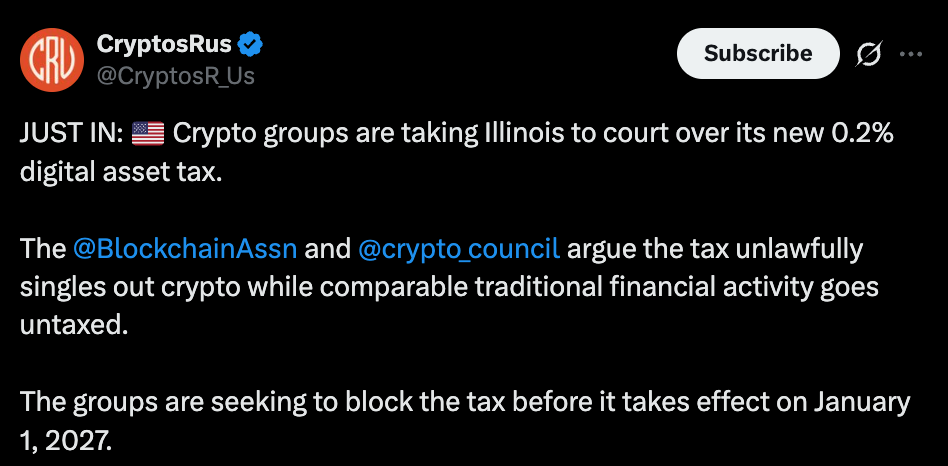
Disclaimer: This article is for informational purposes only and does not constitute legal, financial, or investment advice. The Act lawsuit remains pending, and outcomes in ongoing litigation are uncertain. Readers with holdings or operations affected by this lawsuit should consult a qualified legal or professional before making decisions.
Also read:









