Kalshi News Today: CFTC, Michigan Sports Bet and NJ Legal Fight Grows

Kalshi News Today: CFTC Action, Michigan Ban and Supreme Court Fight
It has been an eventful stretch in Kalshi news today, with the prediction-market platform facing regulatory pressure on several fronts at once. From a CFTC-driven retreat on athlete injury markets to a Michigan court order and a brewing Supreme Court fight, Kalshi's expansion into sports-linked contracts is running into legal resistance even as the company reportedly eyes an entirely different market: crude oil.
At a Glance
Kalshi removed all athlete injury and player-availability markets after a request from the CFTC.
The CFTC's June proposal flagged injury contracts over incentive, privacy, and manipulation concerns.
Kalshi prediction market had processed at least hundreds of thousands of dollars in injury-related wagers in 2026.
A Michigan court issued a preliminary injunction against Kalshi, with fines of up to $500,000 per day for non-compliance.
New Jersey has asked the U.S. Supreme Court to resolve a circuit split over state regulation of prediction-market sports contracts.
Kalshi news today is reportedly preparing a WTI crude oil perpetual futures application.
Kalshi Removes Athlete Injury Markets After CFTC Request
According to Sportico, Kalshi has taken down every market tied to the duration of athlete injuries or a player's game-day status, reportedly at the direct request of the CFTC. Markets referencing stars such as Anthony Edwards and Malik Nabers had let users wager on when an injured athlete might return to play, marking the most significant shift so far in this round of Kalshi news today.
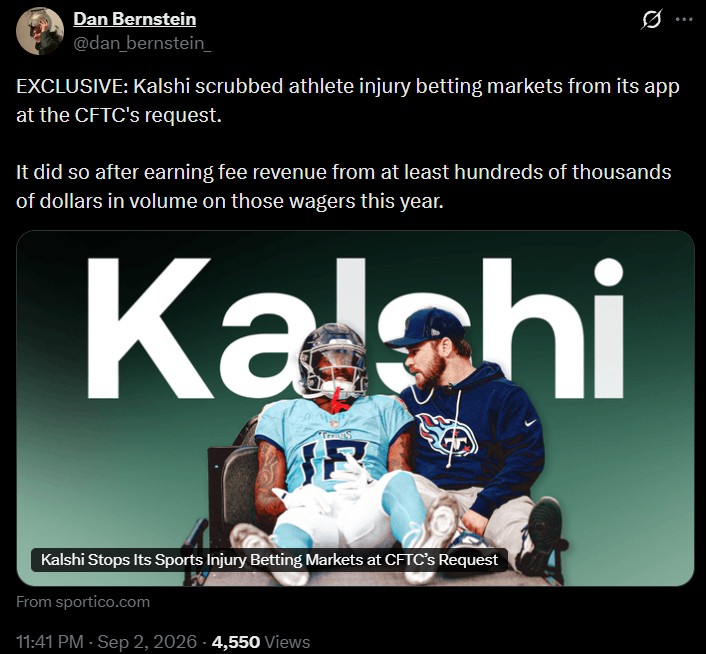
Source: Dan Bernstein
Key Details
Regulator involved | CFTC |
Markets removed | Athlete injury duration and availability |
2026 wager volume | At least hundreds of thousands of dollars |
Estimated fees | At least $8,000 |
Example markets | Anthony Edwards, Malik Nabers |
Main concerns | Privacy, incentives and manipulation |
Why the CFTC Objected?
The CFTC's proposed rulebook, put forward in June, singled out contracts based on the occurrence, severity, duration, or diagnosis of a specific athlete's injury as potentially "not in the public interest."
Regulators pointed to three main concerns: skewed financial incentives around a player's health, exposure of sensitive medical information, and difficulty protecting against manipulation given how few people typically have accurate, timely injury information.
Source: Wu Blockchain
How Much Kalshi Made From These Markets?
Kalshi reportedly facilitated at least hundreds of thousands of dollars in injury-linked wagers over the course of 2026, generating an estimated $8,000 or more in fees based on its published fee schedule.
The relevant markets operated under rule sets titled "INJURYRETURN" and "NFLINJURYRETURN," and a related "ATHLETE EVENT" framework also resolved to "no" whenever a player was ruled out for a given game.
What Happens to Existing Positions?
Kalshi pulled active injury markets from its app without notifying users in advance, and traders reportedly struggled to locate existing positions on the platform's Discord. The prediction Markets had not confirmed how open contracts will be settled, though industry precedent suggests a fair-market-value payout based on the last available odds is the likely path.
A Wider Regulatory Battle: Michigan's Injunction
Beyond the CFTC matter, a Michigan circuit court has issued a preliminary injunction ordering Kalshi to keep geofencing state residents out of its sports event contracts. The order requires to use a geolocation vendor licensed by Michigan's Gaming Control Board and threatens fines of up to $500,000 for each day of non-compliance.
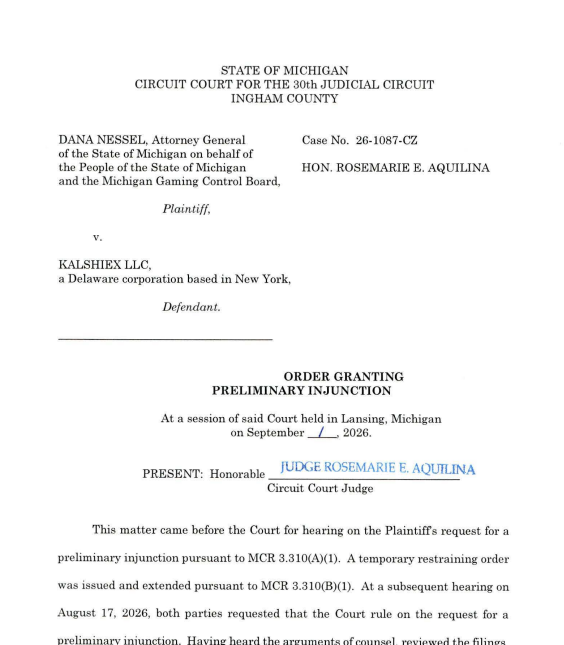
Source: Michigan Document
New Jersey Escalates to the Supreme Court
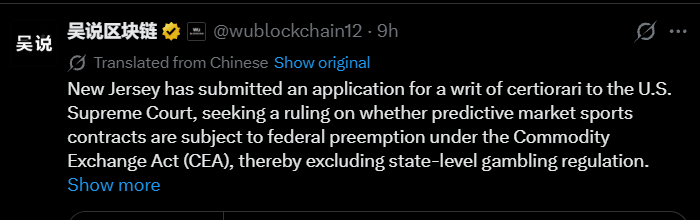
New Jersey has filed a petition asking the U.S. Supreme Court to decide whether the Commodity Exchange Act preempts state gambling law for prediction-market sports contracts.
The Third Circuit sided in April, ruling federal law controls, but the Ninth Circuit reached the opposite conclusion last week, creating a circuit split that increases the odds the Supreme Court could weigh in, though acceptance of the case is not guaranteed.
Source: WU Blockchain
Kalshi Eyes Crude Oil With WTI Perpetual Futures
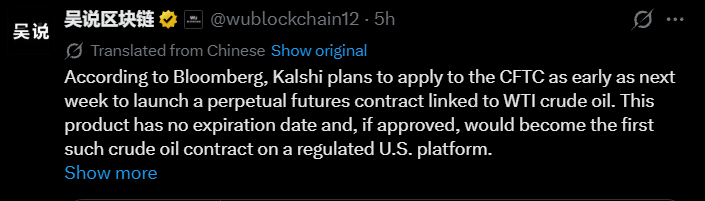
Away from sports, Bloomberg reports intends to apply to the CFTC as soon as next week for a WTI crude oil perpetual futures contract with no expiration date — a first for a regulated U.S. platform.
Unlike its round-the-clock crypto contracts, it reportedly plans to trade five days a week, a response to regulator concerns about continuous trading affecting benchmark Crypto price formation.
What Comes Next?
Several threads are worth watching: how open injury positions get resolved, whether the CFTC finalizes formal restrictions on injury contracts, how the Michigan injunction shapes Kalshi's broader sports offerings, whether the Supreme Court takes up New Jersey's case, and whether regulators approve the WTI futures product.
Conclusion
Taken together, these developments show a company caught between rapid product expansion and mounting legal resistance from federal regulators, state attorneys general, and the courts.
Kalshi's next moves on injury-market payouts, sports contracts, and its push into oil futures will likely shape how prediction markets are regulated across the U.S. for years to come.
Disclaimer: This content is provided for general informational and educational purposes only and should not be construed as financial, investment, legal, or betting advice. Cryptocurrency, derivatives, and prediction-market products are volatile and carry risk of loss. Always conduct your own research and consult a licensed professional before making financial decisions.
Also read:






