Treasury Bond Buybacks Expand as Bessent Targets Lower Rates

Treasury Bond Buybacks: What the Bigger Move Means for Markets
Washington just signaled it's done waiting on the Federal Reserve. The department confirmed it will at least double its Treasury bond buybacks and the size of its long-end debt purchases, and Secretary Scott Bessent has since made clear that's only the opening move in a much bigger push to force borrowing costs down.
What Was Actually Announced
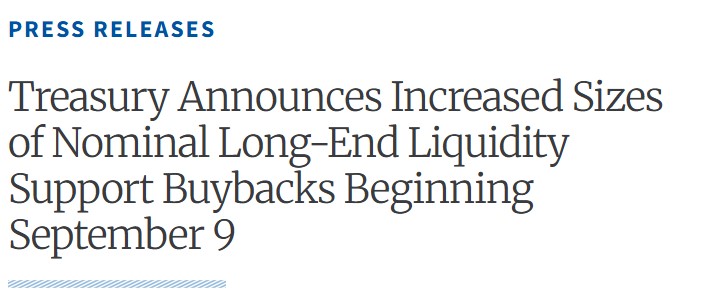
The U.S. Department of the Treasury said it is raising the maximum size of liquidity support buyback operations for longer-dated nominal coupon securities, covering both the 10-year to 20-year and 20-year to 30-year sectors, from $2 billion per operation to at least $4 billion.
This change to Treasury bond buybacks takes effect September 9, 2026, and runs through the end of the current refunding quarter on November 4, 2026, according to the department's own press release.
The department framed the move as a response to consistently strong demand it has been seeing in its longer-dated buyback operations, evidenced by the volume of high-quality offers it routinely receives.
Bessent Signals More Firepower Is Coming
Despite the announcement, yields on longer-dated debt didn't stay down for long, and Bessent has since made clear the department isn't finished.
Reports circulating around the bond market describe Bessent as willing to "do whatever it takes" to bring yields lower, a stance that goes beyond Scott Bessent buybacks in isolation.
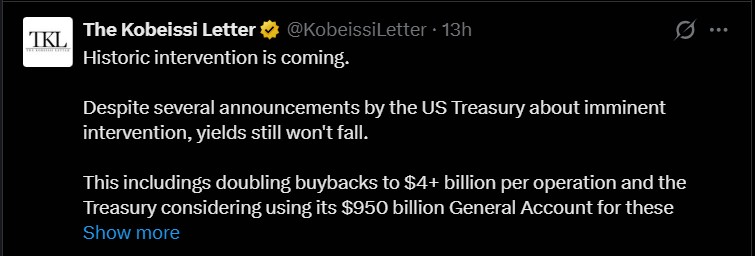
Per commentary from The Kobeissi Letter, that toolkit could extend to shifting more issuance toward short-term debt and potentially scaling back long-dated bond sales altogether, tools that sit well outside a routine buyback schedule.
The $950 Billion Account Now in Play
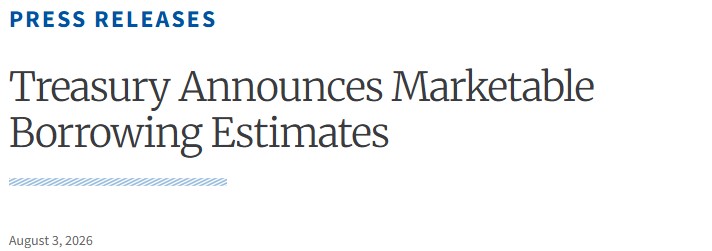
One especially notable option under consideration involves the department's General Account itself. Its own borrowing estimates assume an end-of-September cash balance of $950 billion, according to the department's Marketable Borrowing Estimates release.
A Bessent TGA / Treasury General Account buyback strategy would mean drawing down that cash pile directly to fund purchases, rather than relying solely on issuing new bills to finance them, an approach that would hand the department considerably more room to act without immediately adding to headline debt issuance.
Trump's Military Comment Adds to the Noise
The rhetoric escalated further on Friday night, when President Trump, responding to a reporter's question about further bond market action, said "the ultimate intervention is our military, and if we have to use that, we will," a remark also captured byThe Kobeissi Letter.
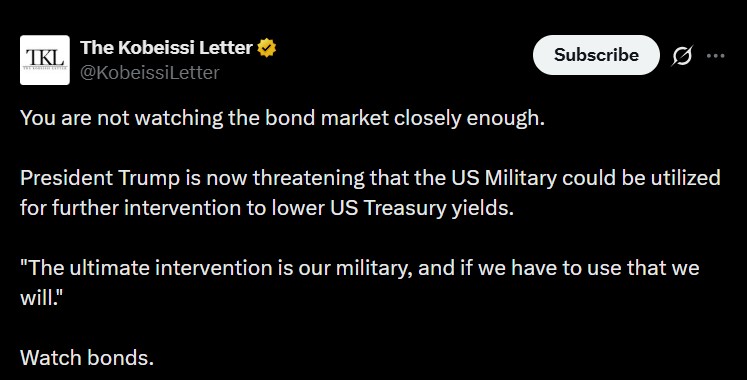
Exactly how a military response would translate into lower yields was left unexplained, and no follow-up policy detail has clarified the comment since.
What the moment does confirm is the level of frustration building at the top of the administration as borrowing costs refuse to cooperate.
Why the Fed Isn't the One Acting Here
The 30-year Treasury yield surged to its highest level in roughly 19 years this month, a run that has left the administration boxed in.
Cutting rates isn't realistic for the Federal Reserve in the current environment, and the administration appears to understand that constraint as well as anyone.
That leaves direct bond market intervention as effectively the only lever the department can pull on its own to push interest rates and yields lower in the short run.
The Treasury doubles buybacks as a headline event, but the underlying story is the department stepping directly into a role markets normally expect from the Fed, precisely because the Fed's hands are tied.
What Comes Next
None of this guarantees yields actually fall in a lasting way. The initial buyback announcement moved markets only briefly before yields climbed back, based on the department's own data trail through its scheduled operations.
Whether the TGA option gets activated, whether short-term issuance rises further, or whether long-dated bond sales genuinely shrink will likely become clearer as the September 9 start date approaches and Treasury releases its updated tentative buyback schedule.
These Treasury bond buybacks are just the opening chapter of a much longer story. For now, the message from Washington is straightforward: don't fight the Treasury.
Disclaimer
This article is for educational and informational purposes only and should not be considered financial or investment advice. Cryptocurrency prices are highly volatile, and past performance does not indicate future results. Always conduct your own research before making investment decisions.









