Crypto Exchange Hacks 2026: Full List and Lessons


Crypto Exchange Hacks in 2026: Why the Losses Keep Growing
Last updated: November 5, 2026. Figures on this page come from exchange statements, security firms, and news reports listed in the Sources section. Fast-moving numbers are marked with the date they were last confirmed.
Crypto exchange hacks are thefts in which attackers drain wallets controlled by a trading platform. Most succeed by breaching staff devices, signing tools, or outside vendors, not by breaking the blockchain itself. Traders now ask a simple question: is money safe on a trading platform?
Blockchain analytics firm TRM Labs counted 207 separate hacks and about $972 million stolen in the first half of 2026. Incidents more than doubled from a year earlier, but losses fell below half of the $2.3 billion stolen in the first half of 2025. Other firms use wider methods and report higher totals: Blockaid counted 212 exploits and more than $1.1 billion.
That trend changed on October 29, 2026, when Binance reported an estimated $6.3 billion impact, the largest crypto theft on record. This article reviews five major cases and what they mean for everyday traders.
Key Takeaways
- The five cases below add up to roughly $7 billion in reported losses. Binance alone is about 90% of that total.
- Operational failures, such as compromised devices, forgotten wallets, and weak approval controls, drove most losses.
- Exchange protection funds are voluntary promises, not legal guarantees. Proof of reserves does not show that an exchange can pay all its debts.
- Several details, including the exact cause of the Binance theft, are still unconfirmed.
How Crypto Exchange Hacks Happen
An exchange keeps customer coins in wallets it controls, so one weak spot can put huge balances at risk. Most coins sit in cold storage, which means wallets kept offline. Daily withdrawals run through crypto exchange hot wallets, which stay online so customers can move money fast. Warm wallets sit between the two and hold funds that are refilled into hot wallets as needed.
Attackers aim at the tools that approve payments, such as employee laptops, signing software, and outside providers. TRM Labs found that infrastructure and key compromises made up only about 15% of first-half 2026 incidents, yet caused roughly 76% of the money lost.
Once a transfer goes through, it is hard to undo. Thieves usually split funds across many networks and swap them into coins that cannot be frozen. Stablecoin issuers such as Tether and Circle can freeze their own tokens, which gives recovery teams a small window. Token choice also matters for traders; this guide explains how a crypto exchange listing is decided.
Biggest Exchange Breaches of 2026 by Loss and Impact
Binance: About $6.3 Billion on October 29, 2026
Binance said on October 30 that the incident had an estimated impact of $6.3 billion, with about $3 billion frozen on-chain. TRM Labs measured $6.36 billion leaving wallets on ten blockchains, most of it in about 20 minutes starting at 20:05 UTC. A public timeline shows Circle froze 823 million USDC within about an hour.
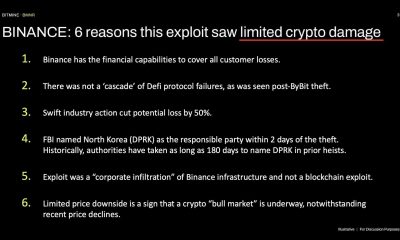
Binance said early findings point to a compromised laptop belonging to a DevOps engineer. The company has not published its full technical report, so the exact cause remains unconfirmed. Binance said it would cover all losses and, as of its October 31 update, reported replacing about 90% of the affected assets. Withdrawals began reopening in phases on November 1.
Security firms and the FBI were reported to link the pattern to North Korea-backed groups. That attribution has not been independently proven in public court records. BNB fell about 7% overnight after the news. Exchange tokens and crypto exchange stocks tend to react fast to security headlines.
Bitget: $387.5 Million on September 24, 2026
Bitget's systems flagged unauthorized transfers from hot and warm wallets at 18:31 UTC on September 24. The first estimate was $351.6 million. After more stolen assets were found on Zcash and TRON, the figure rose to about $387.5 million across seven networks. Bitget's CEO pointed to North Korean affiliates and said the protection fund would cover users.
Bitcoin withdrawals resumed on September 28. The exchange also committed to restoring its protection fund to a $300 million baseline. Insurance-style funds like this are company commitments, so their size and terms deserve a check.
Drift: About $285 Million on April 1, 2026
Drift is a decentralized trading platform on Solana, not a centralized exchange. It is included here because it ranks among the largest platform thefts of 2026 and shows the same lesson: who controls access matters as much as the code. Drift confirmed a loss of about $285 million, and estimates range from $270 million to $286 million. TRM Labs and Elliptic both found signs of North Korea links, but called the attribution suspected, not final.
Drift later said the attack followed a six-month social engineering effort that began at a crypto conference. A recovery and relaunch plan with Tether support was reported afterward, though readers should check Drift's own channels for the current status.
CoinDCX: 15.99 Million USDT on October 21, 2026
Indian exchange CoinDCX lost 15.99 million USDT from old deposit wallets tied to its July 2025 breach, which cost about $44 million. Its co-founder first called the reports a false alarm on October 22. On October 25, the company confirmed the loss and blamed a failed automated process that was meant to sweep deposits out of those addresses.
CoinDCX said it absorbed the full loss. Tether froze about $2.21 million, or roughly 14% of the stolen amount.
Mercado Bitcoin: $40 Million to $46 Million on November 2, 2026
Brazil's largest exchange paused deposits and withdrawals after a security incident. The Block reported about $46.3 million in affected assets based on Arkham data, and Hypernative flagged more than $40 million across at least ten blockchains. Tether froze more than 4.5 million USDT.
The exchange said no customer was affected and no data leaked. Some blockchain security experts disputed that claim, citing on-chain evidence. The exchange has not confirmed a final loss figure or named an attacker.
Comparison of the Five Incidents
| Exchange | Date (2026) | Reported loss | Weak point | Status on Nov 5, 2026 |
| Binance | Oct 29 | About $6.3 billion | Early finding: compromised engineer laptop (unconfirmed) | About $3 billion frozen; losses to be covered; report pending |
| Bitget | Sep 24 | About $387.5 million | Backend wallet systems | Withdrawals resumed; protection fund being rebuilt |
| Drift | Apr 1 | $270 to $286 million | Social engineering and access abuse | Recovery plan reported |
| CoinDCX | Oct 21 | About $16 million | Retired deposit wallets | Exchange absorbed loss; about $2.21 million frozen |
| Mercado Bitcoin | Nov 2 | $40 to $46 million tracked | Under investigation | Final figure unconfirmed |
What the Biggest Crypto Exchange Hacks Have in Common
An exchange security comparison of these cases shows the same problems again and again: compromised devices and logins, weak control over who approves withdrawals, forgotten wallets, outside software providers, and well-funded attackers.
A simple calculation adds context. Binance's reported $6.3 billion is about 6.5 times the $972 million stolen across all of the first half of 2026. The freeze rate also varied widely: about half of the Binance amount was frozen, compared with roughly 14% at CoinDCX. Stablecoin-heavy thefts allow faster freezes, while thefts in Bitcoin or other unfreezable assets leave little room for recovery.
Reserves then shaped the outcome. Platforms with large protection funds or strong balance sheets promised quick repayment, while thinner ones risked long freezes. A shutdown can follow a major loss too. Japan's DMM Bitcoin lost about $305 million in May 2024 and later wound down, moving customer accounts to another operator.
6 Steps Traders Can Take to Cut Exchange Risk
- Keep only what is needed for active trading on the exchange, and move long-term holdings to a hardware wallet bought straight from the maker.
- Check whether the platform shares proof of reserves, and remember that this proof does not show debts, insurance limits, or recovery capacity.
- Turn on withdrawal allowlisting, login alerts, and a security key or authenticator app, both in the mobile app and on the website.
- Trust only official exchange news channels, since fake refund and recovery messages usually appear after every breach.
- Spread trading funds across more than one platform instead of one.
- Save account statements when an incident is announced, because records help with any later claim.
Exchange vs. Self-Custody: What Are the Risks?
Self-custody removes the risk of an exchange failing, but it adds new ones. The owner alone must protect the recovery phrase, and a lost or stolen key cannot be reset. Device malware, fake wallet apps, and simple mistakes can all cause permanent loss. Exchanges are easier to use, yet an exchange protection fund is a company promise, not a legal guarantee.
Regulation also varies by country. Readers should check the rules and any official investor notices in their own region before deciding where to hold funds.
Disclaimer
This article is for informational purposes only and is not financial, legal, or investment advice. Crypto assets are volatile, and exchanges carry hacking, custody, and regulatory risks. Readers should research independently and consult a qualified adviser before making any decision.