Crypto Money Laundering: $14.5M Drug Money Trail Ends in 160 Months


Crypto money laundering is in the crypto news again after a Colombia-based crypto broker was sentenced to 160 months in prison. He helped move drug money through Tether’s USDT.
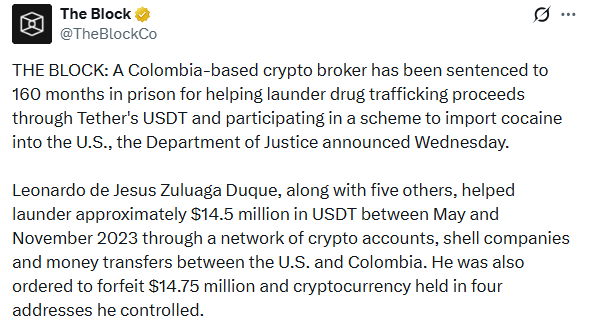
The report comes from a post by The Block , which says the Department of Justice made the announcement on Wednesday. The update also says the broker took part in a plan to bring cocaine into the United States.
Crypto Money Laundering Sentence in the USDT Case
Leonardo de Jesus Zuluaga Duque received 160 months in prison, which is 13 years and 4 months. He helped launder about $14.5 million in USDT between May and November 2023.
He was also ordered to give up $14.75 million and the crypto held in four addresses that he controlled, as per the reported announcement.
USDT Money Laundering Case Facts at a Glance
The table below lists the figures from The Block’s post. It helps readers see the main case details in one place.
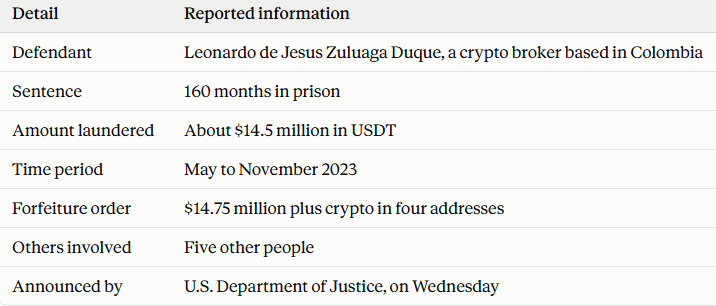
Source: IRS Press Release
How the Crypto Money Laundering Network Moved Tether
According to the post, Zuluaga Duque and five others used crypto accounts, shell companies, and money transfers between the U.S. and Colombia. They did this to clean drug money. Earlier reports linked the same man to a Southern District of New York case.
In that case, Colombia’s Supreme Court backed sending him to the U.S. to face charges over an international crypto laundering network, and the alleged method involved sending Tether to middlemen who turned it into dollars through shell companies and U.S. bank accounts.
Stablecoins such as USDT appeal to criminals because they follow the dollar and move fast across borders.
Even so, every transfer stays on a public blockchain that investigators can trace, which is a common theme in crypto news about police action.
What the 160-Month Sentence and Forfeiture Order Mean
A sentence of 160 months is a heavy result for a crypto broker. It shows that courts treat crypto laundering as seriously as cash laundering. An editorial calculation shows that $14.5 million split over about seven months comes to roughly $2.1 million per month.
The announcement does not say that the money moved at an even pace, so this figure is only a rough guide. The $14.75 million forfeiture order is about $250,000, or 1.7%, higher than the laundered amount.
It also covers four crypto addresses, which shows that authorities now treat wallet funds as property that can be taken.
Crypto Compliance Lessons for Exchanges and Brokers
This case leaves a clear message for exchanges, brokers, and OTC desks. Identity checks, transfer monitoring, and blockchain tracking tools are no longer optional.
They are what lets a compliance team spot dirty money while it is still moving. Funds routed through shell companies or the same transfers crossing borders again and again each leave a pattern. One flag raised at the right time can stop a much bigger problem later.
These points are general notes about the industry, and the post does not say that any platform failed in its duties. For readers who follow crypto money laundering cases, the main lesson is simple. Stablecoin transfers can be traced back to real people long after they take place.
Confirmed Facts Versus Open Questions
-
Reported in the post: the sentence is 160 months, the USDT amount is $14.5 million, the period is May to November 2023, and the forfeiture order is $14.75 million.
-
Not covered in the post: the name of the court, the name of the judge, and the results for the five other people involved are not given.
-
Still unclear: it is not known whether any exchange or wallet provider faces action over the network, since the announcement as reported does not discuss it.
What to Watch Next in Crypto News
Readers who follow crypto news should look for the full Department of Justice release. It may name the court, list the other defendants, and give more detail on how the money moved.
Any update on the four forfeited addresses or on help from stablecoin issuers would also add useful context for the wider crypto money laundering debate.
YMYL Disclaimer: This article is for informational purposes only and is not financial or investment advice. Readers should verify details through official channels and do their own research before making any decision.









