GENIUS Act Rules Are Final: The Jan. 18 Deadline Could Shock Issuers


GENIUS Act Rules: Who Needs Approval Before Jan. 18, 2027 Deadline
America’s top national-bank regulator has turned a landmark crypto law into a detailed rulebook.
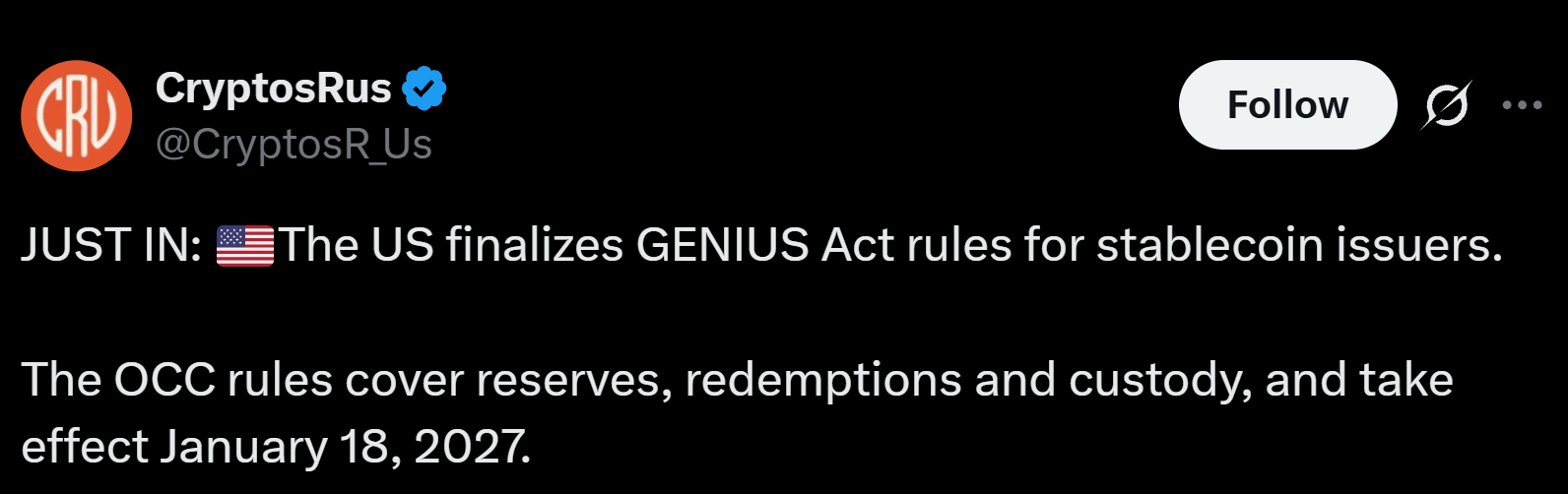
On October 21, 2026, the Office of the Comptroller of the Currency (OCC) announced the final GENIUS Act rules for stablecoins, the digital coins designed to hold a steady dollar value.
Here is what the regulator published in one news release and three bulletins: who it affects and what happens next, explained without the jargon.
Source: X Post
What the OCC Announced
According to the official OCC release, the final regulation sets requirements for approved and foreign stablecoin companies under the agency’s authority, plus certain custody activities handled by banks it supervises.
Comptroller Jonathan Gould said the framework brings strong standards for reserve backing, redemption, and risk management.
The agency also received hundreds of comments from crypto companies, community bankers, trade groups, and academics before finalizing the text, and it says it will keep coordinating with other agencies that handle other parts of the law.
| Key fact | Detail |
| Announced | October 21, 2026 |
| Law signed | July 18, 2025 |
| Rule first proposed | February 25, 2026 |
| Takes effect | January 18, 2027 |
| Not included yet | Money-laundering and sanctions rules |
The regulation covers everything the OCC must write under the law except money-laundering and sanctions, which will come in a separate rulemaking with the Treasury Department.
Who Must Follow the New Rules and What They Cover
OCC Bulletin 2026-50 explains that the law generally bars anyone but an approved issuer from issuing a payment stablecoin in the US.
It also bars digital asset service providers from offering or selling one to people in the US unless the issuer is approved or is a qualifying foreign issuer.
The regulation reaches national banks and their subsidiaries, federal savings associations, federal branches, foreign issuers, nonbank companies seeking federal approval, and some state-approved issuers.
The final text adds a new section of federal regulations on these topics, and it also updates older bank standards on capital, fees, and procedures:
-
Allowed activities
-
Reserve assets, meaning what backs each coin
-
Redemption, meaning how holders get dollars back
-
Risk management
-
Audits, reports and supervision
-
Custody, meaning safekeeping of assets
-
Applications and registrations
-
Capital and an operational backstop
In short, the GENIUS Act rules touch almost every stage of running a stablecoin business, from approval to daily safekeeping.
A Safety Net for Existing Issuers
Starting January 18, 2027, issuing a payment stablecoin in the US without approval carries criminal penalties, says OCC Bulletin 2026-51.
The bulletin notes that firms have had 18 months since the law passed to prepare.
To avoid sudden disruption, companies already operating in the US may ask for a waiver if they file a substantially complete application on or before January 18, 2027.
The regulator says it generally expects to grant these requests, for up to 12 months and for no longer than needed, unless it finds stronger reasons to refuse.
New companies that are not yet operating should wait for approval first, in line with how the regulator treats new bank charters, and waivers for them are not generally expected.
The bulletin also sets an application clock:
| Step | Time limit |
| Check if application is complete | 30 days |
| Review of missing information | 30 days |
| Return if still incomplete | 60 days after first notice |
| Final decision | 120 days after completion |
Applications open only after federal budget officials approve the forms, and the agency will announce that date in a news release.
Anyone planning to apply should therefore watch for that announcement rather than assume a start date.
New Weekly and Quarterly Reports
OCC Bulletin 2026-52 describes revised reporting forms first proposed in June 2026.
A weekly form covers stablecoin activity and reserves, while a quarterly form covers condition and income.
The agency says the forms should help ensure compliance, support supervision, and improve transparency about company finances.
Public comments are open for 30 days after Federal Register publication, and the forms are expected to start with the January 25, 2027 weekly report and the March 31, 2027 quarterly report, subject to approval.
These GENIUS Act rules therefore bring regular public-style disclosure to a young industry.
Why It Matters Beyond Banks
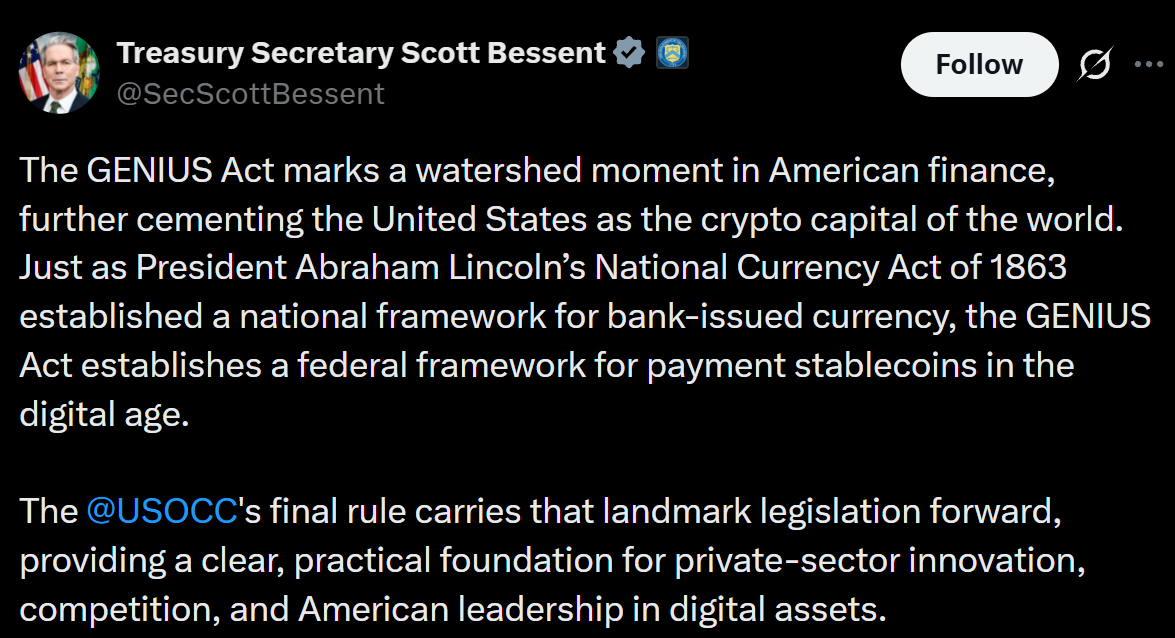
Treasury Secretary Scott Bessent welcomed the regulation in a post on X, calling the law a watershed moment and comparing it to the 1863 National Currency Act.
The release adds that the agency will watch how this young industry develops and adjust its framework when needed.
For everyday readers, four things stand out:
-
Clear approval steps could help trusted issuers operate openly.
-
Reserve and redemption standards aim to protect holders.
-
Crypto platforms will need to watch issuer approval status, because the law limits what they may offer to US users.
-
Timelines are tight, with the main date just under three months away.
Conclusion
The final GENIUS Act rules turn a broad law into practical steps for approval, backing, redemption, and reporting.
Remaining pieces, including anti-money-laundering requirements and the application opening date, are still to come, so readers should follow official OCC updates. This article is not financial or legal advice.
Disclaimer
This article is for educational and informational purposes only and is not financial or investment advice. Crypto assets are high risk, their prices can be very volatile, and you can lose some or all of your money. Always do your own research and consider speaking with a licensed financial advisor before making investment decisions.









