Crypto News Recap Binance Hack, Russia Opens Crypto, Wall Street Moves

Crypto News Recap: Binance, Russia's Crypto Shift and Wall Street Move
This crypto news recap covers the biggest verified stories of the past week: new details on the $6.3 billion Binance attack, two more exchanges under pressure, Russia’s decision to allow retail trading, and fresh moves by US regulators and Wall Street firms.
Every item below links to an official source.
| Date (2026) | Story | Official source |
| Oct 29 – Nov 3 | Binance attack: FBI attribution and incident report | FBI, company report |
| Nov 2 | Mercado Bitcoin pauses deposits and withdrawals. | Company statement |
| Nov 2 | New Jersey drops Coinbase staking case. | Company statement |
| Nov 3 | CFTC clears single-stock perpetual futures. | CFTC |
| Nov 3 | Morgan Stanley tokenizes US stocks and Treasuries | Company statement |
| Nov 5 | Amundi tokenizes an index fund share class | Amundi |
| Nov 6 | US Treasury cuts MEXC off from US banks | |
| Nov 6 | Russia approves Bitcoin, Ether and USDT | Central bank |
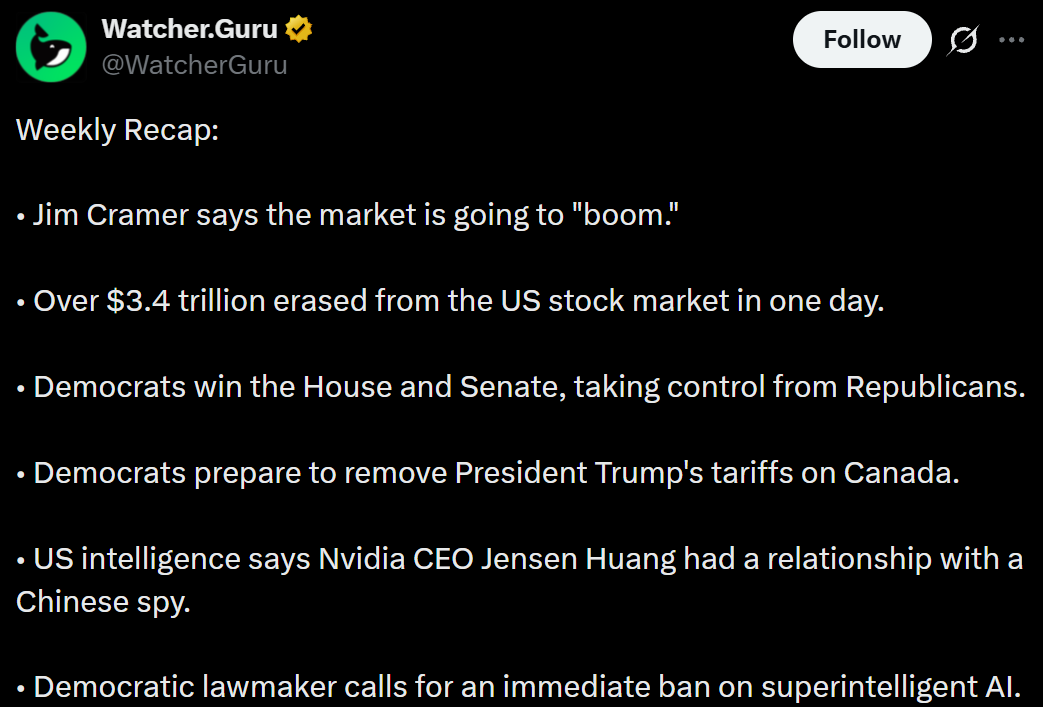
Source: Post On X
Binance Attack: FBI Attribution and the Fake Job Interview
The FBI says North Korea was responsible for stealing more than $6 billion in virtual assets from Binance on or about October 29. North Korea has rejected the claim.
The exchange’s initial incident report puts the affected amount at about $6.34 billion and says roughly $2.85 billion had been frozen or intercepted at that point.
The report describes a multi-stage attack, not a single phishing email. An employee installed a tampered developer tool in June.
In September, a second engineer was lured by a fake job interview into downloading a malicious coding assignment.
The attackers then abused an internal AI tool to reach the system that approves wallet transactions.
Binance says it rebuilt the affected wallet system and replaced compromised devices.
As of October 31 it had replenished about 98% of the affected assets from its own funds, and it says users will not bear the loss.
Its Recovery Update adds that holders of ten major tokens, including BTC, ETH and USDT, can verify their balances are backed at least 1:1.
Withdrawals reopened in phases from November 1, as covered in notice.
Mercado Bitcoin and MEXC Under Pressure
Brazil’s Mercado Bitcoin said in an official statement on November 2 that it identified and quickly contained a security incident in one of its systems overnight.
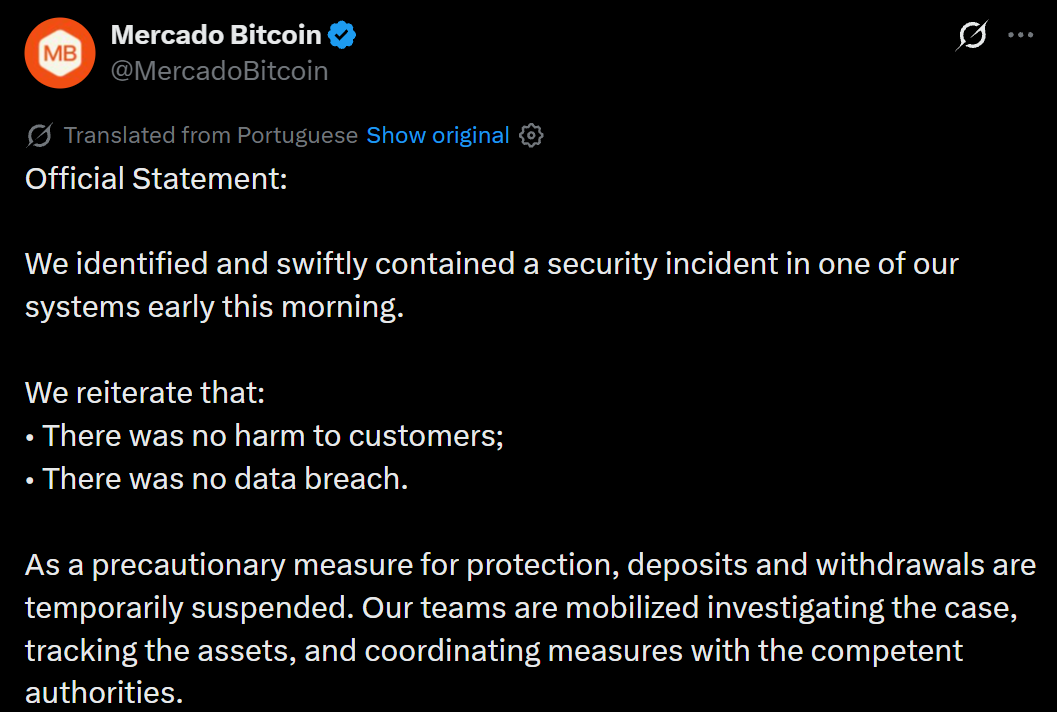
As a precaution , deposits and withdrawals were temporarily suspended. The company says customers suffered no losses and no data leaked, and that its teams are tracing assets and working with authorities.
It has not confirmed a loss figure. Outside analysts flagged suspicious transfers above $40 million across at least ten blockchains, but that number remains unconfirmed.
On November 6, the US Treasury announced that its financial crimes unit (FinCEN) cut MEXC Global off from the US financial system.
In its press release, Treasury says the exchange moved at least $16 billion tied to sanctions evasion, cybercrime, and other illegal activity between May 2021 and May 2026.
It also says MEXC was still handling transactions with a sanctioned Russian exchange as recently as June 2026.
This is a FinCEN order, not a sanctions listing. It targets banks and payment firms: US institutions may no longer process transfers to or from the exchange.
Russia Approves Bitcoin, Ether and USDT for Retail Buyers
The Bank of Russia published its list of cryptocurrencies open to non-qualified (retail) investors on November 6: Bitcoin, Ether, and USDT.
The rule takes effect on November 17. This is the biggest policy story in this crypto news recap, because it moves everyday buyers onto regulated channels.
-
Limit: purchases through a single intermediary may not exceed ₽300,000 per year.
-
Access: through brokers, trust managers, or crypto exchange offices; on exchanges; or over the counter.
-
Safeguards: every investor must pass a test and read the risk information, while qualified investors face no such cap.
Moscow Exchange plans to start digital currency deals on December 1, with pilot trades first and hours of 06:50 to 23:50 Moscow time. BTC, ETH and USDT will be listed at the start.
US Policy: CFTC, Coinbase and the New Congress
-
CFTC: Chairman Michael Selig announced on November 3 that perpetual futures on individual stocks can begin trading for the first time. They can trade on exchanges registered with both the CFTC and the SEC. Perpetual futures are contracts with no expiry date.
-
Coinbase staking: Coinbase said on November 2 that New Jersey dropped its lawsuit over staking and withdrew a 2023 cease-and-desist order. The state’s original 2023 action targeted the staking program as an alleged unregistered securities offering.
-
Coinbase bitcoin: the company says it has bought its 18,000th bitcoin for its own balance sheet, with details in its quarterly filing.
-
Congress: news organizations have projected Democratic wins in both the House and the Senate, and AP’s results page carries the running count. Final counts and committee chairs, set when the new Congress is seated in January, will shape crypto legislation.
In this crypto news recap, the US thread is simple: regulators are opening doors while Congress changes hands.
Wall Street and Payments Move On-Chain
-
Morgan Stanley: said on November 3 that it is among the first banks to tokenize US equities and Treasuries using the DTCC Tokenization Service, which launched on October 28.
-
Amundi: launched a tokenized share class of its Core STOXX Europe 600 index fund on public Ethereum, with CACEIS as agent. Its announcement says this extends tokenization beyond cash management into index investing.
-
Stripe: Its documentation says businesses can send stablecoins to any external wallet in more than 160 countries through Global Payouts.
Conclusion
This crypto news recap shows two trends at once: security pressure on exchanges and steady regulated adoption by banks, funds, and governments.
Watch for Binance’s independent review, the Mercado Bitcoin restart, Russia’s November 17 start date and the first single-stock perpetual launches.
This article is for information only and is not financial advice.
Disclaimer
This article is for educational and informational purposes only and is not financial or investment advice. Crypto assets are high risk, their prices can be very volatile, and you can lose some or all of your money. Always do your own research and consider speaking with a licensed financial advisor before making investment decisions.






