When Blockchains Trust Bad Data: Crypto Oracle Risk

What Is Crypto Oracle Risk and Why Does It Matter in DeFi?
Crypto oracle risk is the chance that a smart contract acts on a wrong, late or manipulated price. The code can be perfect and the loss still real. Smart contracts cannot see the outside world, so they rely on price feeds, and a bad feed can liquidate loans or drain a pool.
This guide splits crypto oracle risk into three failures: a manipulated market, a broken feed and a price that is simply too old. Each one needs a different defense.
What Is Crypto Oracle Risk in DeFi?
A blockchain cannot look up the price of ETH. A data service, called an oracle, reports it. Crypto oracle risk appears when that reported number is wrong or stale at the moment a contract uses it.
Market failure: the price itself was pushed. Mango Markets, October 2022.
Feed failure: the feed was set up or read unsafely. BonqDAO, February 2023.
Timing failure: a valid price was too old for the decision.
Research view: Bank of Canada staff found most tested protocols had inadequate safety parameters (July 2024).
Why Can’t Blockchains Know Real-World Prices on Their Own?
A blockchain only knows what is written on it. It cannot check an exchange or a news site. Lending apps, though, must know what collateral is worth.
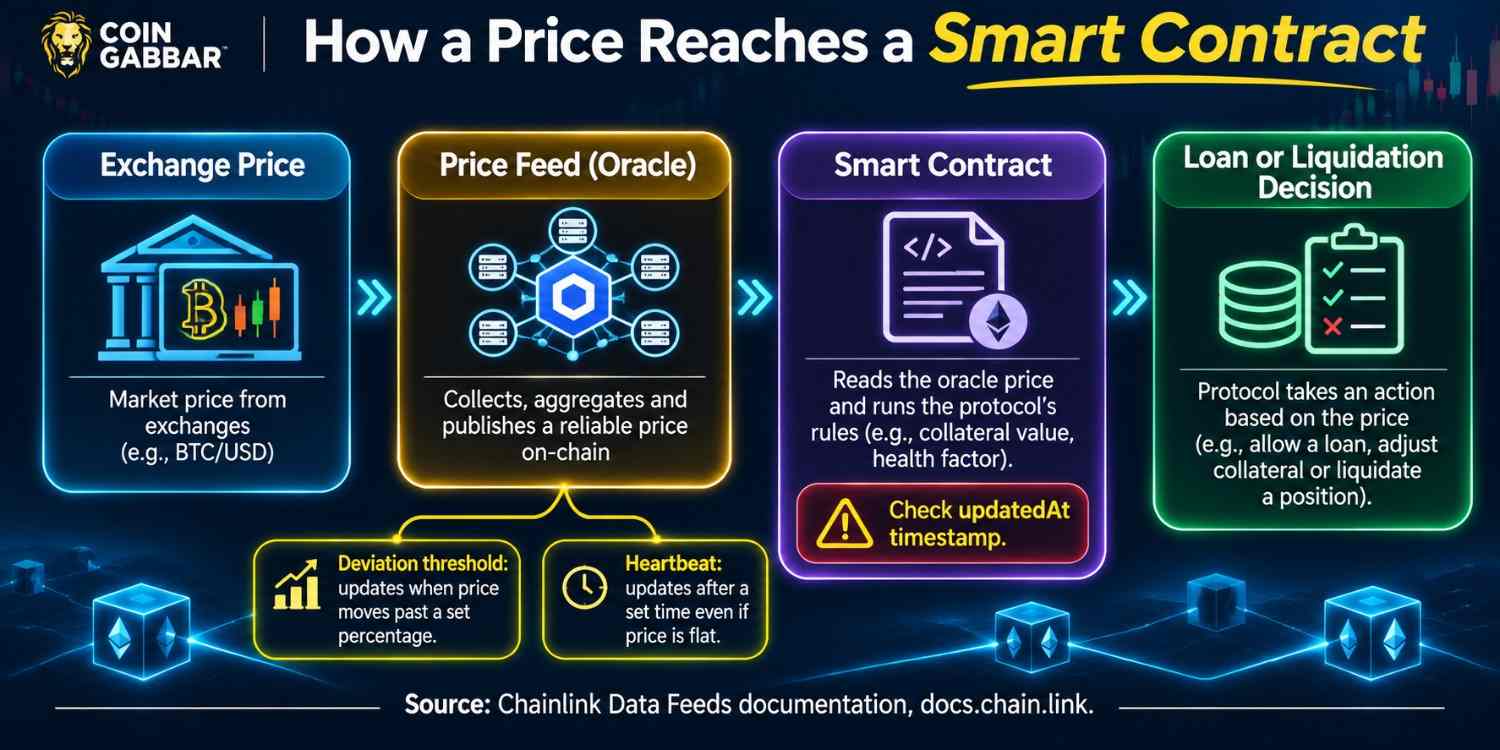
A bridge is needed. Our guide to a blockchain oracle explains the basics. The bridge fetches a price, signs it and posts it on-chain. The contract then treats that number as true.
That trust is the weak point. The contract cannot ask whether the number is fair.
How Do Crypto Oracles Feed Outside Data to Smart Contracts?
Many feeds do not post every tick. Chainlink documents two update rules: a deviation threshold and a heartbeat. A feed updates when the price moves past a set percentage, or after a set time even if it has not. The Chainlink data feed documentation describes both.
So the latest value may be old. Chainlink advises developers to check the updatedAt timestamp and set their own freshness limit.
Pyth reports a price plus a confidence range. An illustrative feed might read $50,000 plus or minus $10. A wide range signals doubt. The app must still decide what to do with it.
What Happens When Feed Data Is Wrong or Delayed?
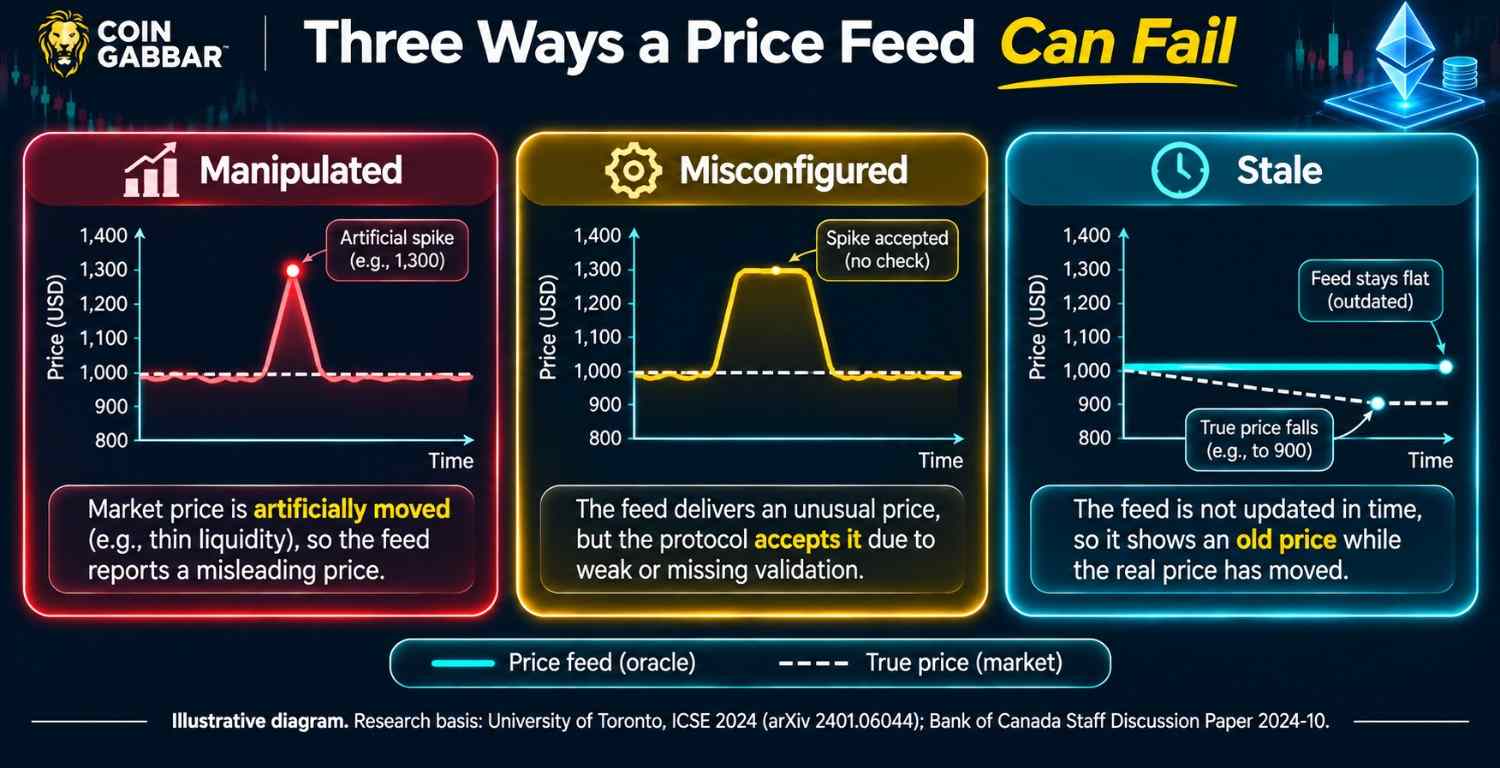
Three things can go wrong.
Manipulated: the market the feed reads has been pushed.
Misconfigured: the protocol reads or validates the feed badly.
Stale: the number was right once but is old now.
University of Toronto researchers studied Chainlink and exchange prices in volatile ETH periods from June 2020 to September 2022. Their ICSE 2024 paper shows safety depends on how much deviation a protocol can tolerate, not only on the feed.
Crypto oracle risk does not need a hack. An odd but legitimate price can break a protocol’s assumptions.
How Can a Bad Price Trigger DeFi Liquidations?
Lending protocols compare a loan with collateral value. If the loan grows too large, the position is liquidated.
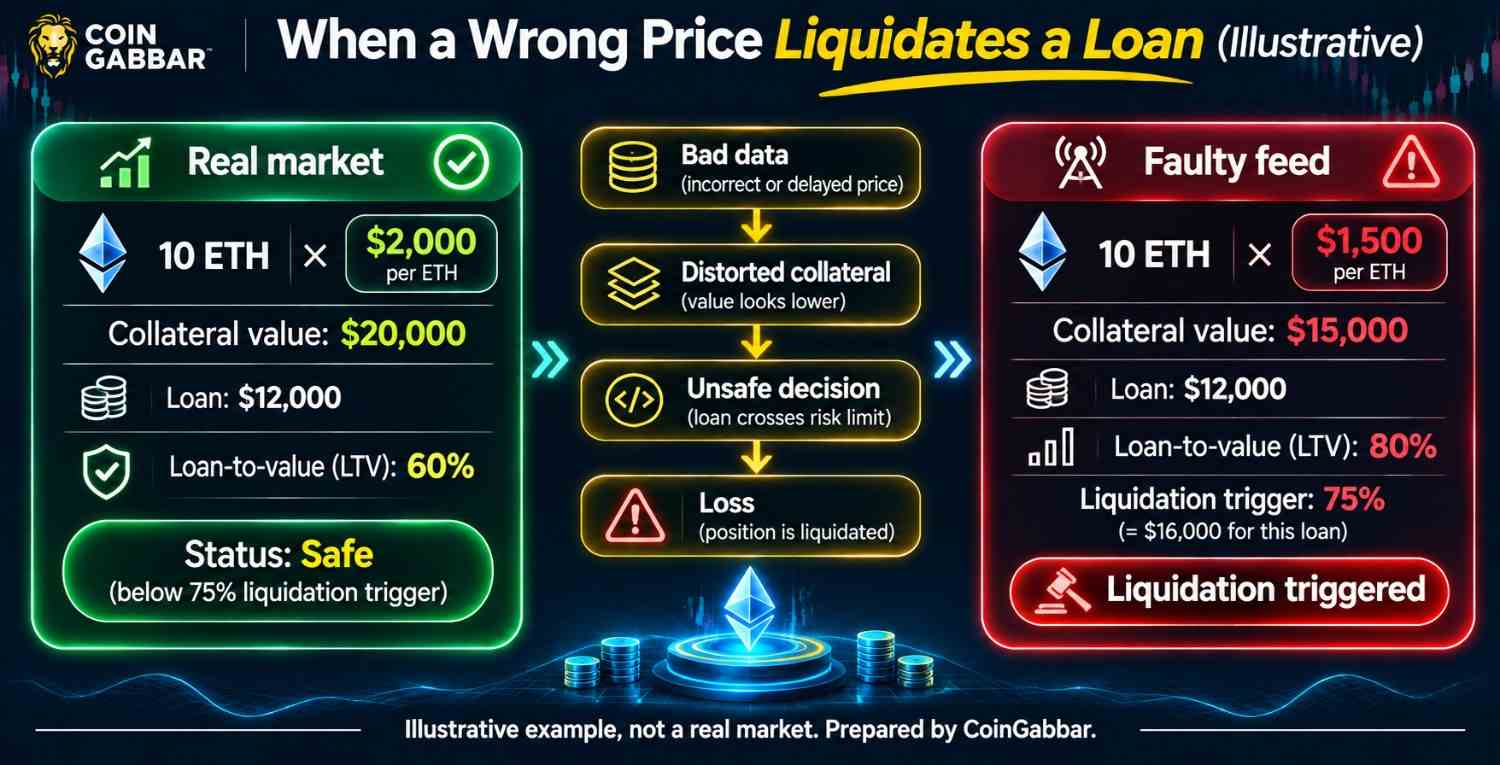
Here is an illustrative case, not a real market. A user deposits 10 ETH, reported at $2,000, so $20,000. They borrow $12,000. Say the protocol liquidates when the loan passes 75% of collateral value. That trigger is $16,000, or $1,600 per ETH.
Now a faulty feed reports $1,500 for a few minutes. The contract sees $15,000 of collateral and liquidates, though ETH is really worth $2,000. The user loses collateral at a bad price.
The same error can run the other way. An inflated price lets a borrower take out more than the collateral can back.
What Happened in the Mango Markets Price Manipulation?
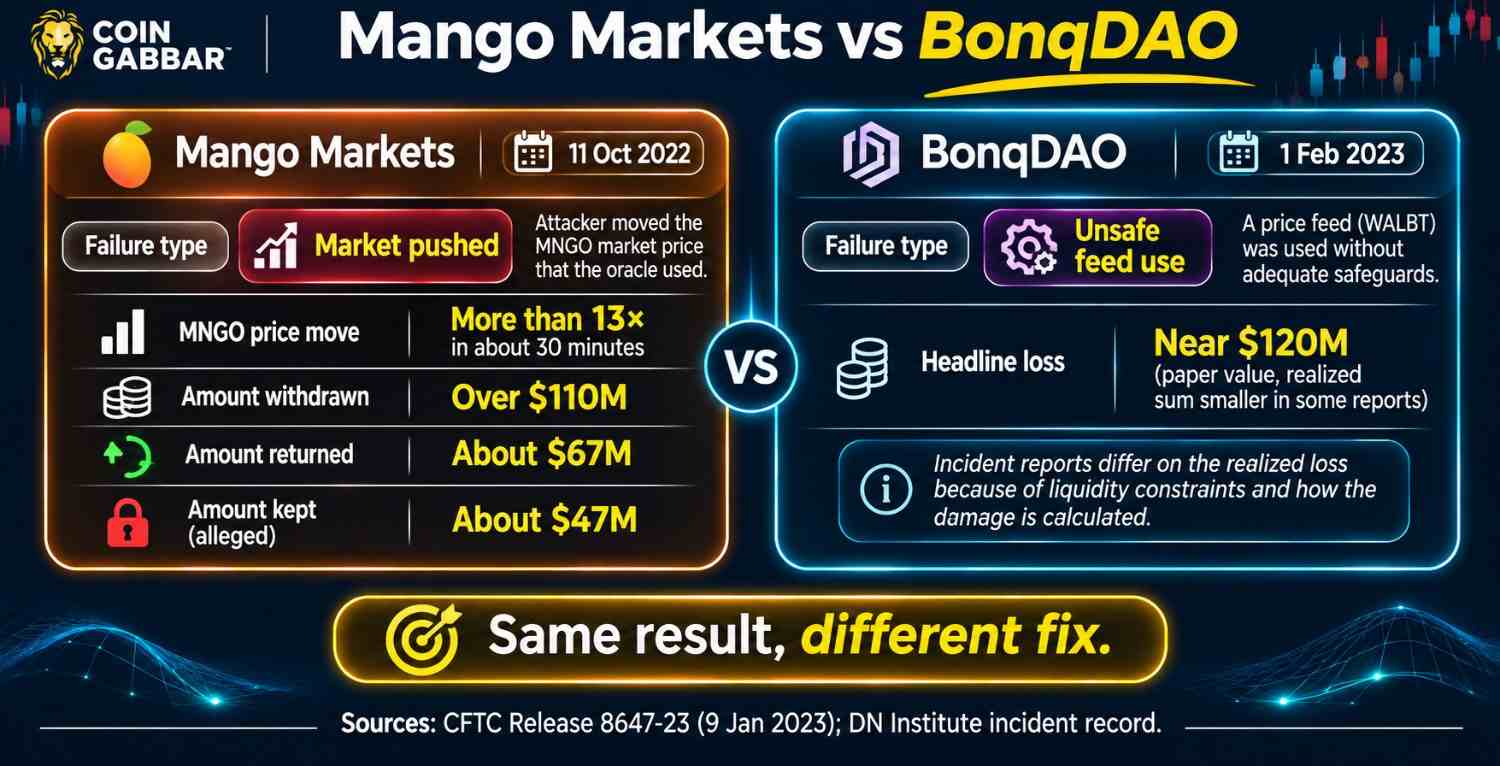
On 11 October 2022, a trader allegedly pushed the price of the MNGO token. The US CFTC says he bought MNGO on three exchanges that fed the platform’s price. The reported price rose more than 13 times in about 30 minutes, per the CFTC release of 9 January 2023.
He then used his inflated positions as collateral and withdrew over $110 million. About $67 million was later returned, and about $47 million was kept, the agency says. These are allegations in a civil complaint.
The lesson for crypto oracle risk is subtle. The data reported the market correctly. The market was the problem.
How Did BonqDAO Lose Millions Through a Price Feed Failure?
BonqDAO is a different failure. On 1 February 2023 an attacker used a price data for its WALBT token to inflate collateral and trigger liquidations. A DN Institute incident record puts the headline loss near $120 million.
Reports differ on the sum. Some analyses count paper value, and others count what could be extracted. Treat the two numbers separately.
The protocol did not guard against an outlier.
Can Decentralized Oracle Networks Prevent Manipulation?
They cut one part of crypto oracle risk. A network of node operators removes dependence on a single reporter. That helps with outages and tampering.
They do not fix everything. Several sources can read the same thin market. Data can be aggregated correctly and still be old. A time-weighted average price can slow an attack but can also lag a real move.
The Bank of Canada found that adding delays was not always protective, and in some cases made protection worse. Its Staff Discussion Paper 2024-10 tested a framework called OVer on 10 benchmark protocols. Most had parameters inadequate against large deviations.
A large study from the University of Basel looked at 40 Chainlink feeds over 18 months.
What Measures Can Readers Take Against Crypto Oracle Risk?
These are general checks, not advice.
Read how a protocol sources its prices before depositing.
Prefer protocols that check data age and pause when data is stale.
Avoid thin markets, since one trade can move the price.
Keep a larger safety buffer on loans. Our DeFi liquidation guide shows how.
Spread funds across protocols rather than one.
Follow incident reports, such as in our DeFi hack coverage.
Our Chainlink guide covers how one network works, and our note on price feed manipulation adds depth.
What Do Key Price Feed Terms Mean for Readers?
Oracle: a service that brings outside data onto a blockchain.
Deviation threshold: the price change that triggers a feed update.
Heartbeat: the maximum time between updates.
TWAP: a price averaged over a time window.
Liquidation: the forced sale of collateral when a loan is too large.
Confidence interval: the range of doubt around a reported price.
Expert Opinion: Is the Data Now the Weakest Link?
CoinGabbar analysis suggests code audits cover only half of crypto oracle risk. Mango Markets, BonqDAO and the delay research show three separate failures, and each needs its own control: manipulation resistance, safe integration and freshness limits. This is an editorial reading, not a forecast.
Disclaimer: This article is for information only and is not financial, legal or tax advice. Returns are never promised or assured. DeFi carries risks of loss, including smart contract and data failures, and rules differ by country. Readers should consult a qualified adviser.