Vitalik's Ethereum Roadmap 2030, Explained Simply

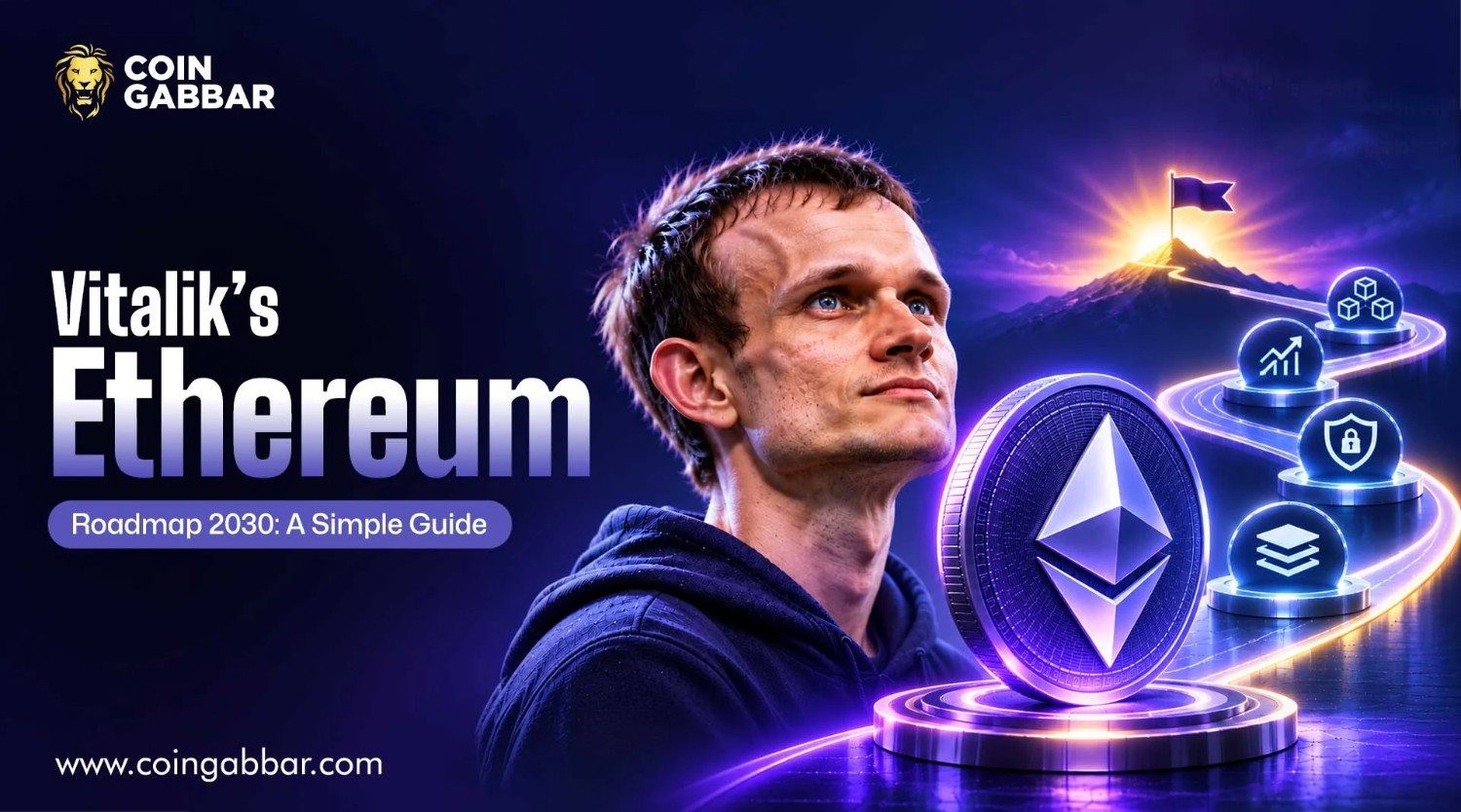
Ethereum Roadmap 2030: What Has Vitalik Buterin Proposed?
Ethereum Roadmap 2030 is Vitalik Buterin’s long-term plan to make Ethereum more scalable, private, and secure. Vitalik’s 2030 Ethereum vision was published on September 27, 2026.
It proposes slots of 4 to 8 seconds, finality in 8 to 32 seconds, and wider use of zero-knowledge proofs and quantum-resistant cryptography.
These are development targets, not guaranteed delivery dates. This guide separates what’s already live, what’s selected for upgrades, and what remains research. Last updated: November 20, 2026.
Why Is Vitalik Buterin Planning a New Ethereum Future?
Ethereum launched in 2015 with blocks about every 17 seconds. Twelve confirmations took roughly 200 seconds.
Today, slots last 12 seconds. The official security roadmap describes finality, the point where a block is economically locked in, at about 15 minutes.
Buterin’s essay, titled “The cryptographic world computer,” argues Ethereum has outgrown the plain blockchain label. Proofs now replace some repeated work.
What Is Vitalik Buterin’s Ethereum 2030 Vision?
The plan rests on five themes:
Scalability: faster processing and more parallel work.
Privacy: protection for transactions and wallet activity.
Security: preparation for quantum computers.
Cryptography: wider use of zero-knowledge proofs.
Decentralization: lighter nodes, so more people can verify the chain.
Measure | Today | 2030 target |
Slot time | 12 seconds | 4 to 8 seconds |
Finality | About 15 minutes | 8 to 32 seconds |
What Is Lean Ethereum and How Will It Change Ethereum?
Lean Ethereum is a redesign of the base layer, first raised in mid-2025. It aims for a simpler, stronger, more decentralized, and more quantum-resistant protocol.
The Strawmap is the draft schedule for this work. It covers roughly four years and appears on Ethereum’s official roadmap.
One proposal separates slots from finality. A one-round finality algorithm, called a Minimmit variant, would let each be tuned on its own. Buterin expects Hegotá to be the last conventional fork. That’s his expectation, not an official guarantee.
Ethereum Scaling in 2030: Faster Slots and Finality
Slot times would shrink in steps, from 12 seconds toward 4 to 8. Faster finality remains active research.
PeerDAS already went live with Fusaka in December 2025. It lets nodes check that data is available by sampling small pieces instead of downloading everything.
That matters most for Layer 2 networks, which are rollups that process transactions off the main chain and post the data back to it. Cheaper data helps them. Faster slots and finality speed up the base network, called Layer 1.
How Will Ethereum Improve Transaction and Network Privacy?
Transaction privacy hides amounts and addresses. Network privacy hides what a wallet asks the network and from where.
The roadmap treats wallet request privacy as core protocol work. That’s a different job from hiding payments.
FOCIL, defined in EIP-7805, is planned for Hegotá. It forces block builders to include valid transactions, which supports censorship resistance rather than privacy. Stronger privacy could also raise regulatory questions that remain open.
How Is Ethereum Preparing for Quantum Computers?
A powerful quantum computer could break the signatures that protect wallets today. Nobody knows when one will exist.
The risk spans three layers. Account signatures, validator signatures, and data commitments each need their own fix.
The Ethereum Foundation’s protocol priorities set a December 2029 target for post-quantum readiness. That’s an organizational goal, not proof that every task will finish by then.
Quantum safety also depends on the chosen schemes, the quality of implementation, and years of testing. Buterin has said slots could become quantum resistant before finality does. More detail sits in the official post-quantum documentation.
How Will Recursive STARKs and ZK Proofs Transform Ethereum?
A zero-knowledge proof shows something is true without revealing the data behind it. It works like a receipt that proves a payment without listing the purchase.
Recursive STARKs are proofs that verify other proofs. A node could check one small proof instead of re-running every transaction, which cuts verification cost.
Formal verification uses math to prove code behaves as intended. RISC-V, an open instruction set, is discussed as an alternative execution base to the current EVM design. All three remain in research and development.
Ethereum Roadmap 2030: Current Status vs Targets
Technology | Current status | Longer-term direction |
PeerDAS | Live since Fusaka | More scalable data availability |
FOCIL | Selected for Hegotá | Better censorship resistance |
Fast finality | Active research | Finality in seconds |
Recursive STARKs | Research and development | Cheaper verification |
Quantum resistance | Active development | Post-quantum security |
Formal verification | Ongoing research | Stronger protocol assurance |
Details on Hegotá are on the official upgrade page.
Ethereum Roadmap 2030: Challenges, Risks, and Limitations
Delivery is the main risk. Several things could delay the plan:
Cryptographic flaws found during testing.
Validator coordination across a large network.
Hardware demands on node operators.
High development and audit costs.
Consensus changes that touch every client.
Regulatory uncertainty around privacy.
The harder question may not be speed. It’s whether performance can improve without concentrating verification among a few operators.
Is that balance achievable? The answer will take years of upgrades to show.
Final Thoughts: Can Ethereum Achieve Its 2030 Vision?
The Ethereum Roadmap 2030 describes a faster, more private, and more secure network built on proofs. Some pieces, like PeerDAS, are already live. Others, like fast finality, are still research.
Readers can track progress through the official security roadmap and upgrade announcements. A target date is a goal, not a promise.
Disclaimer
This article is for informational purposes only and isn’t financial advice. Crypto assets are volatile and risky, and roadmap targets may change or fail. Readers should do their own research before making any decision.