Ethereum Glamsterdam Delay: What Does It Mean for ETH Investors?

How Will the Glamsterdam Delay Affect ETH Investors?
A hack did not slow Ethereum's next big upgrade. A repricing did. The Glamsterdam delay began when security researchers found that new gas rules could change how existing contracts behave, even though nobody touched the deployed code. The network keeps running. The question is what a slower roadmap means for ETH holders.
The risk sits in Ethereum smart contracts written around the old rules.
What Are the Key Takeaways for ETH Investors?
Developers paused the hard-fork process, and mainnet is unaffected.
The trigger was compatibility risk, not a theft or exploit.
No replacement mainnet date had been set in the sources checked.
Higher state-creation costs and ETH burn matter more than the date.
What Is the Glamsterdam Delay and What Has Slipped?
The Glamsterdam delay means core developers paused the hard-fork process after security work found existing contracts that could break under new gas rules. The Hoodi testnet activation, planned for 26 October, was postponed with no new date. Ethereum mainnet is not affected.
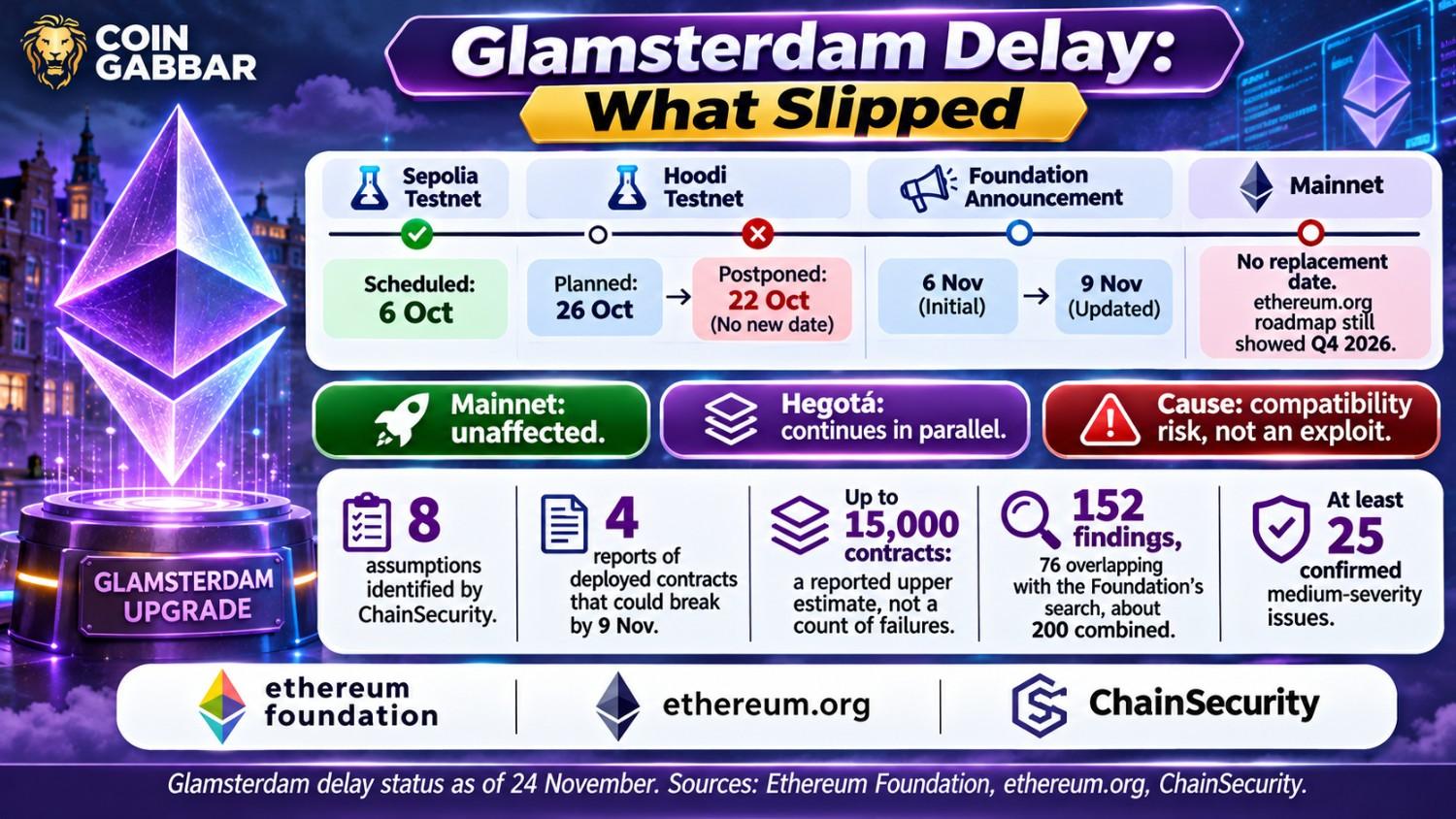
The Ethereum Foundation's 6 November announcement says work on Hegotá, the next upgrade, continues in parallel. The ethereum.org roadmap still showed Q4 2026 for Glamsterdam. Reports point to 2027, but no official date exists.
The Foundation's 22 October notice said developers needed more time to study how EIP-8037 interacts with mainnet contracts. Sepolia, the first public testnet, had been scheduled for 6 October. Mainnet users need to take no action.
What Do EIP-8037 and EIP-8038 Change in Ethereum Gas?
EIP-8037 charges 1,530 gas per byte of new state. EIP-8038 reprices reads and writes of existing state. The aim is to slow database growth while block capacity rises.
Operation | Current gas | Proposed gas |
New account | 25,000 | 183,600 |
New storage slot | 20,000 | 97,920 |
24 kB contract (account and code deposit) | About 4.95 million | About 37.8 million |
The state database held about 390 GiB in January. Daily new state rose from about 105 MiB to about 326 MiB after the gas limit moved from 30 million to 60 million. At a 200 million limit, the EIP projects about 387 GiB of growth a year.
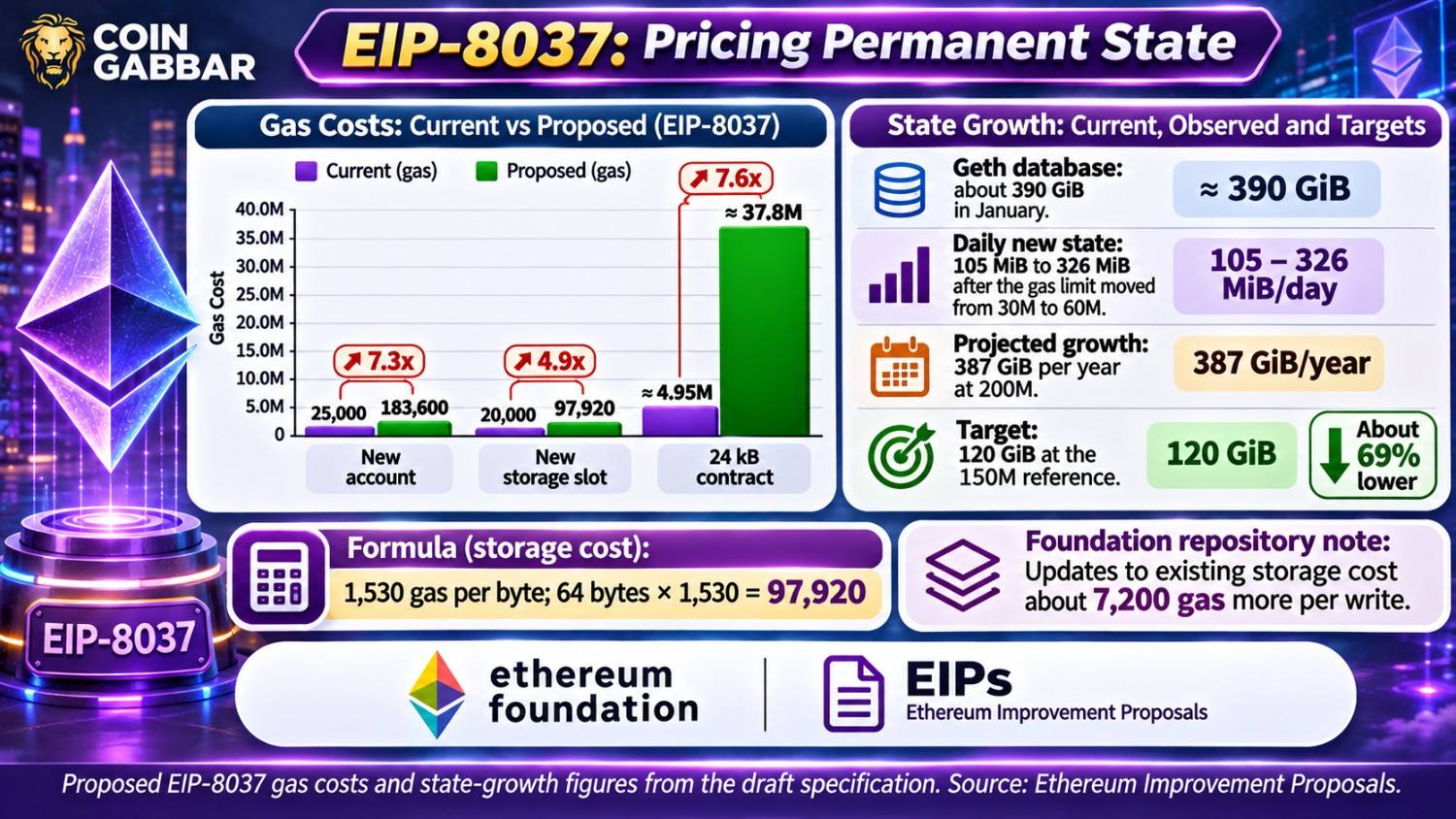
Its target is 120 GiB at a 150 million reference limit. The heavy state raises hardware needs. That pressures node decentralization.
Why Could Gas Changes Break Contracts That Never Changed?
Some contracts assume that a failed external call leaves almost no gas. The failure handler then cannot finish, and the transaction reverts. Under a new reservoir mechanism, gas can come back after a failed call. The handler may then complete and record the failure instead.
ChainSecurity identified eight such assumptions, and the Foundation published the list in a repository called glamsterdam-gas-invariants. By 9 November, four reports of deployed contracts that could break had arrived.
How Many Contracts Could the Glamsterdam Delay Affect?
A reported estimate from foundation developer Marius van der Wijden, given on a 16 November call, put the upper bound at up to 15,000 contracts. That is a ceiling for possible impact, not a count of failures. He added that no reliable figure existed for funds at risk.
Reviews give a different view. ChainSecurity reported 152 findings, and 76 overlapped with the Foundation's own search, for about 200 combined. Each finding describes a class of contracts. The Foundation reported at least 25 confirmed medium-severity issues.
What Was Glamsterdam Meant to Deliver for Scaling?
Two headline features carry the upgrade. Enshrined proposer-builder separation (EIP-7732) moves the handoff between block proposers and builders into the protocol. Block-level access lists (EIP-7928) let validators process unrelated transactions in parallel.
The ethereum.org roadmap says ePBS widens the propagation window from about 2 seconds to about 9 seconds. It also refers to a 200 million gas limit floor, with testing at a 150 million reference. That capacity matters for layer 2 networks that settle on Ethereum.
What Does the Delay Mean for the Ethereum Roadmap?
Slower Glamsterdam work does not stop later plans. The Foundation's protocol priorities post set a quantum-resistant layer 1 target of December 2029. It lists five hard forks after Glamsterdam, starting with Hegotá, which carries native private transactions.
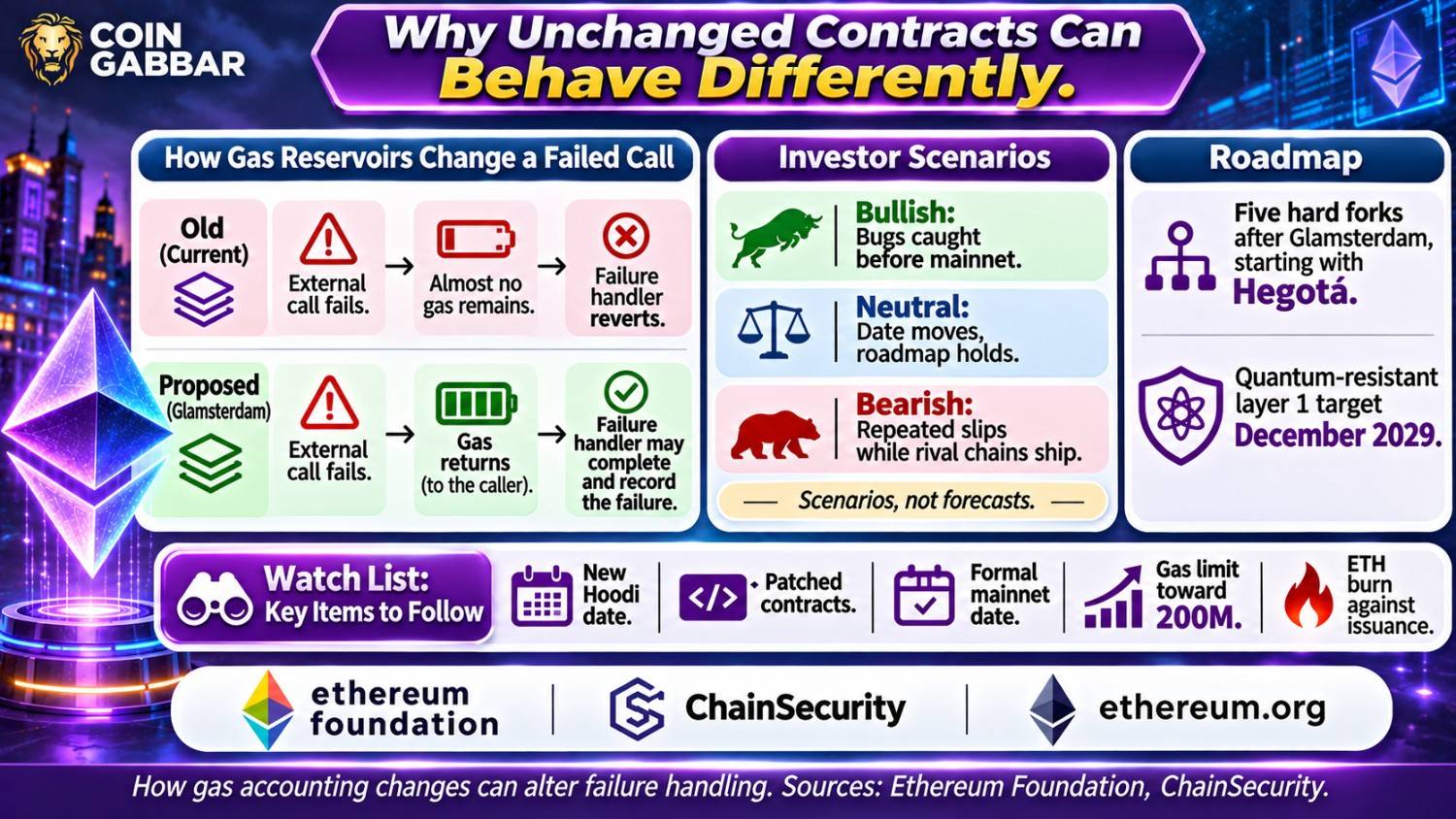
The same post treats the December 2029 date as fixed at least until January, when progress will be reviewed. Upgrades also need agreement across independent client teams. Wider client diversity adds safety but slows any rule change.
How Could the Glamsterdam Delay Affect ETH Investors?
View | Argument | What would support it |
Bullish | Catching compatibility bugs before mainnet protects users and trust. | A clean retest and patched contracts |
Bearish | Repeated slips weaken confidence while rival chains keep shipping. | New specification changes or further delays |
Neutral | The date moves, but the roadmap holds. | Hegotá work staying on schedule. |
Costs rise mainly for operations that create a permanent state, not for each transaction. The Foundation's repository puts the creation of storage, accounts, or contracts at 5 to 8 times the old cost, and updates to existing storage at about 7,200 gas more per write. A faster network also does not mean more ETH burned, because under EIP-1559 the burn tracks base fees paid. Cheaper blocks can burn less. The Glamsterdam delay therefore delays both the scaling benefit and the fee test.
What Does CoinGabbar Expert Analysis Say About the Delay?
CoinGabbar analysis suggests the delay reflects a trade-off, not a failure. The proposal makes a new storage slot 4.9 times more costly, a new account 7.3 times more costly, and a 24 kB contract about 7.6 times more costly. In return, it cuts the projected 387 GiB yearly state growth at a 200 million limit to a 120 GiB target, a drop of about 69%.
Investors should read the Glamsterdam delay as a security checkpoint. A clean retest would support the upgrade. A redesign would be the warning sign.
What Should ETH Investors Watch After the Delay?
A new Hoodi testnet date from the Foundation.
The count of patched or migrated contracts.
A formal mainnet date, which does not yet exist.
The gas limit path toward 200 million, which shows real capacity progress.
ETH burn against issuance as fees shift.
What Do the Key Terms in the Ethereum Upgrade Mean?
Gas: the unit that measures computing work on Ethereum.
State: the accounts, balances, and storage nodes must be kept.
Hard fork: a network upgrade that changes the rules.
Invariant: a behavior that a contract expects to hold.
Disclaimer: This article is intended to be informative, not investment or legal advice. Readers should do their own research before investing in any cryptocurrencies. Prices of crypto assets are volatile, and the timing of upgrades is uncertain, so readers should verify figures with primary sources.
















