Waller Zombie Chains: Fed Governor Asks Who Pays When Keys Are Lost

Waller Zombie Chains: Fed Governor Asks Who Pays When Keys Are Lost
Federal Reserve Governor Christopher Waller asked what happens to assets stranded on failed blockchains in a speech on November 17, 2026.
As of November 18, 2026, the Waller zombie chains remark stands out in crypto news today because it ties tokenization to accountability.
Below is the Fed Governor Waller tokenization speech explained, based on the Federal Reserve’s published text.
He spoke at The Clearing House annual conference in New York. The Clearing House conference 2026 speech was titled “Considerations at the Intersection of Payments and Tokenized Markets.”
Eleanor Terrett also covered this news in her tweet on X, saying the bank monopoly in payments is breaking down.
The prepared text itself speaks of rising competition between new entrants and established firms.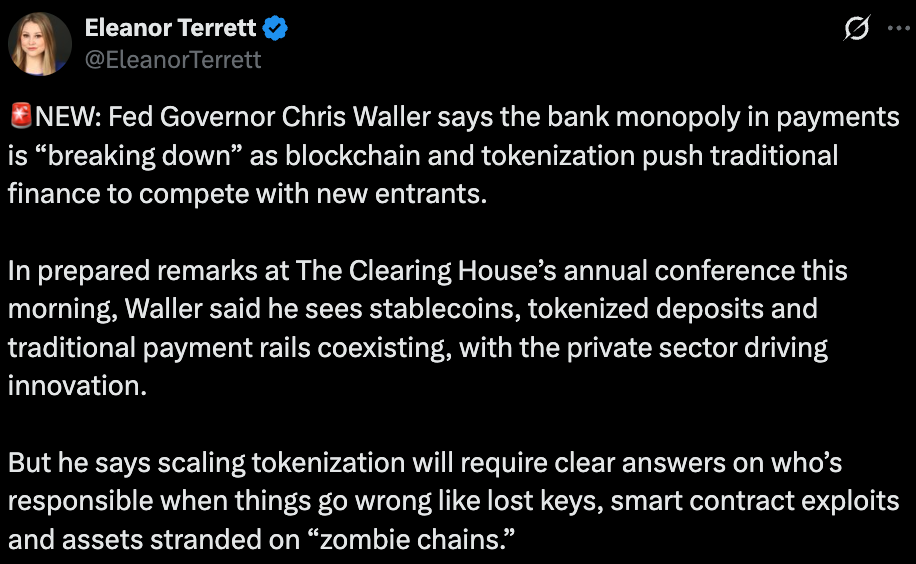
What Did Waller Say About Zombie Chains?
He asked what happens to assets on failed blockchains, calling them the inevitable “zombie chains.”
For readers asking what are zombie chains, a footnote gives a zombie chains blockchain definition: networks with very low developer activity and daily use.
The Waller zombie chains question sat beside other accountability points. He said recent events around Binance have highlighted issues programmable blockchains can raise, and a footnote cites a report on a cyber heist there.
Who Is Responsible When Tokenized Systems Fail?
His list covers smart contract exploits, lost keys crypto users could face, and failed networks.
Risk | Question Waller Raised |
Smart contract exploits | Who bears responsibility when fraudsters use automatic execution? |
Lost or compromised keys | Who is responsible for keys, erroneous transfers and pricing errors? |
Zombie chains | What happens to assets stranded on failed networks? |
The Waller zombie chains point puts blockchain accountability and smart contract risk at the center of the Fed payments speech.
Clear legal treatment of custody, insolvency and resolution, he said, will be critical to mainstream institutional adoption.
Is the Fed Supporting Tokenization of Payments?
The speech says the Federal Reserve will support responsible innovation by:
Listening to industry
Providing core payment and settlement infrastructure
Monitoring financial stability risks
On Fed tokenization policy, he called himself a firm believer in the free market. He also cited a payments innovation roundtable held September 18, 2026, with DeFi and traditional finance participants.
Waller Stablecoins vs Tokenized Deposits
Both enable programmable settlement but differ in issuer model, regulatory treatment, connectivity and reach.
Stablecoins: Stablecoin payments are starting to settle obligations among card network participants.
Tokenized deposits: Digital forms of checking balances, with The Clearing House among groups building a network.
He added that atomic settlement, where a multi-step transaction completes fully or not at all, should not be the only model for tokenized markets.
Will Stablecoins and Bank Payments Coexist?
Waller sees several payment solutions coexisting. Central bank money need not be used in every transaction, he said, but its presence at the foundation is essential.
Traditional payment rails already move stablecoins in and out and settle tokenized deposit transactions. A CPMI report from the Bank for International Settlements, published October 29, 2026, reached a similar conclusion.
Expert View: What Could Come Next?
Analysts following crypto news may read the speech as a checklist tokenization must clear before it scales.
The Waller zombie chains question could shape how banks and crypto firms handle liability and custody.
No rule change or timeline was announced. Market impact, if any, remains uncertain.
Disclaimer: This article is for information only and is not financial, legal, or investment advice. Crypto assets are volatile, and you can lose money. Verify details with official sources before making any decision.






