First Tokenized Trades of CNTN Stock: Is Wall Street Moving Onchain?

Nasdaq Stock Goes Onchain: What These First Tokenized Trades Mean
TSV LLC, the permissioned venue for tokenized NMS stocks on the Canton Network, has completed the first tokenized trades of a U.S.-listed stock under the SEC’s Innovation Exemption, as announced by TSV on November 4, 2026.
The shares belong to Canton Strategic Holdings (Nasdaq: CNTN). Put simply, a real Nasdaq-listed company’s stock was traded on-chain, inside a regulated framework, for the first time.
This article explains who traded, how the system works, and which risks remain.
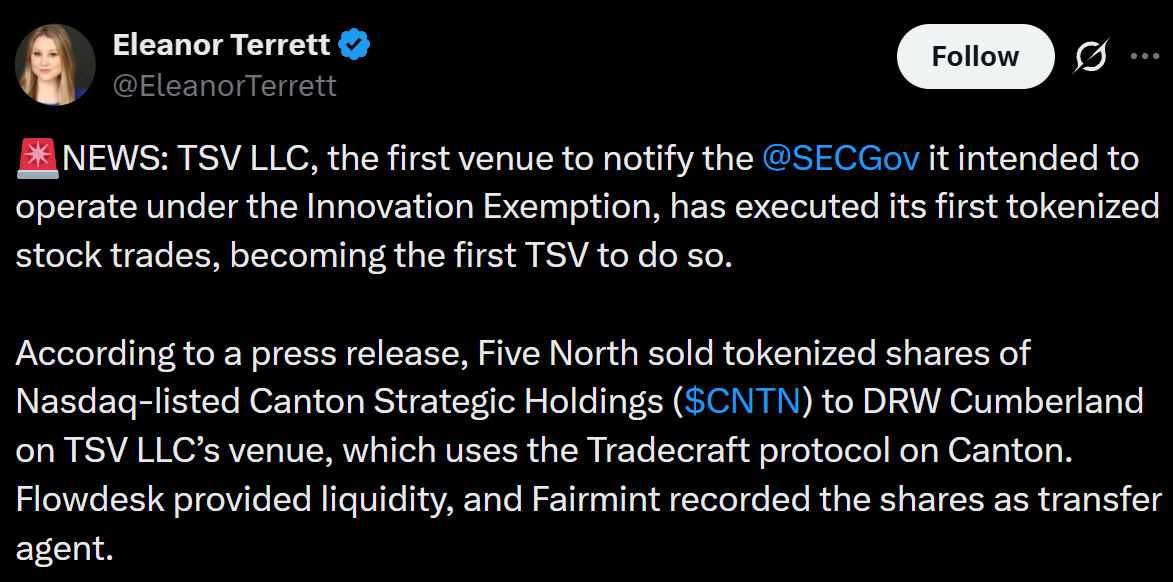
Source: Post on X
What Happened in the First Onchain Stock Deals
DRW Cumberland made the first-ever purchases of CNTN common stock in token form, buying from Five North, an existing shareholder.
According to TSV’s official press release, the deals ran through a permissioned pool on Tradecraft, the automated market maker (AMM) protocol that powers TSV.
Fairmint TA LLC, an SEC-registered transfer agent, recorded the shares in Five North’s verified Loop Wallet, while Flowdesk Liquidity Solutions LLC supplied liquidity.
Here is a quick look at every player involved:
Participant | Role |
TSV LLC | Venue operator |
Tradecraft | AMM protocol powering the pool |
Five North | Existing shareholder and seller |
DRW Cumberland | Buyer |
Fairmint TA LLC | Transfer agent that recorded the shares |
Flowdesk Liquidity Solutions LLC | Liquidity provider |
Why the SEC Innovation Exemption Matters
The exemption, set out in SEC Release No. 34-106402, lets qualifying platforms trade U.S. stocks in token form through permissioned AMM pools.
The venue published its initial public notice on September 23, 2026, and calls itself the first venue to formally notify the SEC of its plans.
Version 1.3 of that notice, dated October 29, 2026, named CNTN as the stock to be offered and Fairmint TA LLC as transfer agent.
Because Canton Strategic Holdings sponsored the tokenization of its own shares, the listing did not need the 30-day issuer notice-and-objection process that applies when an unaffiliated party creates tokens of someone else’s stock.
The notice also reports no issuer objection. One caution deserves attention.
The disclosure says TSV LLC is not registered with the SEC for these activities, that the Commission has not passed on the merits of its disclosures, and that the venue is not subject to Regulation NMS or fair-access rules.
Readers following the first tokenized trades should keep that regulatory context in mind.
How Issuer-Sponsored Shares Protect Holder Rights
Canton Strategic Holdings engaged Fairmint to create its tokens as issuer-sponsored shares, as the company’s agreement announcement explains.
Fairmint TA LLC keeps the official on-chain ownership record, operates the allow list of verified holders and wallets, and applies the company’s transfer controls.
Holders receive the same rights and privileges as holders of CNTN shares traded on Nasdaq.
Key safeguards include:
Identity checks on every participant before trading
Sanctions screening and jurisdiction review
Approved wallet addresses linked to approved participants
Smart contracts that reject transactions from unapproved parties
Transfer restrictions enforced through the issuer’s register
The filing adds that the venue began on a voluntary basis, with one shareholder choosing to have shares converted into tokens.
It also states that production minting authority sits with the issuer’s transfer agent, not with the venue.
How Trading Works on the Venue
The venue’s public notice describes the mechanics in detail:
Hours: The venue is intended to be available 24/7, subject to mandatory trading stoppages, maintenance, risk controls, and volume limits.
Pool design: A concentrated-liquidity AMM in a Uniswap v3-style design runs at launch. Prices come from the pool algorithm rather than an order book.
Settlement: Trades settle atomically on Canton, so shares and payment move together or not at all.
Paired assets: USDC (issued by Circle) and SBC (issued by Brale) on Canton.
Fees: A standard pool has a baseline total swap fee of 0.30%, with 0.20% to liquidity providers and 0.10% to the operator. This baseline is not fixed for every pool, so check the official website for current schedules.
Transparency: Pool smart contracts are auditable, and the pool source code is public. Required post-trade data is to be published publicly.
Security: The notice says Halborn has independently reviewed the Tradecraft software.
Halts: Trading stops when the underlying Nasdaq stock is halted, where the exemption requires it.
Risks to Understand Before Following This Market
Onchain equities are new, and the official disclosure lists material risks. Anyone reading about the first tokenized trades should note these points:
Private key loss or wallet compromise
Smart-contract defects or network disruptions
Low liquidity and impermanent loss for liquidity providers
Price gaps between the token and the Nasdaq-listed stock, especially when conventional markets are closed
A transfer agent’s authority to freeze, reverse, or adjust positions where law requires
No fixed price band or venue-wide circuit breaker as of the notice
The notice also says participants should not expect compensation for market losses or losses from compromised keys.
Access is permissioned, so ordinary users cannot simply connect a wallet and trade.
Conclusion
The first tokenized trades of CNTN stock mark a practical milestone: a Nasdaq-listed company’s shares changed hands on-chain, with a registered transfer agent keeping the official record and settlement happening on Canton.
Whether this model spreads depends on more issuers joining, liquidity deepening, and the venue operating within its disclosed conditions.
For now, it is a working example worth watching, not investment advice.
Disclaimer
This article is for educational and informational purposes only and is not financial or investment advice. Crypto assets are high risk, their prices can be very volatile, and you can lose some or all of your money. Always do your own research and consider speaking with a licensed financial advisor before making investment decisions.






