Aave SEC Framework: Could This Change How the US Regulates DeFi?

Aave SEC Framework: Why DeFi Lenders Say Securities Laws Don’t Apply
Three DeFi teams have asked the US securities regulator to confirm a simple idea: using a decentralized lending protocol is not the same as buying a security.
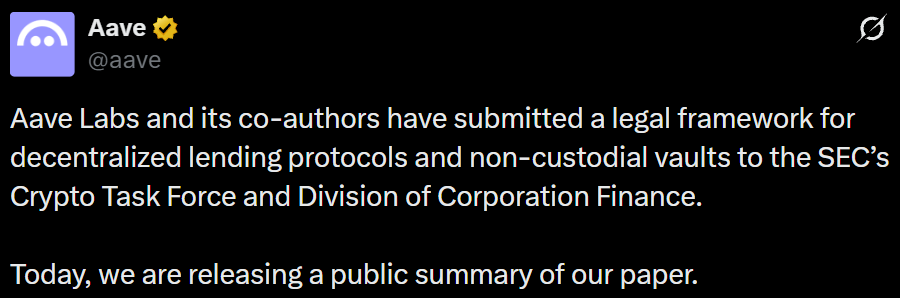
Aave Labs and its co-authors sent a legal framework to the agency’s Crypto Task Force and its Division of Corporation Finance and have now released a public summary.
Source: Aave Post
This Aave SEC Framework could shape how DeFi lending is treated in the United States, so here is a clear, source-based guide to what it says and what it does not.
What Was Submitted
On its policy page, Aave Labs explains that Veda, Kamino, and Aave Labs filed a detailed, confidential version on 26 October 2026 and asked to meet staff.
The public summary followed on 2 November 2026.
The full PDF summary names the authors as Aave Labs, Kamino Foundation and Veda Tech Labs Inc.
Item | Detail |
Authors | Aave Labs, Kamino, Veda |
Detailed filing | 26 October 2026, confidential |
Sent to | Crypto Task Force and Division of Corporation Finance |
Public summary | 2 November 2026 |
Scale cited | More than $50B recorded across lending protocol markets (October 2026) |
The paper adds that the $50B figure is a data-provider estimate, often called total value locked.
The Core Question and Four Conclusions
The paper asks one question: do federal securities laws apply when someone supplies an asset to a decentralized lending protocol or borrows against their own collateral? For the designs it describes, the authors say no.
It reaches four conclusions:
Test | Authors’ conclusion |
Note (Reves test) | No debt instrument is created and nobody owes a repayment. |
Investment contract (Howey test) | No common enterprise, and returns come from published rules |
Investment company | The vaults analyzed have no issuer holding assets for itself. |
Investment adviser | Curators paid for advice may be covered, but they do not have custody |
How the Aave SEC Framework Argues Its Case
The policy page lays out the reasoning step by step. Key points:
Start at the base layer. The analysis begins with the protocol itself, since vaults are built on top of it
No lender, no loan, no promise. Securities laws target promises. The authors say no company takes money and promises a return, and users keep control of their positions
Governance is administration. Token holders list assets and set rates and risk limits, which the authors compare to a market’s rulebook. Changes need public notice and a timelock so users can leave first
No common enterprise. Suppliers earn a published rate and do not share one fortune, and the paper cites the recent Aguilar v. Baton Corp. decision for similar reasoning
The transaction, not the token. A receipt token is evidence of a position, so identical positions should be treated alike with or without one
Vaults hold assets but do not own them. Users keep their share, and a curator cannot take or redirect it
A timelock is a built-in delay that gives users time to withdraw before a change applies.
What the Authors Ask the Regulator to Confirm
The paper says it does not request a safe harbor, an exemptive program or a compliance entity. Instead, it asks the agency to confirm what existing law already provides. Its guidance section lists five requests:
Bounded market administration alone does not create the “essential managerial efforts” that Howey requires
A protocol does not need to be unchangeable to stay outside the securities laws
Guidance should separate routine maintenance and risk controls from activity that actively drives returns
A token should be judged by the transaction it records, in line with the Commission’s 2026 Interpretation
The existence of an issuer should be checked before applying investment company tests
The paper also says these requests should not extend to discretionary portfolio management, ongoing rate subsidies, or promises that users can rely on someone to generate returns.
Conclusion
The submission is a detailed attempt to explain DeFi lending in legal terms, built on what users own, what rights they hold and who controls assets.
Still, the Aave SEC Framework is the authors’ own view, and its conclusions are limited to the designs it describes.
Readers should wait for any official response and read the full paper before drawing conclusions.
Disclaimer
This article is for educational and informational purposes only and is not financial or investment advice. Crypto assets are high risk, their prices can be very volatile, and you can lose some or all of your money. Always do your own research and consider speaking with a licensed financial advisor before making investment decisions.






