FLOP Network Explained: AI Agents, GPU Mining and Token Utility


How Does FLOP Network Connect AI Agents and GPU Miners?
Every task an AI agent finishes burns computing power, and somebody has to pay for it. Today that bill runs through human systems such as cards, bank accounts and cloud invoices. FLOP Network is a project that wants to cut those out. The idea is easy to say and hard to build: let software pay for compute directly, and let anyone with a spare GPU earn by supplying it.
This guide walks through the design using the project’s own website, intro page and whitepaper, and it keeps the unfinished parts in view so readers can judge it fairly.
Key Takeaways
Agents pay miners in FLOP for verified inference, and validators settle the proofs in blocks.
The block reward starts at 96 FLOP, halves every 730 days five times, then stays at 3 FLOP for good.
The whitepaper is a draft dated September 25, 2026, and the Yellow Paper is the final word, so numbers can still move.
What Is FLOP Network?
The network in brief
According to the website, the chain is a proof-of-inference network built for the agentic economy, a world where autonomous software buys, sells and works without a human approving each step. Its name comes from floating-point operations, the standard measure of compute. The official website says the launch has no pre-sale, no VCs and is a 100% fair launch.
Source: official website.
The $FLOP token in brief
The $FLOP token is the native currency of the chain. The website calls it food for your AI agent. In practice that means one thing: spend it, and an agent gets inference back. The same token also pays for compute, secures the chain through staking and settles deals between agents, so the project avoids a two-token setup.
How Does It Work?
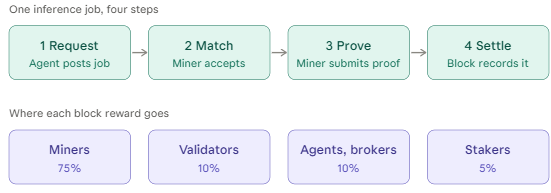
Think of the project as a decentralized compute network with a built-in cashier. A single job moves through four steps:
Request. An agent posts a session request naming the model, the maximum delay, the compute needed, a confidentiality flag and the fee.
Match. A miner with suitable hardware accepts the job and opens a private connection with the agent.
Prove. The miner runs the inference and submits proof that the work was done.
Settle. Validators place the proof hash in a block, and the miner is paid.
Blocks arrive about once per second, and finality comes from AlephBFT. Once a block is ordered, it cannot be reversed.
FLOP Network Proof of Inference Explained
Anyone reading this will ask the obvious question: how can a buyer know a miner really ran the model it claimed? As a proof-of-inference blockchain, the project answers with four layers that work together. None of them is trusted alone.
Layer | What it does |
Hardware attestation | Enterprise GPUs with a trusted execution environment confirm the model ran untampered. Optional per request. |
Showing the work | The miner commits to a fingerprint of the model’s internal activity, and validators re-check a sample. |
Re-execution | Random sessions are re-run by bonded checkers, so audits look like ordinary traffic. |
Stake at risk | Miners post FLOP, and a proven cheat can lose all of it and be banned. |
Proof of inference does not choose blocks. It decides rewards and eligibility.
How Does the FLOP Token Work for AI Agents?
Humans accept money because it buys food and shelter. The whitepaper argues that agents need something different, because they consume compute and produce intelligence. So an AI agent currency has to buy compute.
That is the core pitch. FLOP can be converted into inference at any point, which the project calls the nearest thing yet to a compute-backed currency. It contrasts this with stablecoins, which it describes as claims on human money. This is the project’s argument, not a proven result, and its own risk section admits that demand may not arrive at the scale assumed.
How AI Agents Pay for Compute with Crypto
An agent needs a decentralized identifier (DID) that it generates itself, plus a wallet. After that, machine-to-machine payments settle in FLOP per block.
Agents that already hold crypto can swap USDT or BTC into FLOP through the chain’s native atomic swaps. Agents arriving through orchestration platforms never touch FLOP at all. They pay in fiat or stablecoin through a broker, who fronts the tokens to miners. Nobody is forced to hold FLOP just to use the network.
Who Does the Work
Role | Job | Entry | Earnings |
GPU miners | Run inference | Any GPU with 16 GB+ VRAM | 75% of block reward plus 85% of inference fees |
Validators | Build blocks, verify proofs, store model weights | 1,200,000 FLOP bond, 1,000 seats | 10% of block reward plus 15% of fees |
Agents and brokers | Buy compute | A DID and a wallet | 10% share of block reward |
Stakers | Lock FLOP | Any holder | 5% of block reward |
Miners can go offline whenever they like. They are slashed only for accepting a session and failing to deliver it.
FLOP Network Tokenomics and Supply
The $FLOP tokenomics are built around earning, not selling. The whitepaper says there is no token sale and no investor allocation. The block reward halves from 96 to 48, 24, 12, 6 and finally 3 FLOP. The year-10 chart shows about 18.1 billion FLOP in total:
Allocation | Amount | Share |
Miners | 8.8bn | 48.6% |
Genesis (airdrop and reserve) | 4.4bn | 24.3% |
Team and Foundation | 2.0bn | 10.8% |
Validators | 1.2bn | 6.5% |
Brokers and agents | 1.2bn | 6.5% |
Staking rewards | 0.6bn | 3.2% |
Figures are rounded. The genesis share is up to 3.6bn for the testnet airdrop plus 0.8bn for an ecosystem reserve. No FLOP is burned, and the protocol itself takes no fee.
Flop Labs and the FLOP Foundation
Two entities stand behind the project. Flop Labs LLC is the operating company, organized in St Vincent and the Grenadines, and it built the software. The FLOP Foundation is the steward. It funds independent core developers, receives stake forfeited by dishonest operators and holds the sole right to submit protocol proposals until the first halving.
Each entity mints 8 FLOP per block on top of the normal reward, ending after year ten. Validators still vote on every change, and an upgrade needs two-thirds approval plus a 14-day delay.
The Person Leading the Project
Arthur Hayes, the BitMEX co-founder, is the CEO of the company behind the project, as his X Account profile (@CryptoHayes) states. The whitepaper names him too, noting that he has described the first two years of the Foundation’s proposal rights as a constitutional monarchy: the Foundation proposes, and validators decide.
Beyond Single Jobs: Technocore and Compute Reservations
Jobs are only part of the picture. Technocore is a commerce platform for AI agents, where they find one another, agree on work, list services and store memory. An agent needs only its DID to take part. The whitepaper describes Technocore as the marketplace and the chain as the currency and settlement layer. Memory is not free on mainnet, since every read and write is paid for in FLOP.
The official whitepaper also describes FLOP Compute Units. An FCU is a prepaid, miner-bonded promise to serve a fixed rate of compute for up to thirty days, covering inference only. It is ratified as a design, but implementation comes after the core protocol.
Risks to Weigh
The whitepaper is blunt here. Parts of the protocol are specified but not yet audited. At genesis, a multi-signature superuser key can alter the runtime until a planned handover happens. FLOP has no cash flows, buyback or revenue share, so its value rests on demand for compute. Legal treatment also differs by country.
Final Thoughts
FLOP is a serious attempt at a hard problem: giving machines money tied to the thing they actually consume. The documents are open about what is unfinished, which helps. Read the whitepaper and Yellow Paper directly before forming a view.
Disclaimer: This article is for information only and is not financial advice. Crypto assets carry risk, so research carefully before making any decision.