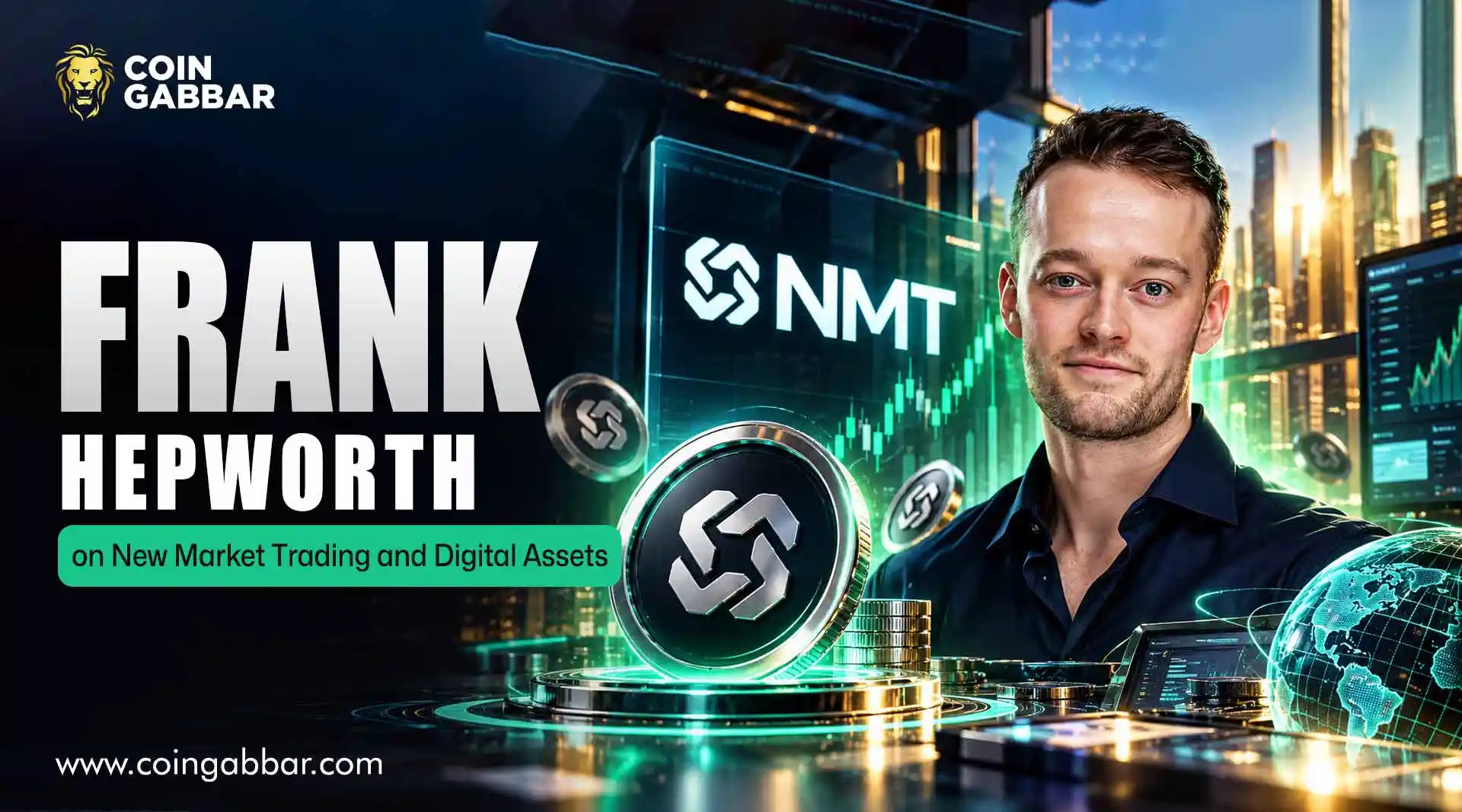
Frank Hepworth on Onchain Wealth Management and Market Trading Model

How Does New Market Trading Approach On-Chain Wealth Management?
What if your wealth manager could trade your crypto portfolio but never withdraw a single coin? That is the pitch from Frank Hepworth, a former securities lawyer who now runs New Market Trading (NMT).
In an interview with CoinGabbar in October 2026, Hepworth explained how NMT delivers onchain wealth management to investors who want professional help without handing over their keys.
Quick answer: Onchain wealth management is the professional management of an investment account that lives on the blockchain alongside the assets it holds. At New Market Trading, clients own a Safe smart account and keep their keys, while the NMT team gets permission to trade but not to withdraw funds.
Key Takeaways
Frank Hepworth says Yieldschool began in 2022, and New Market Trading launched publicly in July 2026.
Each account has three keys, and withdrawals need two, so New Market Trading cannot move funds alone.
The minimum is $100,000, plus a one-time onboarding fee and a quarterly management fee.
NMT says it trades only spot digital commodities and is still working toward a regulatory structure.
Losses remain possible, and these accounts carry no government backstop.
Who Is Frank Hepworth, the Founder of New Market Trading?
Frank Hepworth is the founder and CEO of New Market Trading. His official bio says he spent three years in the digital assets practice of a prominent securities law firm, advising some of the largest crypto exchanges.
He told CoinGabbar he left law because he understood the asset class better than many clients he advised. “I wanted to help others invest in digital assets better,” Hepworth said.
He founded Yieldschool in 2022 to teach investors how to invest in digital assets. That business later became NMT, an onchain wealth management firm that launched publicly in July 2026, according to Hepworth.
Four years of one-on-one client work shaped the product. He said only 10 to 15% of education customers put in the time to run strategies themselves. The rest wanted a team to manage the portfolio, which led to NMT’s self-custody crypto account model.
What Is Onchain Wealth Management, and How Does NMT Differ?
Hepworth compared three models. On a crypto exchange, investors manage everything themselves. A traditional wealth manager handles the work, but the account sits on a custodian’s books. NMT puts the account on the blockchain, owned by the client.
Model | Who manages the portfolio | Where the account is recorded | Crypto access |
Crypto exchange | The investor | The exchange | A few hundred assets |
Traditional wealth manager | The adviser | The custodian’s books | Often a couple of ETFs |
New Market Trading | The NMT-team | The blockchain, owned by the client | Over 10,000 assets and products |
Source: Frank Hepworth’s answers to CoinGabbar, October 2026. Asset counts are his estimates.
In other words, onchain wealth management keeps professional trading but moves ownership of the account to the investor. The 10,000-asset figure is NMT’s own claim, and CoinGabbar has not verified it independently.
How Do NMT’s Three-Key Safe Accounts Keep Funds Non-Custodial?
Each client opens and owns a Safe smart account, built on ERC-4337, an Ethereum standard for smart accounts. He said NMT chose Safe instead of building its own infrastructure. Safe reported in March 2024 that more than $100 billion in assets were secured on its smart accounts.
Key | Held by | Role |
Everyday key (accessed via email) | Client | Co-approves withdrawals |
Hardware wallet key (cold storage) | Client | Co-approves withdrawals |
Trading key | NMT | Trades, rebalances, and enters yield positions |
Withdrawals and ownership changes need two of the three keys. The client holds two, so NMT cannot withdraw funds alone. If New Market Trading ceased operating, he said, the portfolio would stay on the blockchain under the client’s control.
Replacing a lost key requires identity verification, and he said that process cannot be expedited. He added that Consensys Diligence completed an audit of NMT’s smart contracts and permission modules in June 2026 and that the report is public. NMT announced the audit in a press release dated September 30, 2026.
How Does NMT Build an Onchain Wealth Management Portfolio?
Hepworth said New Market Trading selects digital commodity investments that offer something unavailable in traditional markets. Each portfolio holds a long-term allocation to crypto assets the team expects to survive the market cycle.
Alongside that, the team manages liquidity positions that earn daily trading fees, lending and staking, and early-stage assets not yet listed on major exchanges. Such primary crypto market assets are newer and less proven, so they carry extra risk.
In a bull market, New Market Trading takes profits as prices rise. In a bear market, it moves into yield positions that keep earning as prices fall, He said. These are stated methods, not performance results.
What Are the Risks, Rules, and Costs of Onchain Wealth Management?
Hepworth named three main risks: volatility, smart contract failure, and poor key management. NMT says it uses only audited components. He was direct about limits. Losses remain possible, the account is not a bank account, and no government backstop applies.
On regulation, Hepworth said clients contract with NMT’s US entity in Florida and that the Dubai entity is no longer used. NMT deals only in spot digital commodities, not securities, derivatives or futures. He said the firm has retained US counsel, including a former SEC official, to work toward the right regulatory structure.
Hepworth added that rules for spot digital commodities are still being formulated.
Hepworth did not identify a specific license or registration in his written responses. Readers should independently verify the firm’s applicable regulatory status before engaging its services.
The minimum is $100,000. NMT-charges a one-time onboarding fee and a quarterly management fee, though Hepworth did not disclose amounts. A full refund is available for seven days after funding. Onboarding starts with a call, then a dedicated associate guides setup in a live video session.
Expert Opinion: What Does This Model Mean for Investors?
As per analysts, the three-key design is a direct answer to the biggest objection to hiring a crypto manager, which is custody risk. The trade-off is that clients must protect two keys themselves.
Analysts add that the model’s credibility will rest on a public audit report, clear fee disclosure, and visible regulatory progress. For investors weighing onchain wealth management, those three tests matter more than any marketing claim.
Frank Hepworth on Tokenization and the Next Five Years
Hepworth said clearer regulation and tokenization both support onchain wealth management. As stocks, bonds, and funds are issued on-chain, on-chain accounts can reach them immediately, without waiting for a custodian to list them.
Looking five years ahead, he expects on-chain accounts will not yet be standard because the industry moves slowly but may become the next default way of owning wealth. He said managers will compete on strategy and service, and trust will depend on brand.
Over the next 12 months, Hepworth said clients can expect more supported networks, improved reporting, and services such as estate planning. Hepworth said New Market Trading plans to clarify its regulatory position and hopes to begin offering securities in the future.
These are stated plans, not confirmation that the firm is currently authorized to provide those services.
Conclusion: Is Onchain Wealth Management Ready for Mainstream Investors?
Frank Hepworth’s New Market Trading offers a clear design. Investors keep ownership; a team handles trading, and withdrawals need two keys. That structure explains why onchain wealth management is drawing attention from investors who want help without giving up custody.
What stands out is the clarity of the key model. What remains open is regulatory status, since New Market Trading has not named a license. Check the public audit report and the fee schedule on NMT’s official site before trusting any claim.
Disclaimer: This article is for informational purposes only and is not financial, investment, or legal advice. Statements about New Market Trading come from its founder’s written answers and were not independently audited by analysts. Crypto assets are volatile, losses are possible, and no government backstop applies. Consult a licensed advisor before investing.